



29 Apr Choice Beans to Tasty Brews
Lake Tahoe coffee roasters share how passion, science and remarkable beans are the recipe for fabulous flavor
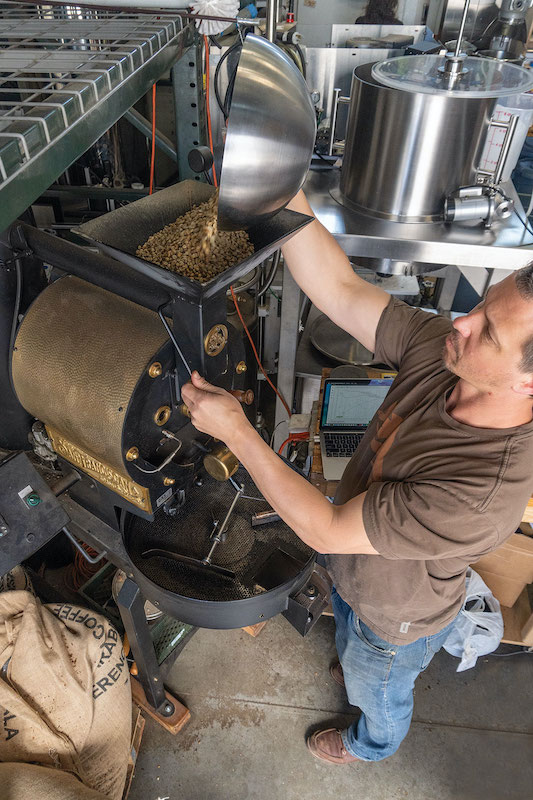
Ralph Backstrom of Pacific Crest Coffee loads his roaster with green beans
It’s a gorgeous day in March, and Ralph Backstrom, co-owner of Pacific Crest Coffee in Truckee, has the roll-up door next to his coffee roaster wide open.
Fresh Sierra air mixes with the sweet smell of freshly roasted coffee in perfect harmony. It’s an exquisite atmosphere any coffee connoisseur might choose to live in for eternity.
Backstrom is jazzed, not for the delightful aroma he’s created, but for nailing the roast of a special batch of beans from a Guatemalan farm he visited the previous spring.
Once cooled and packaged, the rarefied beans will be shipped out to Pacific Crest customers eager to start their day with a flavorful new morning brew.
Workdays, powder days, bike rides and dog walks are among a million reasons to wake up and drink coffee at Lake Tahoe. From enhancing endurance to improving mental focus, a morning coffee is the key to a more productive, energetic day in the mountains for many residents and visitors alike.
Tahoe’s love for a strong cup of coffee has spawned a vibrant local industry. Every town center has multiple coffee shops, and there are now several local roasters producing high-quality specialty coffee for cafes, restaurants and retail stores.
Who brews the best coffee will always be a matter of preference. But what’s not up for debate is that roasters in the Tahoe region have the utmost passion for the craft, and the quality of their coffee reflects that. Roasting rich, flavorful coffee is no gimme, so when you’re served or brew a stellar cup, you’re drinking thoughtfully sourced beans that were roasted and brewed to perfection.
Flavor Starts at the Farm
Delicious coffee is the result of upholding the value chain, says Backstrom.
From planting the trees to pouring an espresso, the coffee value chain is a complex global network that turns coffee cherries into a brewed product. The chain has four primary stages: cultivation, processing, roasting and consumption.
“Coffee can only get worse as it moves up the chain. It can never improve,” says Backstrom.
Which is why both commercial roasters and coffee shops put so much effort into sourcing the finest beans. Great flavor is born at the coffee farm.
Coffee is native to Africa and was introduced to India, Southeast Asia, and Central and South America in the eighteenth century. It is now commercially grown in over 80 countries on five continents.

Green beans await the roaster
There are more than 120 species of coffee plants, but 95 percent of all commercially cultivated coffee is from two species: arabica and robusta. Arabica accounts for about 70 percent of the overall coffee market and 100 percent of the specialty market. It’s known for its mild, complex and acidic flavor. Robusta is used in lower-grade coffee products, as its flavor is more bitter and it is higher in caffeine.
Between the two species, there are thousands of subspecies, known as varieties or cultivars, depending on whether they are found in nature. The exact number of coffee subspecies worldwide is unknown. In Ethiopia alone, where coffee is native, more than 10,000 have been identified.
Where coffee is grown heavily influences its flavor profile. The unique combination of environmental factors—soil, climate, altitude and rainfall—that shape a coffee bean’s flavor is known as terroir, a French term for “land.” Terroir affects characteristics such as acidity, aroma and body, creating distinct, location-specific flavor profiles such as fruity, floral Ethiopian coffees or nutty, well-balanced Central American beans.
Specialty roasters like Backstrom source unique varieties from farms with ideal terroir for growing flavorful coffee. Beans grown above 4,000 feet in elevation are especially prized, as the cooler temperatures and slow maturation create denser beans with brighter and more sophisticated flavors.
“High-elevation coffees have more sweetness and acidity. There’s a little more to caramelize and play around with in roasting,” says Backstrom.
The way a coffee bean is processed after harvest also affects flavor. Coffee grows like a cherry, with a hard bean enveloped by a fleshy pulp and skin on the exterior. How and when the pulp and skin are removed from the bean in the drying process can drastically change the flavor, even of beans of the same variety.
In traditional “washed” processing, the pulp is removed mechanically, and the beans are left to dry on raised beds. Recently developed fermentation-based processing methods, such as anaerobic fermentation and carbonic maceration, use yeast and bacteria to remove the pulp within sealed containers. This gives the bean more time to marinate inside the pulp after harvest, which can impart brighter flavors, especially in heirloom varieties with complex flavor profiles.
Backstrom makes it easy to try coffees with different terroir and processing methods by subscribing to Pacific Crest Coffee’s “Coffee World Tour” plan. Subscribers are sent a bag of roasted beans from some of the world’s most celebrated growing regions at an interval of their choice, from every week to every two months.
Roasted to Perfection
While the interplay of variety, terroir and processing method defines the flavor potential of a given bean, roasting is the key to unlocking that flavor in brewed coffee. Identical beans can taste substantially different depending on how they are roasted.
Most commercial roasting is done using a barrel-oven-style roaster that heats the beans as they are continually tumbled in a revolving drum. When the beans touch the surface of the drum, they roast with conductive heat, like a frying pan, and as they fall through the hot air, they roast convectively, akin to a popcorn popper.
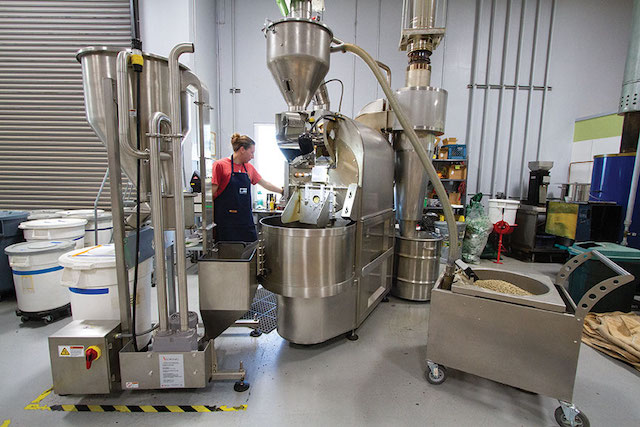
Alpen Sierra Coffee’s roaster, Jamie Smith, monitors a roast
A roast takes eight to 15 minutes, depending on roasting equipment, batch size and desired outcome. Most machines allow the operator to track the temperature of the beans and the air inside the roaster throughout the cycle. The art lies in applying conductive and convective heat appropriately at each stage of the cycle, and consistently repeating the results of a given roast.
Light, medium and dark are the industry-standard general classifications that describe how a batch of beans was roasted. Light-roasted beans are heated only long enough to make them brewable, a roasting style that brings out fruity and floral terroir flavors specific to where the coffee was grown. Medium- and dark-roasted beans are heated more thoroughly, pronouncing the sweet, nutty flavors and pungent aromas for which coffee is more traditionally known.
Christian Waskiewicz, founder of Alpen Sierra Coffee, has been roasting coffee for nearly 40 years. He opened his first coffee shop and roastery in South Lake Tahoe in 1991. Waskiewicz compares the process to cooking an onion.
“When you take a bite of raw onion, you taste the terroir, its true bold flavor. But put the onion in a pan with heat, and the flavors transform,” says Waskiewicz. “The sweetness comes out as the sugars start to caramelize.”
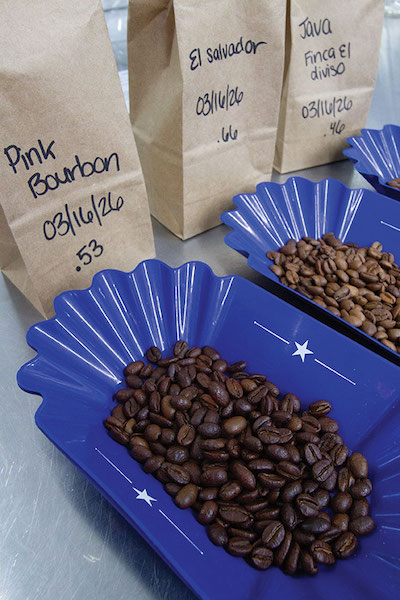
A longer roast time breaks down the beans’ cellular structure and brings out sugars and oils
The length of a roast cycle is measured from “first crack,” a point in the roasting process when the bean is hot enough for the exterior layer to split. Once cracked, the bean expands and begins to turn brown as moisture is released from its core. For a light roast, the beans are removed from the roaster 60 to 90 seconds after first crack, preserving the terroir flavors. For medium and dark roasts, the beans are left in longer, allowing more time for heat to penetrate the core and bring out the sugars and acids that create a heavier-bodied flavor profile.
“Roasting is focused on sugar development,” says Waskiewicz. “We nurture the sugars by understanding when caramelization begins to occur and then make changes to the heat that favorably develop the sugars rather than sear or mute them.”
Waskiewicz learned to roast on a 12-kilo San Franciscan-brand roaster that had only manual controls and basic temperature monitors. The machine taught him how to “sensory roast,” a practice of using sight, smell and sound to guide the process. He still makes Alpen Sierra’s micro-lot coffees on this roaster by listening for the telltale “pop” of first crack and pulling sample beans to detect changes in color and aroma that dictate when to adjust the heat or airflow.
As Alpen Sierra’s business grew, Waskiewicz opened a roasting facility in Minden, Nevada, and invested in a 35-kilo Loring-brand roaster. The bigger machine offers greater control over the roasting environment and produces a more consistent roast, says Waskiewicz.
“Roast consistency has been a big part of our growth and reputation. We really get full flavor development and dimensionality in every cup. That’s served us well.”
Moving roasting operations from South Lake Tahoe to the Carson Valley also mandated recalibrating Alpen Sierra’s roasters to a new elevation. Roasting at a higher altitude does not inherently produce sweeter or more flavorful coffee, but it can affect how the equipment operates. The natural gas-fueled burners that heat the roasters operate less efficiently at higher elevations due to lower oxygen levels. This makes its heat controls less sensitive, allowing a slightly wider margin for error when roasting in the mountains compared to lower elevations.
Bodacious Blends
Gale Klenk, owner of Sierra Pacific Coffee in Truckee, is another local master of the subtle adjustments that produce a perfect roast. Klenk has been commercially roasting for over a decade on a fully manual Diedrich machine.
“Every roast is hands-on,” says Klenk. “I’m always watching. I watch the beans. I watch my flame. When I’m roasting, I never leave the roaster.”
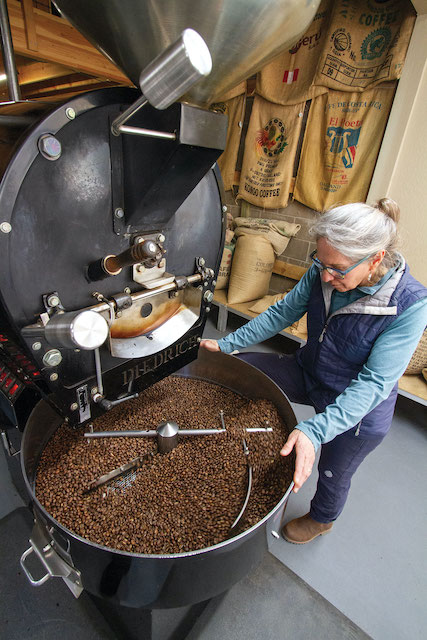
Gale Klenk of Sierra Pacific Coffee Roasters inspects a batch of beans as they cool
Klenk’s artisan approach to the craft has earned her a devoted following of both retail and wholesale customers. One of her specialties is producing custom-blended coffees for cafés and restaurants.
If a coffee is labeled “single-origin,” all the beans are of the same variety and from the same farm. The flavor profile of single-origin coffees tends to be more delicate as it highlights terroir flavors. Blended coffees contain a mix of varieties, often from multiple farms or growing regions. By combining varieties, blended coffees seek to offer a more dynamic and robust flavor profile that often pairs better with milk or other coffee additives.
“Blended coffees can be so fulfilling,” says Klenk. “You get the body, you get the flavor profile, you get complexity. You’re not trying to wash out one flavor with the other. Each flavor enhances the next.”
Klenk sells both single-origin and blended coffees under the Sierra Pacific moniker and a unique coffee line called Twisted Tree.
Twisted Tree coffees are notable because the beans are Fair Trade Certified, 100 percent organic and produced by women-owned farms. Klenk sources the beans for Twisted Tree from Café Femenino, a global cooperative that supports social justice and empowerment for women coffee producers.
“It’s so impactful for these female coffee farmers to have this support,” says Klenk. “When women can contribute to the family financially, it takes stress off men to provide. We’ve seen men get more involved in childcare, take different roles and families get less abusive. It’s really super special.”
Though Klenk calls herself an “old-school” roaster, her Twisted Tree coffee line reflects hallmarks of the latest movement in the specialty coffee industry, which embraces ethical reform across the entire supply chain by emphasizing livable wages, ownership equity, climate resilience and traceable sourcing.
Don’t Botch the Brew
Whether you buy locally roasted beans or whatever coffee is on sale at the store, your brewing method plays an important role in determining what flavor ends up in your cup. Not all brewing methods are created equally when it comes to extracting the full flavor from a bean.
Drip coffee makers may be the easiest way to wake up and start sipping, but their coffee quality pales in comparison to many other methods.
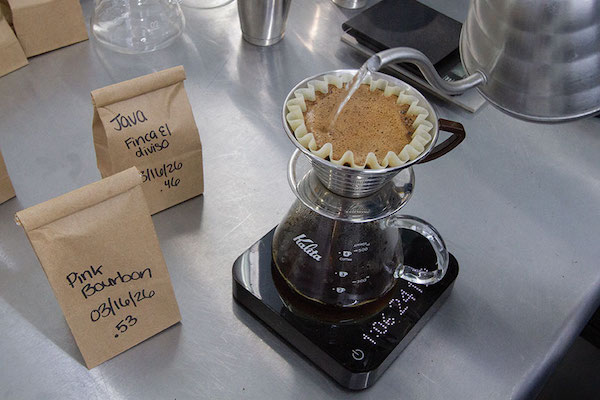
Measuring the amount of water and when it’s added are two keys to a delicious pour-over coffee
An AeroPress—a device invented in 2005 by Alan Adler, a retired Stanford engineering professor and inventor of the Aerobie flying ring—is among the most recommended methods to quickly and easily make top-notch coffee. The AeroPress resembles a bike pump and uses air pressure to force water through the coffee grounds as the plunger is depressed. While the AeroPress requires a special filter, it takes only two minutes to brew a cup and is easy to clean.
The pour-over method is another trusted brewing style that demands a bit more time and technique but delivers phenomenal results. It only requires a coffee cone with a paper filter, and the process is hard to mess up unless the coffee-to-water ratio is way off. The secret to a great pour-over coffee is using a specific size of coffee grounds, measuring the temperature and amount of water, and pouring the water into the cone at precise intervals.
If espresso is your jam, you’re in luck. There’s never been a better time to invest in a home espresso maker. None of the machines comes cheap, but espresso lovers of any budget can now find a machine that brews up a decent shot. Some of the new super-automatic machines include a built-in grinder and fully automate the process.
Whatever brewing method you choose, practice and experimentation make perfect. Try variations of the method to dial in the process that works best for you. You’ll likely find more flavor in every new cup, and begin building the critical muscle memory that lets your body brew coffee when your brain is still in bed.
Seth Lightcap is a writer and photographer from Olympic Valley who enjoys light-roasted coffee with floral, tea-like flavors.
No Comments