


27 Jun The Long Return
The original stewards of the greater Lake Tahoe region, the Washoe are celebrating a groundbreaking reacquisition of former territory
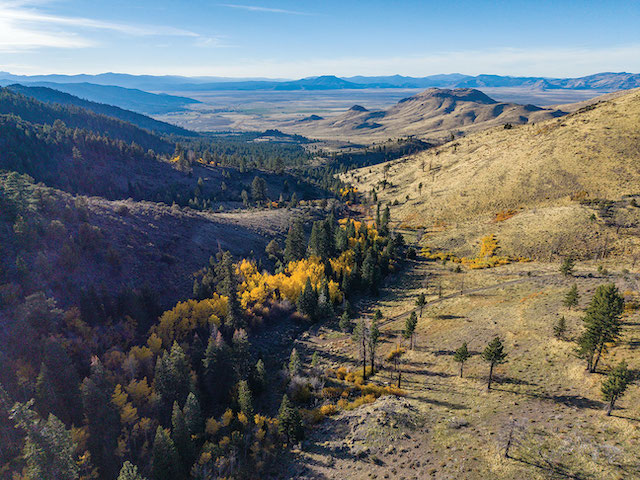
The varied terrain of the WélmeltiɁ Preserve from a bird’s-eye view, photo by Elizabeth Carmel
After more than a century of fighting to claw back its ancestral grounds one small chunk at a time, the Washoe Tribe of Nevada and California tripled its land base in one historic swoop.
The 10,274-acre WélmeltiɁ Preserve, located about 37 miles north of Truckee, spans from Long Valley in the east to Sierra Valley in the west and features varied terrain from sagebrush and grasslands to conifer forests and mountain meadows. The land is dotted with aspen groves, juniper and pinyon pine, riven by natural springs and perennial creeks, and rich with wildlife, including pronghorn, mule deer, mountain lion and gray wolf.
The purchase of this vast and ecologically significant property marks a major triumph for the Washoe, as it represents both a culmination of a long process of reacquisition and the beginning of a new chapter as the tribe seeks to regain a portion of its sovereign land.
Ancestral Origins
Lake Tahoe is the center of the spiritual and geographical homelands of the Washoe Tribe (Wašišiw).
According to one tradition, the tribe’s people were brought to Lake Tahoe by the coyote (géwe), and once settled, they were ordained by nenťúšu, a primordial maternal power, as caretakers of the region. That region was generally acknowledged to extend as far north as Honey Lake, south to Sonora Pass, eastward to the Pine Nut Mountains and the Virginia Range, and west all the way to the Sierra Crest.
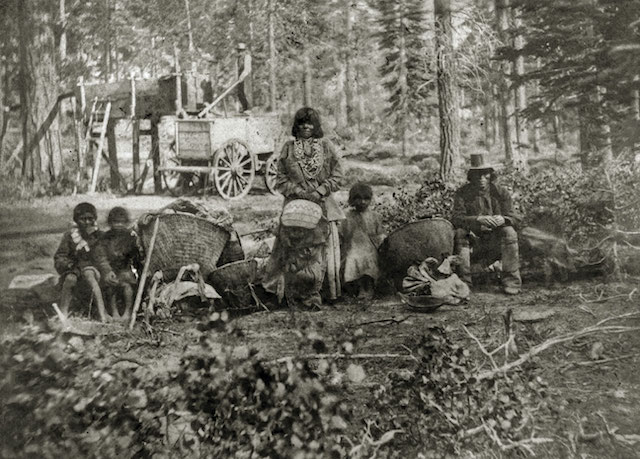
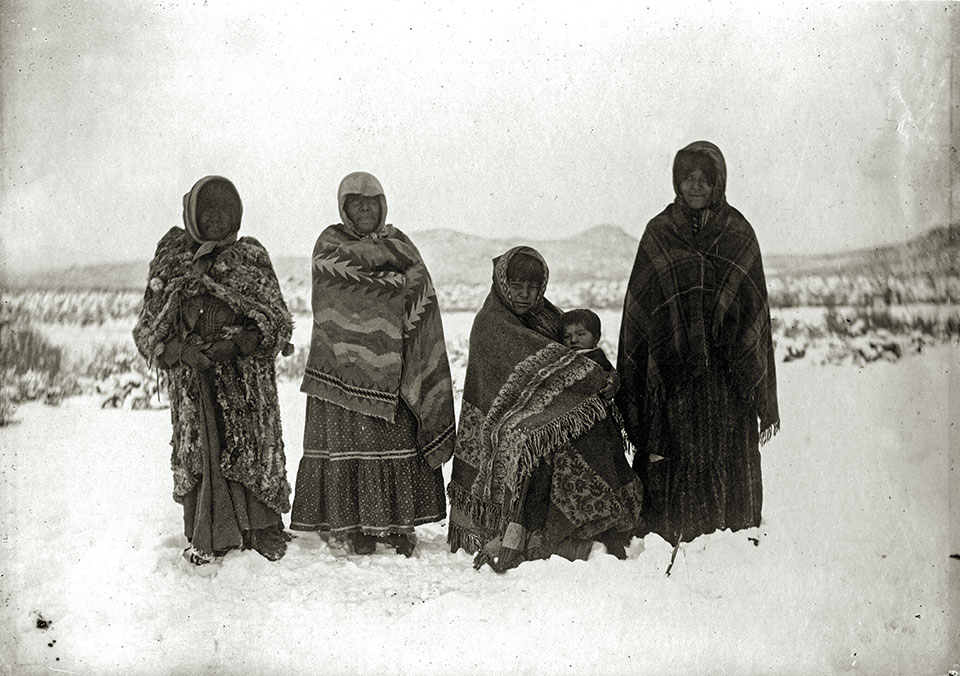
A Washoe family at Lake Tahoe, circa 1866, photo courtesy Library of Congress Prints and Photographs Division
Generally, the borders of tribal lands pre-contact were porous, if not entirely imaginary, as the Washoe people often extended their nomadic movement beyond these strict geographic markers, intermingling with other area tribes such as the Paiute, Shoshone, Maidu and Miwok.
Regardless, Lake Tahoe was not only at the geographical center of the tribal lands but also at the center of the Washoe’s sustainable seasonal migrations, as they descended to the lower-elevation valleys during the winters and spent their summers hunting and gathering at the shores of the enormous alpine lake.
“Tahoe” is an anglicization of the first two syllables of the Washoe phrase “Da ow a ga,” which means “edge of the lake.”
“Da ow,” meaning simply “the lake,” was changed to “Tahoe,” as it was easier to pronounce for the settlers. The name was contested for nearly a century—the lake was alternatively called Lake Bigler, after California’s third governor—before culminating in its official designation in 1945.
While Tahoe’s geographical and spiritual centrality has nourished the Washoe people since time immemorial, it remains a cruel irony that the tribe’s proximity to the lake is also what led to the swift totality of its dispossession.
Shunted Aside
The Washoe’s territory contained the principal overland routes into California, with Sonora Pass, Carson Pass and Donner Pass being the most notable, so the tribe was shunted aside as settlers arrived beginning in the 1850s.
In 1859, prospectors discovered the Comstock Lode, the richest silver strike in U.S. history, which was also on Washoe lands.
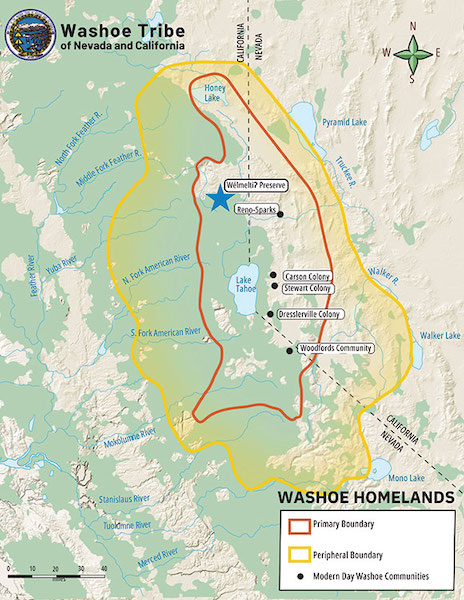
A map illustrates the extent of the Washoe’s ancestral territory, courtesy photo
The Comstock’s voracious appetite for timber meant the plunder of pinyon pine forests upon which the Washoe relied, and within a decade of the silver strike, the region’s native inhabitants were pushed off nearly every piece of land they had used for millennia.
Unlike many other Great Basin tribes that retained a land base into the twentieth century, the Washoe received no treaty and were granted no reservation.
By the early twentieth century, the Washoe were a scattered people with no land base and no formal governance structure. Yet they maintained their connections to their culture and language while cleaving to the landscape.
The process of inexorable dispossession did not begin to reverse until 1917, when an act of Congress set aside small colonies in and near Carson City.
Since then, however, the tribe has slowly and steadily been reclaiming its ancestral lands, culminating earlier this year with the purchase of the WélmeltiɁ Preserve in the northern reaches of Washoe territory.
The name WélmeltiɁ carries particular weight, as it refers to the northern regional group, whose homelands lie closer to Sierra Valley. Until the recent purchase, most of the land reacquisitions have taken place in the southern and eastern parts of the tribe’s historical range.
Washoe Tribal Chairman Serrell Smokey, who helped steer the acquisition on behalf of the Washoe, says the achievement is just the latest milestone in a century of tenacious persistence.
“All lands that Washoe people gained were always hard-fought,” he says. “We were never just given lands. … We were never given an original reservation base just for Washoe people.”
Land Back
The more than 10,000 acres of ecologically significant land, formerly known as the Loyalton Ranch, is the largest tribal Land Back purchase in the Sierra Nevada and the third largest in California.
Helen Fillmore, board president of the Waší·šiw Land Trust, says she immediately recognized the purchase as historic for the Washoe people.
“It was the first time for me in a really long time that I felt this true sense of agency that our tribe finally had over our own homelands,” she says.
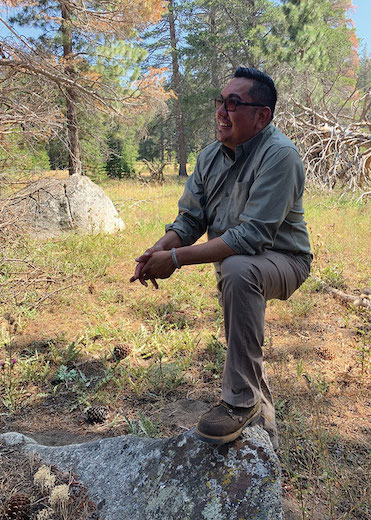
Washoe Tribal Chairman Serrell Smokey, courtesy photo
The purchase was made possible by the Washoe’s creation of the Waší·šiw Land Trust in 2025 as a federally chartered nonprofit under Section 17 of its tribal charter, a unique piece of institutional engineering. This structure allows the tribe, which operates in both Nevada and California, to move seamlessly across state borders without having to register in either state. It also allows for more effective fundraising, according to Smokey.
“The reality right now is that people are less willing to give money to tribes,” he says.
Fillmore says the tribe has fielded public skepticism rooted in a fear that it intends to develop the land rather than conserve it.
“There’s a lot of fear that comes about when tribes acquire land, where everybody immediately goes, ‘Oh, they’re going to develop it, they’re going to build a casino there,’” Fillmore says. “But our tribal land planning codes have some of the strongest environmental protections that I’ve seen in terms of not being able to change it once it goes into a conservation status.”
Once the Washoe created the mechanism for the land transfer, they partnered with organizations that brought decades of private fundraising experience to the task of buying a large property in a region where real estate prices remain stubbornly high.
“Land purchases in our homelands are extremely expensive,” Fillmore says.
So in 2019, the Washoe began working with the Feather River Land Trust and the Northern Sierra Partnership as they explored acquisition possibilities in Sierra Valley. The three organizations collaborated to secure state grants and private fundraising to cinch the deal.
“We really did just work as a single team on this,” says Lucy Blake, president of the Northern Sierra Partnership. “But people who wanted to fund the effort wanted to fund it because of the tribe. It’s very important to understand that the tribe was the driver of the project.”
Blake says the partnership raised approximately $6.9 million to purchase the property and cover associated costs, with the largest single piece coming from the California Wildlife Conservation Board, which provided a $5.5 million grant. The Waší·šiw Land Trust is currently fundraising to create an endowment to help cover annual property taxes.
While challenges remain, the Washoe are in celebratory mode, as other tribes have asked about their specific approach and the California Natural Resources Agency has expressed interest in turning the approach into a statewide toolkit for tribal land acquisitions.
“It is kind of groundbreaking,” Smokey says. “There is a new way to do things, and it’s because we’re creating them.”
Fillmore is more cautious about using terms like model and template, but she says the Land Back purchase undoubtedly fosters a general sense of optimism and possibility.
“We’re so often faced over generations with these stories of loss—loss of land, loss of resources, loss of habitat,” she says. “Now, the narrative is falling more into our favor in a way that it hasn’t over the last two centuries.”
Piece by Piece
The WélmeltiɁ Preserve purchase tripled the amount of land under Washoe control within its ancestral territory.
Both Smokey and Fillmore see it as the culmination of a process that began in the late 1800s and early 1900s and a reaffirmation of a principle Smokey returns to often: The Washoe were never simply given their land back, and instead had to fight to reacquire it piece by piece.
The federal government did distribute land to individual Washoe members under the Dawes Act of 1887, but the allotments were discrete parcels of barren ground with little access to water. The more valuable lands, including the pinyon pine forests of the Pine Nut Mountains, were given to non-natives.
“It was meant to separate us as a people into individual ownership,” Smokey says. “It was meant to break up the tribe.”
The Washoe did not procure a collective land base until three decades later.
In 1917, an act of Congress established the tribe’s first communally held land: 156 acres in Carson City and 40 donated acres at Dresslerville, near Gardnerville.
The tribe’s long fight for legal recognition of its own distinct homelands began in 1948, when the Washoe started preparing a case for the Indian Claims Commission, a federal body created two years earlier to adjudicate tribal land claims.
Filed in 1951, the Washoe’s case sought compensation for millions of acres taken without payment. The most important figure in this process was Richard Barrington, a WélmeltiɁ elder who had earned an education and started a logging mill.
“[He] became such a significant advocate, testifying on behalf of Washoe people about our cultural uses, the extent of our homelands and their importance and value,” Fillmore says.
But Barrington and the Washoe were at a disadvantage: Their homelands straddled the state line, so the tribe, already small and under-resourced relative to their Great Basin neighbors, had to pursue claims in Nevada and California.
Their larger neighbors also advanced competing claims across territory where boundaries were notoriously blurry and difficult to delineate.
“Everybody had to prove where their people truly came from,” Smokey says.
The Washoe did prove it. Largely through Barrington’s advocacy and the testimony of expert witnesses, they won the commission’s recognition of their territorial boundaries.
Thus, the legal description of the Washoe’s homelands is still acknowledged today, reaching from Honey Lake south to Sonora Pass, and from the Pine Nut Mountains and Virginia Range west to the Sierra Crest.
“It’s not just handwritten, ‘This is us.’ It was proven that our people were here this whole time,” Smokey says.
But the victory was partial.
When the claim finally settled in 1970, the tribe received about $5 million. The 1.5 million acres were valued at 1860s prices, meaning most of the money was used to help establish the Washoe’s first institutions, from housing to health care, and was not used to purchase actual land.
Nevertheless, the Washoe now had a legally established territory within which they could continue the slow work of reacquisition—work that had already started and would continue piecemeal for decades.
The tribe had bought a 95-acre ranch in Carson Valley in 1938 and 1940, raising hogs, sheep and dairy cattle on it. In 1970—the same year the claim settled—a separate act of Congress granted 80 acres in Alpine County to the Washoe families who had long lived there, establishing the Woodfords Community, the tribe’s only community on the California side.
In the decades since, the tribe has added stray parcels across its homelands, some of which were used for ranching, while others were set aside expressly for conservation and cultural use. While each acquisition was a small reversal of the larger loss, none has approached the scale of what the tribe took on this year.
Stewards of the Land
Before the historic land purchase, Smokey visited the WélmeltiɁ Preserve with his fellow people. His first trip was with tribal elders, and subsequent ones were with the youth and young adults, and on all occasions, he asked the prospective inheritors what they would like to see done with the property.
“We truly wanted to see what the people wanted to do with this land,” the chairman says. “From elders all the way to the youth, they all said the same thing: They didn’t want to see a whole bunch of buildings all over the place, the land being torn up. So that was an easy choice for us. The people want conservation. They want to restore the land.”
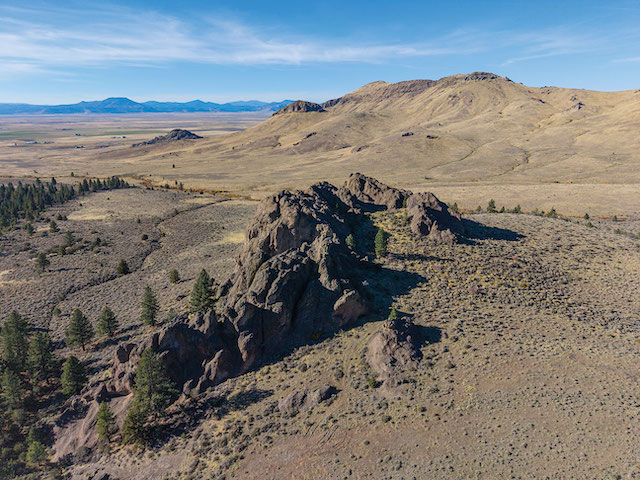
Large rock outcrops on the WélmeltiɁ Preserve, photo by Elizabeth Carmel
Fillmore says the tribe is no stranger to land stewardship, pointing to the decades of experience assisting the U.S. Forest Service in managing Meeks Meadow (also known as Máyala Wáta), one of the largest forest meadows in the Tahoe Basin.
In fact, Meeks Bay on Tahoe’s West Shore is the site of the largest Washoe presence within the Basin itself. The Washoe have operated Meeks Bay Resort, with its campground, cabins, a general store and beach, under a special-use permit since 1998.
In late 2023, the Forest Service selected the tribe through a competitive bid to continue running the resort for another 20 years, with a possible 10-year extension, meaning tribal presence is guaranteed through 2043 and possibly beyond.
On the ecological side, the tribe signed a stewardship agreement in 2019 to lead the restoration of Meeks Meadow, where conifers have grown in dense stands and encroached on the meadow, raising fire danger.
“We’ve been putting huge knowledge and effort into stewarding our homelands without the agency that ownership provides,” Fillmore says.
The Forest Service itself acknowledges that before European settlement, low-intensity fires routinely ignited by Washoe land managers maintained the meadow system that forest has since overtaken.
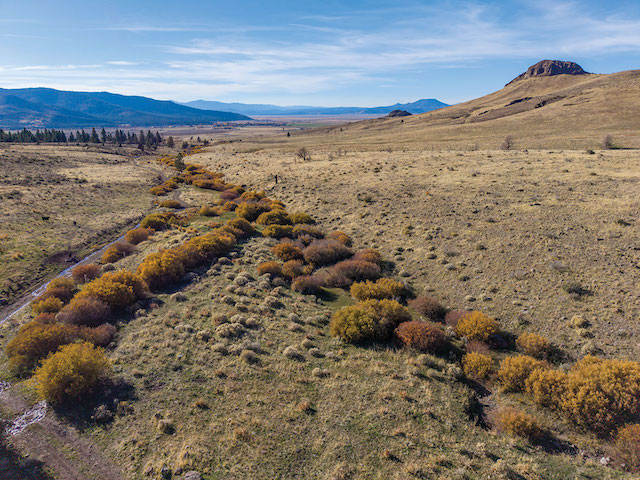
Vegetation lines a drainage on the WélmeltiɁ Preserve, photo by Elizabeth Carmel
Acting as stewards of the land is a practice the tribe built into its governance long before the broader American conservation movement existed, Smokey says. The Washoe’s self-governance compact with the federal government included forestry from the moment it was implemented, with the tribe writing it in as a nod to its historical landscape management and because it was what the people demanded.
It goes even further back, as the Washoe captains—or tribal leaders—journeyed to Washington, D.C., in the late nineteenth century to advocate before Congress for the protection of pinyon forests being stripped to build the Comstock mines.
As Smokey recounts the story, those captains told the lawmakers the pine nut was “like our mother’s milk” and that the Washoe could not survive without it.
Smokey says the current conservation efforts at the WélmeltiɁ Preserve are an extension of those historical efforts.
“We’re just doing it in a little different manner. But we’re doing the same thing that our ancestors did just over 100 years ago,” he says.
The fire-mitigation project at Meeks Meadow and the history of advocacy for the pinyon forests both remain pertinent to the contemporary project, as the WélmeltiɁ Preserve was severely damaged by the 2020 Loyalton Fire.
“The upper part of (the preserve) has some beautiful forest land that, if the Washoe people had been managing it for the last 200 years, probably would not have burned down,” Blake says. “The Washoe were very active stewards of the land, using cultural fire to maintain the health of the forest. A lot of the forests of 200 years ago were much more resilient to wildfire than the forests today.”
Smokey says this fire and the aftermath are central to the tribe’s vision of restoration and preservation. Many of the pinyon pines that are of enormous ecological and spiritual significance to the Washoe burned. Protecting the remnant population while planting new trees will be a multi-generational project that forms the centerpiece of the tribe’s conservation project.
“One hundred and fifty years down the road, I would love to see the reforestation of the single-leaf pinyon pine,” he says.
The tribe will also pursue the restoration of wildlife, including rabbits and groundhogs, and restore watersheds both for the health of the land and to help the small fish population that still clings to the creeks.
But foremost among all these goals is to give the Washoe a sense of connection to their ancient land—to a specific place of ownership and belonging.
“It’s all about having Washoe people on the lands, especially our youth out there doing the work with their own hands, so they can be a part of what our ancestors did for thousands of years,” Smokey says.
The Road Ahead
There is something unmistakably triumphal in conversations with Fillmore and Smokey. Securing the WélmeltiɁ Preserve is a great victory, no doubt, a symbol that resonates beyond the bare fact of acquiring the land.
But both Smokey and Fillmore express confidence that the purchase was not a glorious ending so much as a hopeful beginning.
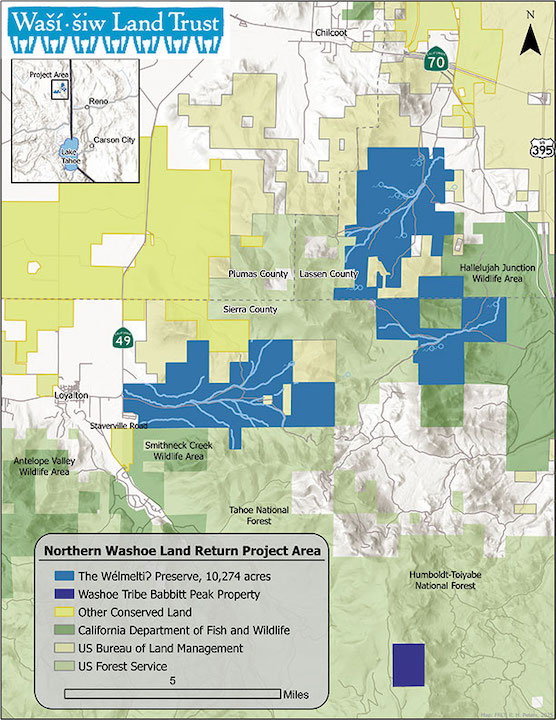
A map of the 10,274-acre WélmeltiɁ Preserve
“We’re going to do good things, and I’m all for pushing boundaries,” Smokey says. “If the land trust wants to jump right in there and get more, then I’m all for it.”
The Waší·šiw Land Trust is already evaluating additional parcels. There is a nearby property whose intact plant diversity, undisturbed for three decades since its last fire, could provide seed stock for restoring the burned ground on the WélmeltiɁ Preserve.
The land trust is also eyeing a smaller developed parcel closer to the preserve that could serve as a field headquarters, or a place to store equipment and cut travel times from Carson Valley.
But the long-range vision remains trained on the spiritual and geographic center of the Washoe lands—Lake Tahoe.
Smokey says the tribe is tracking federal legislation currently pending in Congress that would make it easier for tribes to purchase federally owned land. The stakes are highest at Tahoe, where more than 90 percent of the land within the Basin is owned by the federal government.
Fillmore says the trust is eager to engage in conversations with some of the large private landowners in the Basin, some of whom have held their land for generations and may be more inclined to see it held by the tribe rather than developed.
“If they want to keep the land in conservation status but have it owned by the tribe, those are conversations we’re definitely willing to have,” she says.
Hurdles remain, of course, not the least of which is Tahoe’s high cost of real estate. The Waší·šiw Land Trust still needs an executive director and must finish fundraising for the endowment attached to the WélmeltiɁ Preserve.
But Blake is confident the hurdles can be overcome. Given time, she says, and with the support of regional conservation partners, a renewed Washoe land base in the Tahoe Basin is genuinely feasible.
“We see this as a collaboration that will go on for a number of years as the Waší·šiw Land Trust gets off the ground,” Blake says.
Irrespective of the long-term plans, Fillmore is content to bask in the here and now, at least for a moment.
She talks of conversations with board members and elders, many of whom remember a hardscrabble childhood, where families couldn’t afford to keep the lights on, and food often ran short. Now, those same board members are discussing how to manage million-dollar endowments.
A phrase spoken to her by a friend, a member of a different native tribe, has stuck with her: “We’re the first generation that isn’t just trying to survive.”
Instead, the Washoe people are discovering what it means to thrive.
Matthew Renda is a Santa Cruz-based journalist and former Tahoe resident.
No Comments