



27 Jun Forest Fungi Fever
Delicious wild eats and the thrill of the find inspire a growing community of mushroom foragers at Lake Tahoe
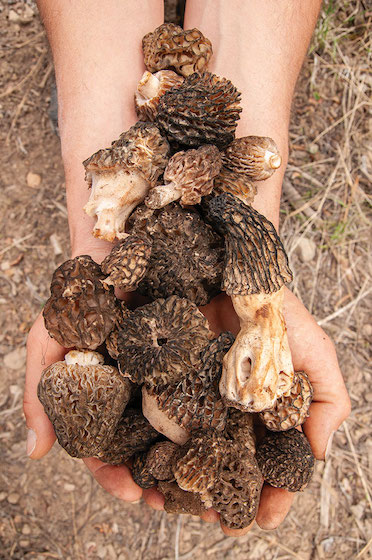
A heaping handful of morels found in the Tahoe National Forest, photo by Seth Lightcap
You would have thought $100 bills were sprouting up from the dirt and pine needles. The joy in An Hoang’s smile is palpable.
On a sunny, cool day in April 2026, Hoang has just found a large cluster of wild morel mushrooms in the forest near Fallen Leaf Lake. Treasured for their meaty texture and rich, earthy flavor, morels are one of the most coveted yet hard-to-find edible mushrooms native to the Sierra Nevada.
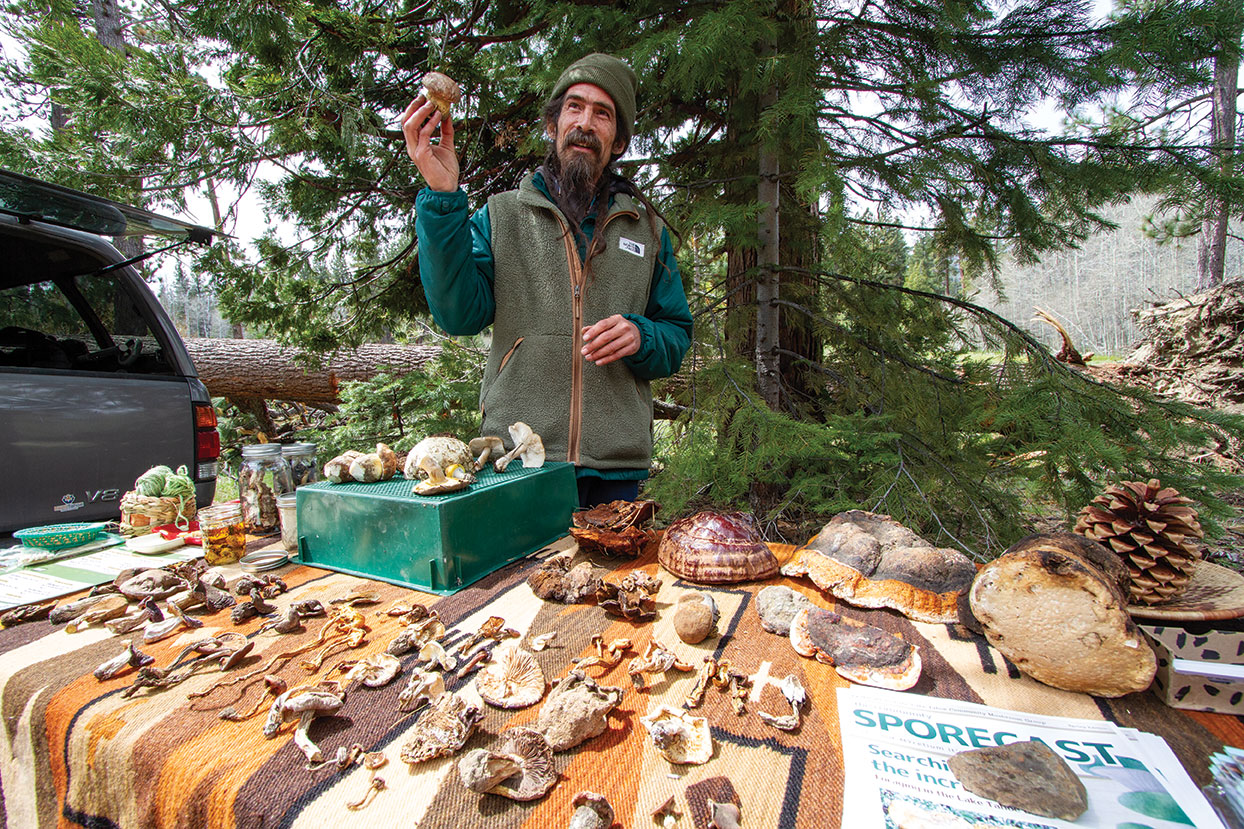
Hoang’s discovery comes in the final minutes of a guided edible mushroom hunt led by Luis Rubio, a naturalist from South Lake Tahoe. Rubio offers free wild mushroom foraging experiences to the public every spring and fall through his organization, Amongst The Trees.
As Hoang uses a knife to carefully harvest the mushrooms, more squeals of excitement ring out through the forest. Rubio and the dozen-plus fledgling foragers he’s guiding that day have come across a patch of morels, known as a flush. Within a few minutes, almost everyone in the group has a couple of morels in their collection baskets.
Rubio couldn’t have scripted a better finish to the foray. For a few in the group, the morels are the first edible mushrooms they’ve ever found. Which, for Rubio, means mission accomplished. Both Amongst The Trees and the nearly 8,000-member Lake Tahoe Community Mushroom Group that Rubio founded on Facebook are dedicated to helping people safely find edible mushrooms in the Sierra.
The forests surrounding Lake Tahoe are home to hundreds of mushroom species, but only about 50 have been confirmed as edible. The vast majority contain toxins that are harmful, if not fatal, if ingested. Despite the danger, local interest in wild mushroom foraging has surged in recent years. As the snow melts in the spring or the rain comes in the fall, more people than ever are on the hunt for these delicacies of the forest.
Community courses, social media and online resources have made it easier to confidently identify edible varieties and avoid deadly ones, contributing to foraging’s newfound popularity. A few of the wild mushrooms found in Tahoe are also world-renowned for their flavor. So, for a mushroom lover or foodie who likes to hike, foraging is the perfect hobby.
The tricky part is finding the fungi and accurately identifying them as safe. Motivation and luck might land you a few, but collecting solid harvests season after season takes practice and education. The first step is to learn the basics of mushroom ecology and the life cycles of the varieties you’re most interested in eating.
Fruiting a New Foraging Community
Historically, fungi were classified as plants because most grew out of the ground and produced mushrooms that resembled strange flowers. With the adoption of the five-kingdom system of life in 1969, fungi became their own kingdom as scientists realized they were genetically more closely related to animals than plants. Plants meet their carbon needs through photosynthesis, while fungi obtain carbon from the environment, just as humans obtain carbon from food.
Where fungi source their carbon from the environment further defines them. Saprotrophic fungi break down organic matter, such as dead wood or decaying leaves, to meet their nutritional needs. Mycorrhizal fungi form symbiotic relationships with living tree and plant species to obtain nutrients. In a mycorrhizal association, the fungus colonizes the host plant’s root tissue and supplies it with water and minerals in exchange for sugars and lipids that the plant produces through photosynthesis.
Fungi also differ from plants in that they lack roots. The working body of a fungus is a structure called mycelium that resembles a woven network of thin threads. The threads, known as hyphae, are responsible for digesting nutrients, decomposing organic matter and producing the mushrooms, which serve as the reproductive fruit that distributes spores.
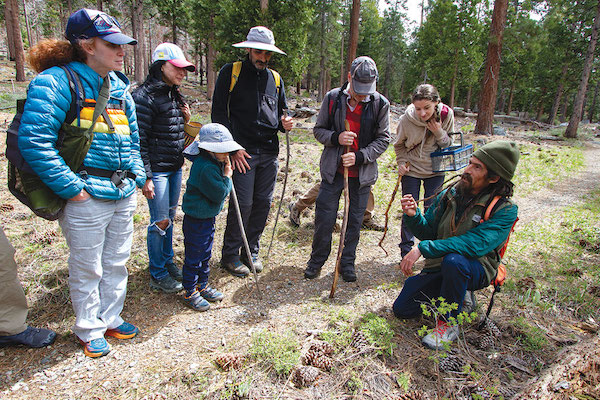
Luis Rubio shares insight on how to find edible mushrooms during an Amongst The Trees outing in South Lake Tahoe, photo by Seth Lightcap
Native Americans were the first to identify edible mushrooms and understand that mycelial-level saprotrophic and mycorrhizal interactions with the environment determine where mushrooms are found. Here in Tahoe, morel and puffball mushrooms have been part of the Washoe’s seasonal diet for thousands of years. Washoe tribal foragers passed down knowledge of these mushrooms’ most suitable habitats and growing conditions over generations.
When Rubio created the Lake Tahoe Community Mushroom Group in 2018, his goal was to build a public forum for exchanging information about mushroom ecology and foraging tips like a native tribe. Within a year, the group had 1,000 members. By the end of the COVID pandemic, it had 5,000.
Now clocking in at almost 8,000 members, the group is a thriving resource for both experienced and aspiring local foragers. Most of the content is shared photos of successful harvests and requests for help identifying mushrooms. Details about specific locations are rarely shared, but for a culture that has traditionally been very secretive, any public attention to the pastime is too much for some.
“I got a lot of pushback the first year I created the group, and I still get people who message me saying what I’m doing is wrong,” says Rubio. “But I don’t agree with the mentality that if you show anybody else your spot, you won’t ever find anything there again. For me, that’s never been true. The more I walk, the more I find.”
Rubio, who works as a freeride ski coach in the winter, led free public foraging trips through the Facebook group for several years before founding his organization to expand the type of experiences he offered. In the spring of 2026, Amongst The Trees hosted six group hunts, a free online presentation about Lake Tahoe’s edible mushrooms, and other events focused on foraging native plants and gardening.
The Mighty Tasty Morel
Much of what Rubio teaches in his presentations and events focuses on introducing people to the most easily identifiable edible mushrooms and the environmental factors that dictate where they fruit.
“You can wander for a long, long time and not find anything if you don’t know what to look for,” he says.
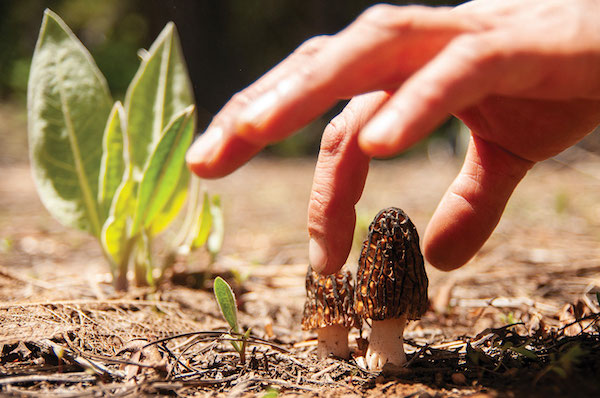
Morels fruit in forested areas that were recently disturbed, photo by Seth Lightcap
Morchella mushrooms, better known as morels, are what most Sierra foragers hunt for in the spring. Morels’ rich and earthy umami flavor pairs perfectly with almost any seasoning, and their meaty texture makes them a delight to eat, even for those who don’t love mushrooms.
Thankfully, morels are some of the easiest wild edible mushrooms to identify. The eight primary Morchella species found in the Tahoe region all look similar, with a distinctly honeycombed cap and hollow body. The species differ in color, size and the shape of their caps. Morels fruit only in spring, just after the snow melts, and their ideal habitat is burn scars and forested land recently disturbed by activities that stir up the soil. They especially like burn zones because the soil is so nutrient-rich.
“Morels can be very prolific, but people tend to rely on their old spots, and after three to four years, they won’t find them there anymore,” says Rubio.
Controlled-burn areas, freshly logged forest and landscaped grounds can be ideal habitats for morels.
“I know people who rake their property every fall, and they get morels in the backyard every spring,” says Rubio.
Morels are unique in that they employ both mycorrhizal and saprotrophic strategies. Some species form symbiotic relationships with pine and oak trees, while other species digest decaying leaves and pine needles. This makes them slightly trickier to find, as they do not associate with just one tree species.
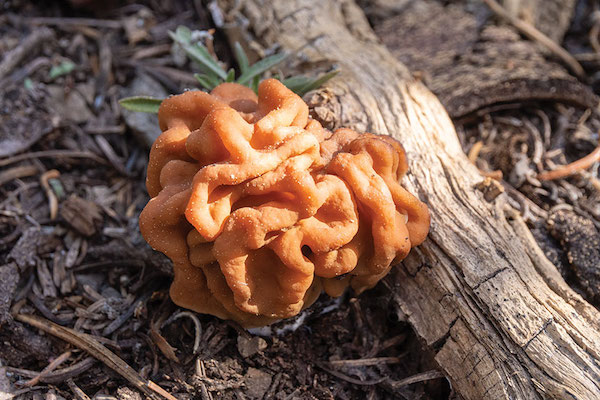
Snowbank mushrooms, aka “false morels,” are edible if thoroughly cooked, photo by Seth Lightcap
The secret to spotting them is to train your eye to pick out the soft brown or blonde hue and smoothly rounded contours of their caps, says Rubio.
Until you develop such spotting skills, be ready to endlessly scan the forest floor, yet find nothing. Picking out the unique contours of a morel cap from a visually chaotic mess of forest debris is a practiced skill, but for each mile walked, observation skills improve.
Keen-eyed foragers might also come across a “false morel” species that’s native to the Tahoe region. Snowbank mushrooms, or Maublancomyces montanus (formerly Gyromitra montana), have brain-like wrinkled caps that vaguely resemble true morels. False morels found in other regions often contain dangerous amounts of toxins, but Maublancomyces montanus can be eaten if properly identified and thoroughly cooked.
The Delicious and Precious Little Pig
Longtime locals Rita and Craig Nelson have been foraging for wild mushrooms on Tahoe’s West Shore for decades. The couple learned to forage from Silvano Achiro, an Italian immigrant who moved to Tahoe in 1964 and started a garbage collection company that would later become Tahoe Truckee Sierra Disposal.
Achiro had been foraging on the West Shore for 40 years by the time the Nelsons met him walking in the woods with a huge burlap sack full of mushrooms. They became fast friends, and Achiro taught them how to find king bolete (Boletus edulis), a mushroom called porcini in Italian—the “little pig.” Porcini are highly prized in Italy, and many consider them one of the most delicious mushrooms in the world.
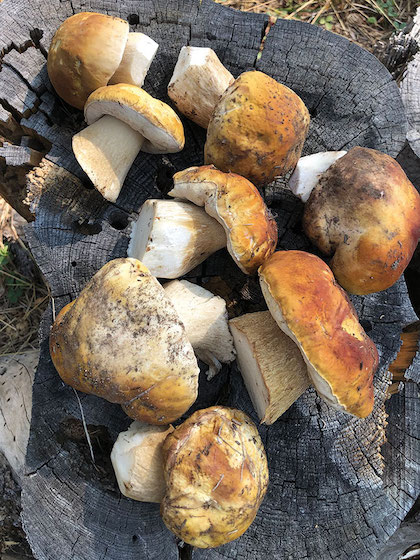
Chunky king bolete mushrooms found on Tahoe’s West Shore, photo by Rita Nelson
As Craig Nelson tells it, Silvano would take his family from Italy out mushroom hunting when they visited. “One day,” he says, “we found so many porcini that his aunt, who did not speak any English, knelt down and kissed the ground. She could not believe how many we were finding.”
Bolete mushrooms are aptly named in Italian, as their sturdy appearance with a plump white stem and a bulbous brown cap resembles a little piglet. The Sierra is home to multiple bolete species, some that fruit in spring and others in fall.
Achiro and the Nelsons primarily foraged in the fall for king bolete, which, like the related spring king bolete (Boletus rex-veris), is mycorrhizal with Tahoe conifers and found in mature forests near creeks.
“I like softball-sized boletes,” says Nelson. “The big ones rot quicker and get more worms. But the worms aren’t a problem if you dry them. Cut your mushrooms into half-inch-thick slices and place them on a drying rack. The worms will drop out as they dry.”
Finding a bolete takes a trained eye, as they tend to sprout up under a thick layer of loose dirt and pine needles. The growing mushroom, or cluster of mushrooms, will push up the forest debris, forming a slightly raised bump. The bump, known as a “shrump,” is often the only sign that a potentially huge mushroom exists there. So, unlike morels that have a visible fruiting body to look for, boletes require patient scanning of the forest floor for level inconsistencies.
Though well-hidden, boletes often recur in the same areas every year, making the hunt for them slightly less daunting.
“If you find a bolete, you can be pretty confident you will find one or more there every single year,” says Rubio. “Even in dry years where you’re not finding anything else, boletes will keep popping up in the same spots.”
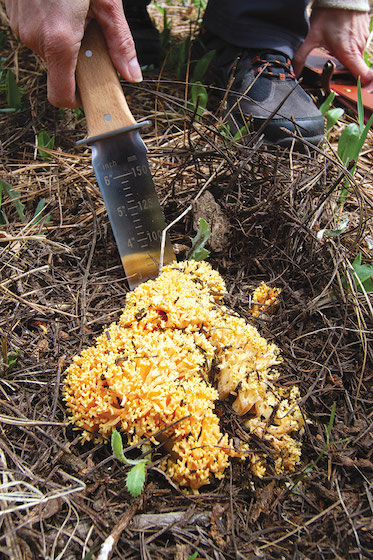
Coral fungi grow under thick pine debris and have a mild, peppery taste, photo by Seth Lightcap
Coral, Oysters and Puffballs, Oh My!
Of the approximately 50 edible mushroom species that fruit in the Tahoe Basin, only about 15 are commonly eaten. Beyond boletes and morels, experienced foragers are on the lookout for chanterelle, chicken of the woods, coral, giant sawgill, hedgehog, oyster, moron cap, pine woodwax, sculpted puffball, shaggy mane, slippery jack and yellow robe mushrooms.
Moron caps (Agaricus moronii) are regarded for their taste and have a flavor similar to that of portobello mushrooms. They are typically hidden beneath a shrump in shady forested areas with thick pine duff.
Corals also form a shrump, but look nothing like a traditional mushroom. They resemble a loofah sponge and taste similar to cauliflower.
Chicken of the woods, oysters and puffballs are three uniquely edible saprotrophic fungi. Chicken of the woods is a bright orange and yellow bracketed fungus that fruits on pine tree stumps after rainstorms in the late summer and fall. When properly cooked, it’s thought to taste like chicken.
Oysters are fan-shaped mushrooms that fruit in bracketed clusters on downed logs or standing dead aspen and cottonwood trees. They are prized for their delicate, slightly sweet flavor and velvety texture.
Sculpted puffballs look like textured snowballs sprouting from the earth. They may be covered in pyramid-shaped spikes or have raised flat warts on their outer surface. Young and firm puffballs have a mild, nutty flavor that readily absorbs any seasonings you cook them in.
While most people can eat all these mushrooms without gastrointestinal distress, it’s important to test your body’s reaction to a new mushroom before eating a lot of it, says Taye Bright, a Sebastopol-based mycologist who offers courses on Sierra mushrooms and guided foraging experiences through the Berkeley-based organization Fork In The Path.
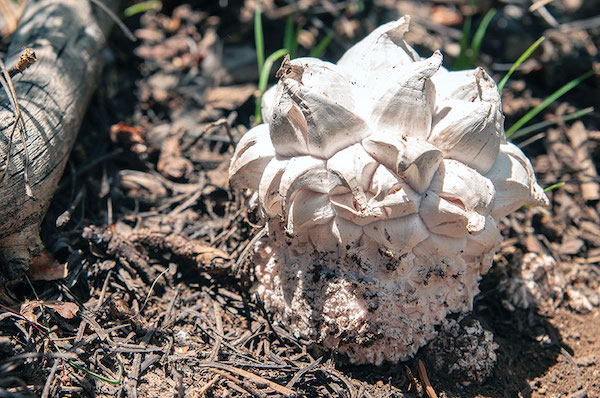
Sierran puffballs have a spongy texture and a mild, nutty taste, photo by Seth Lightcap
“Just because a mushroom is supposedly edible doesn’t mean it’s edible to you, because we all have our own unique body chemistry, our own allergens and our own unique digestive microbiomes,” says Bright. “We are an ecosystem within ourselves, and that ecosystem will determine whether that mushroom sits well in our body.”
Bright, who’s working with colleagues on the first-ever comprehensive Sierra Nevada mushroom guidebook, is quick to admit there’s still plenty to be learned about what makes certain mushrooms toxic.
“For a lot of mushrooms,” he says, “we don’t fully understand the chemistry behind what makes them toxic, but we have enough evidence that we know they make people sick. Only the really toxic, deadly ones like death caps have been fully studied.”
A fact that may come as a surprise is that most wild edible mushrooms contain toxins that must be destroyed by cooking before ingesting. Only a few mushrooms found in Tahoe can be eaten raw, and only in small amounts.
Cook Wild Mushrooms Like You Mean It
“It’s a good practice to basically cook the crap out of any wild mushroom you want to eat,” says Bright.
This advice is especially critical for morels.
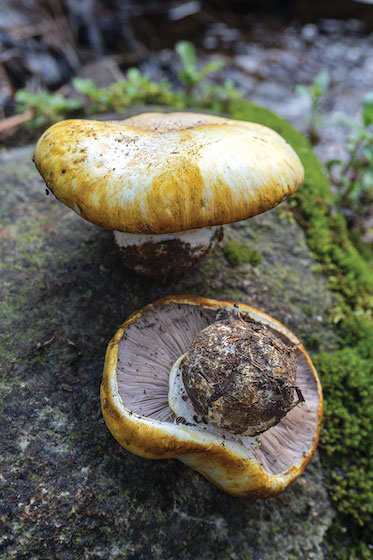
Agaricus moronii is a delicious edible that tastes like a portobello mushroom, photo by Seth Lightcap
“The toxic compounds within morels, the hydrozines, are very heat-sensitive; they volatilize and become inert once they are cooked, but they can make you very, very ill if you eat them raw,” says Bright.
Sautéing morels in butter or oil over medium-high heat for seven to nine minutes is long enough to destroy the toxins. Frying morels in 340-degree oil for two minutes per side or boiling them for 10 minutes will also ensure they are fully cooked.
Parboiling wild mushrooms for 10 minutes before sautéing them for another seven to nine minutes in oil and seasoning is another safe way to ensure the mushrooms are digestible.
For fresh porcini, it’s recommended to dry-sauté them over medium heat for 15 to 20 minutes until the water evaporates and they begin to turn golden. Then, add butter or oil and sauté for another five to 10 minutes.
Nelson, the porcini aficionado, recommends feasting on them soon after they are found.
“Porcini are best fresh,” he says. “Try to cook them the same day you pick them because they don’t keep; they go bad really quickly, even in the refrigerator. That’s why it’s so hard to find them in a grocery store.”
If you can’t eat all the wild mushrooms you find before they go bad, drying them is a good option. The drying process does not destroy all the undesirable compounds, though. Dried wild mushrooms need to be rehydrated and cooked thoroughly, just like fresh mushrooms, to be safe.
No Fancy Gear Needed
Picking up a new hobby is usually a costly endeavor. Not mushroom foraging. The financial barrier to entry is virtually zero. The only semi-required equipment beyond hiking shoes is a mesh bag or woven basket and a medium-sized folding knife.
Foragers use mesh bags or woven baskets because porous containers allow microscopic spores to fall to the ground as they walk, helping the mushrooms regenerate. But collecting in a cute basket is not critical. By the time a mushroom is fruiting and big enough to find, it will have already released most of its spores.
The preferred way to harvest a wild mushroom is to slice it off at the base of the stem with a knife. Leaving the mushroom “stump” in the earth is thought to protect and preserve the mycelium layer from which the mushroom fruited. A sharp folding knife works well for this task.
Studies have shown that harvesting mushrooms does not affect future generations. But like apples on an apple tree, the mushroom is the fungus’s reproductive fruit.
“If you come across a morel patch and you harvest every single one, you are not harming that population of morels,” says Bright. “But I would consider leaving a couple of small ones, and only taking the mature ones, out of understanding and respect for the organism.”
Spring 2026 was a standout season for morel foraging in the Tahoe region, as the usually elusive fungus started fruiting after the heat wave in late March and continued through the rains in early June—an earlier and longer season than usual.
“Historically, snowmelt is more of a slow, gradual process, and the moisture takes its time moving across the landscape,” says Bright. “But more and more with big heat waves and the weather getting hot really fast, the snow almost sublimates. It goes straight from snow to water vapor, and that’s really changing the spring snowmelt mushrooms. They are fruiting earlier and earlier.”
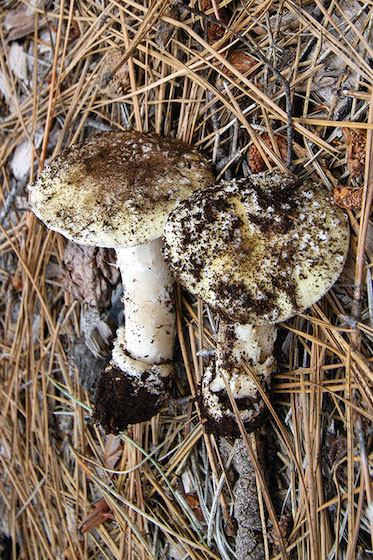
The poisonous Amanita pantherinoides killed several Tahoe dogs in the spring of 2026, photo by Seth Lightcap
Identify Twice, Eat Once
The importance of properly identifying any wild mushrooms before eating cannot be overstated. This was evident in spring 2026, as California experienced an unprecedented outbreak of severe illness and deaths from people accidentally picking and eating poisonous wild mushrooms.
These cases were attributed to an unusually prolific bloom of death cap and western destroying angel mushrooms in the Bay Area and North Coast. Both species contain highly toxic peptides that do not break down even after cooking, boiling, freezing or drying. Several of the victims misidentified these as Asian paddy-straw mushrooms or young puffballs, two safely edible mushrooms that look similar.
Death caps have not been found in Tahoe yet, but a few instances of western destroying angels have. The most common toxic mushrooms found in Tahoe are Amanita muscaria, which is the red-and-white-spotted “Super Mario” mushroom, and Amanita pantherinoides, which is similar in appearance but white with yellow spots. While not often fatal to humans if ingested, both species can be deadly to dogs.
One approach to navigating the dangers of misidentification is to cross-reference what you find with photos of edible species right there in the forest. If the mushroom doesn’t look exactly like the photo, don’t even bring it home.
Confidence in identifying edible species comes with experience and learning from experts, so don’t hesitate to tap into online resources like Rubio’s Facebook group to double-check what you’ve found.
Because no wild mushroom feast is worth dying for, and as the old Czech adage goes: “Every mushroom is edible—but some only once.”
Seth Lightcap is a a writer and photographer based in Olympic Valley.
No Comments