

29 Apr The Immersive Revolution
Reno’s Potentialist Workshop features art you can feel
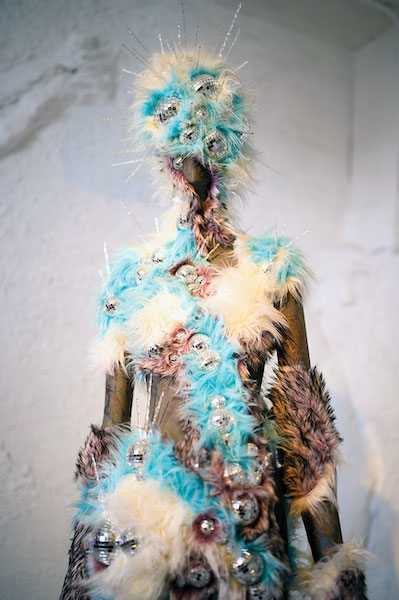
The sculpture oddities of Daisy Mae Jones can be found all over “Under the Mountain” installation
Touch it. Touch the art. Feel the texture of the paint. Is it soft? Is it crunchy? Does it make you feel uneasy? Good. Now take a step forward. Let the art touch you.
In an immersive art installation, there are no ropes, sterile white walls, acrylic cubes or gallery attendants watching from the corners. Immersive art surrounds visitors physically, impacts them emotionally and encourages them to reflect on their role in the experience. It transforms us from passive observers of art into active participants.
“I think immersive art is a societal response to living our lives online, then as a result, craving real-life, in-world experiences,” says Kent Caldwell, creative director at Meow Wolf’s Omega Mart installation in Las Vegas. “It’s something that allows us as adults to be curious and playful.”
The goal of immersive experiences, Caldwell says, is to make art feel more accessible and even doable.
These art installations range from temporary pop-ups in restaurants or convention centers to omega-scale freestanding structures. The art itself can include projections on a screen, as with the traveling Van Gogh Exhibition, interactive theater like “Sleep No More” or fully realized worlds with soft sculptures, technology, lights, storytelling, side quests and games all wrapped into one amorphous art blob.
In Las Vegas, more than 300 people built a fully interactive, touchable story inside a 52,000-square-foot warehouse. And in Reno, a smaller 60-person art collective at the Potentialist Workshop created a 20,000-square-foot experience.
“You’ve got Meow Wolf, but every single city has a pop-up immersive,” says Jessi Janusee, the art administrator at the Potentialist Workshop. “You have cool ones in cities smaller than Reno you wouldn’t expect. The fact that immersives are in every little hub makes it more accessible and understandable.”
While these experiences and similar ones are called “exhibits” and “art installations,” they are nothing like a day at the museum viewing contemporary sculptures on pedestals or paintings screwed into the wall.
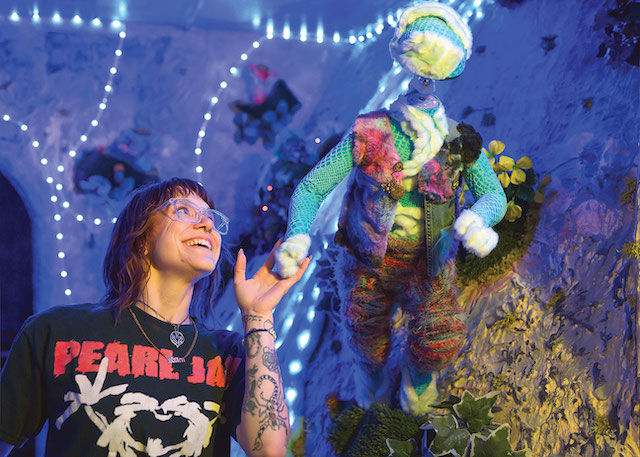
Artist Danyella Thrall shows off some of her figures in a portion of the basement of “Under the Mountain”
“The museum context can be off-putting,” Caldwell says. “People can almost feel like they’re supposed to be smarter just to understand the work.”
Throughout the Potentialist Workshop’s “Under the Mountain” installation, viewers will experience an entirely new form of storytelling through varying styles, materials and methods.
Both Janusee and Caldwell agree that the true draw of immersive art lies in its imperfections. Visitors want to see the handcrafted elements, feel the messy edges and experience a space entirely free of a manufactured, corporate finish.
“We want you to walk away going, ‘Is that all art? Can I make art? Am I art?’” Caldwell says. “Are you inspired because the hand of the artist is so present? We’re not putting it in the context of needing to be impressed. We just want you to be engaged by the art, engaged with the world and to rediscover elements of both.”
‘Under the Mountain’
“I’ve been making large installation worlds since I was little,” says Pan Pantoja, executive artist at the Potentialist Workshop.
On Second Street, the unassuming, beat-up brick building with “GALLERY” mounted over the two front doors beckons to courageous visitors. Beyond portal number one: a small room with familiar white walls and a monthly rotating art show. Behind portal number two: a paint-spattered front lobby with saloon doors that give way to indescribable chaos.
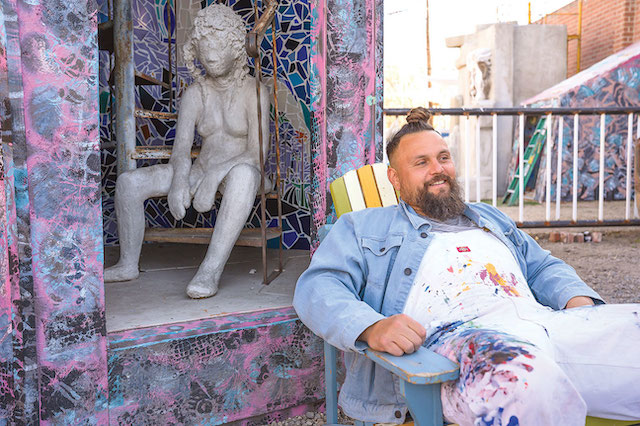
Executive artist Pan Pantoja takes a break in between painting, building, planning and poetry night
At the Potentialist Workshop, artists bring to life the bedtime stories Pantoja has been sharing with his son, Axiom, for eight years. Mushrooms with one eye, surrounded by tiny mushroom people, give way to giant, otherworldly figures, technicolor dreams, painted monsters, sculptural oddities, light and sound.
The physically immersive, acid-trippy exhibit is just one small fraction of a fully realized universe that Pantoja has meticulously mapped in drawing books, poems, paintings, sculptures and stories. “Under the Mountain” is the second part of a multi-year installation.
While “Under the Mountain” focuses on a little boy’s journey through an imaginary underground world, the previous installation explored the “Upside Down Land.” The final installation, “Metropolis,” will attempt to explore the fictional surface world.
A foundational law of Pantoja’s universe is that magic is incredibly rare and completely invisible to anyone who doesn’t possess it themselves. In his lore, the boy gains supernatural powers that allow him to see the secrets. Pantoja views this rule as a direct reflection of our real world and builds these exhibits to give everyday people a chance to see the magical world layered under our common reality.

Small mushroom people stand at the base of the massive one-eyed all-seeing mushroom inside the Potentialist Workshop’s “Under the Mountain” installation
As Axiom has aged, he has started adding new elements to the story that appear in the installation.
“He decided that Nemo, the Prince of Dreams, is actually a fish,” Pantoja says. “It’s a rainbow trout that swims in the air. After he said that, the Nemo of my mind completely disappeared. Now it was only a rainbow trout.”
If you look in the right place, you will see a school of sequin rainbow trout on the walls near the flamingo mannequin creature that Janusee swears is a duck.
“My type of art is a blank mirror; whatever you see is what you get,” says Jack Ryan, an artist at the Potentialist Workshop. “It was on this project that I realized art may be subjective.”
The story unfolds completely unguided. There are no placards on the wall giving credit to an artist, benefactor or explaining what you’re supposed to get out of the experience. No “untitled” works. Many of the creatures and objects have secret names. Every corner, every hole in the wall, every portal, holds a surprise. Look closer, and you’ll find another layer.
“It’s not Disney World, man,” Janusee says.
The Art Monsters
“Pan is an art monster that gets people together and dares them to throw out what they naturally want to do,” Ryan says. “He’s a natural-born leader, and people will follow a natural-born leader. He doesn’t need to cajole. A real artist will see his work and want to be part of that.”
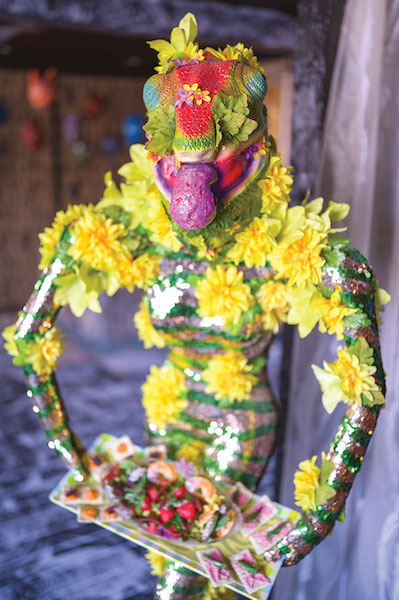
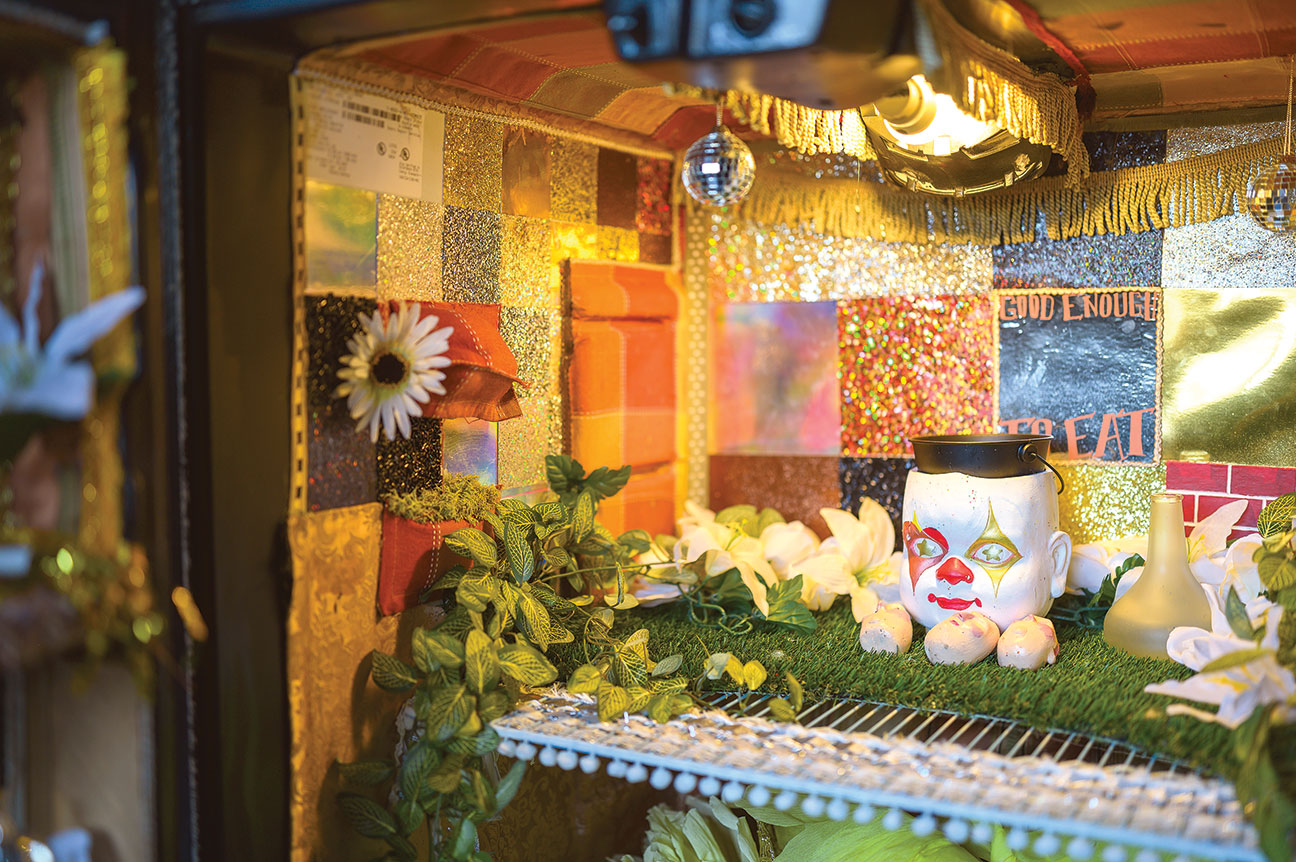
A sculpture by Daisy Mae Jones at the Potentialist Workshop
It’s difficult not to see Pantoja as his mythological Greek namesake, Pan, shepherding artists, twisting nature, inciting revelry and joy in a world of centaurs. But instead of creating panic, Pantoja projects calm and provides guidance. Motivating people to create one massive vision requires that special talent.
“It’s hard because everyone has a different communication style, art style and process for how they make their work, and that’s a challenge,” Janusee says. “Doing anything in a community is a challenge. Not every artist stays. At least a few got excited, then it was too much work, not enough time, a clash of ideas or communications styles, and they left.
“But when it is working, and we’re all doing our separate art, and it comes together … that’s magic,” she says.
Pantoja explains aspects of the story and the project’s vision to each artist, spurring them to create their unique corner of the installation.
“Very few people can look at the whole thing without going completely mad,” Pantoja says. “So, I don’t do that to people.”
Artists get an area, or a small room, a wall or an element to work on. Caldwell takes the same approach at Meow Wolf, giving artists prompts instead of specifications.
“It’s just a beautiful thing to allow artists to show the world who they truly are versus trying to satisfy a commission for a client,” Caldwell says.
Janusee says the final product always turns out different than the original vision, and for all of them, that’s the beauty.
The Making Of
When local artist Sogand Tabatabaei walked into the workshop on a recent Monday, she only carried a small tote bag and a steamer. Pantoja took her down into the basement of “Under the Mountain” to a small room filled with technology and a large, angular chair. The previous artist had set up an interactive musical light show with a TV. But it was time to replace that with something new.

Executive artist Pan Pantoja and his son Axiom pose for a conceptual photo demonstrating how they tell bedtime stories together, which created the “Under the Mountain” universe
Tabatabaei kept asking what she was allowed to do, and Pantoja kept telling her she could do anything she wanted. Tabatabaei waited for Ryan and Pantoja to clear out the room before she unfurled a fabric collage. She wanted to hang them from the ceiling so people could walk through or around the fabrics, hold them between their fingers and see through them.
“We don’t see touch as an artistic experience,” she says.
Her collage demonstrates how everyday textures connect us to identity and cultural memory. Sitting around a table, for example, touching a wooden table, fabric placemats and paper napkins creates shared memories of eating dinner with family.
“The dining set records who’s there and who’s not,” Tabatabaei says. “I try to shape that meaning in my work.”
Tabatabaei’s fabric room is one small piece of the constantly shifting world. Behind the scenes, artists toil away in a workshop hidden within. They inspire each other, contribute recycled junk, cut, paste, sew, glue, hammer, paint and shape the junk into new art. They rely on lead builder Colin O’Bryan to anchor the collective’s wild imagination in “stone, steel and Styrofoam.”
As they complete each piece, the installation evolves. It’s never really finished. Janusee always sees the next thing to add or puzzle to solve.
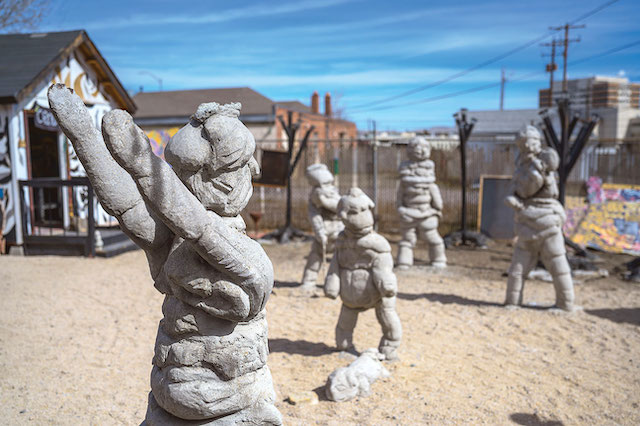
Pan Pantoja’s concrete sculptures are scattered throughout the side yard of the Potentialist Workshop
“The thing that helps me is when a new person comes in, and they have never been here before, and wander around for 30 minutes saying, ‘Woooow, look at this!’” Janusee says. “Just hearing them gives me a lot of joy. I can only enjoy the work vicariously.”
The full-time desire to create keeps Pantoja up at night, his brain spinning out new monsters, collaborations and worlds. At a poetry night event in downtown Reno, he rapidly tapped a marker against his drawing book, adding dotted dimension to creatures.
“I’m glad I get to do this, even on days I have the blues—I can never shake it,” he says. “When I thought I was going to be an artist, I didn’t know it would take this much work.”
It requires months of physical labor, mental anguish and untold emotional and spiritual expense to create such a complex installation that will only last 18 months and sometimes less.
So why do it?
“I don’t do it for the money, I do it for the love of it,” Pantoja says. “So that people remember what’s important in life, what’s real and what’s not. I think that’s what I’m here for—to remind us what creativity and love do and how powerful they are.”
The Potentialist Workshop, located at 836 E Second Street in Reno, is open Thursday through Sunday from noon to 11 p.m.
Mike Higdon exhibited interactive photography shows on the gallery side of the Potentialist Workshop in 2017 and 2025. He was recently scolded by a gallery attendant at the Phoenix Art Museum for touching an exhibit that had clear “Do not touch art” signage.
No Comments