




29 Apr A Ruby in the Rugged West
Ruby Mountain Heli—the oldest family-run helicopter ski operation in North America—pairs world-class terrain with warm hospitality in a remote corner of the Great Basin
In 1845, Lansford Hastings published The Emigrant’s Guide to Oregon and California, the lengthy subtitle of which promised “a description of the different routes to those countries and all necessary information relative to the equipment, supplies, and the method of traveling.” Hastings, a lawyer and self-styled empire builder, published the guidebook with the intention of taking California from Mexico by sheer numbers. If he could get enough settlers into the territory, he reasoned, it would fall naturally, and bloodlessly, into American hands—his own chief among them.
Buried in the flowery prose of his guidebook is a brief description of an alternative route from Fort Bridger, Wyoming, to California: Hastings Cutoff. Rather than follow the traditional route north of Salt Lake, the cutoff skirted the southern edge of the lake, requiring passage through the formidable Wasatch Range, the waterless Great Salt Lake Desert and the barely explored region just south of the Ruby Mountains.
Despite having never traveled the route himself, Hastings personally vouched for its safety and efficiency, guaranteeing settlers that the “shortcut” would save them at least 300 miles—a false claim. Among those who bought into the promise were George and Jacob Donner.

Guests and guides prepare to descend into a canyon in the Ruby Mountains, with the Independence and Jarbidge mountains in the distance, photo by Matt Bansak
The fate of the Donner Party is lodged firmly in the American canon, but the ill-advised cutoff that precipitated their doom has faded from our collective memory, in part, perhaps, because that region of the American West remains as inhospitable today as it was then: dramatic mountain ranges separated by forbidding desert.
In the early 1970s, 20-something Joe Royer was as familiar with that inhospitable landscape as any other long-distance commuter traveling Interstate 80 through Utah and Nevada. A California kid working as a ski patroller at Snowbird in the Wasatch Range, Royer made the 12-hour drive from home to work each season, and every time he hit Elko, Nevada, he would glance out his windows at 80 miles per hour and marvel at the inscrutable Ruby Mountains rising from the desert in the distance.
“It was really isolated, and nobody knew what the snow was like,” Royer says. “It’s a high-desert range; the snow that happens here is not in the maritime category.”
The mystery of the snowpack captured his imagination, but the beauty sustained his interest.
“It’s unbelievably scenic,” he adds. “It’s hard to believe you’re in the state of Nevada.”
Short on insights from fellow skiers and patrollers, Royer determined the only way to learn about the Rubies was to get lost in them. What he found there in the winter of 1977 has shaped the last 49 years of his life as the founder and owner of Ruby Mountain Heli, and has exerted a gravitational pull that many—including his wife Francy and son Mike—have found impossible to resist.
Today, Ruby Mountain Heli is the oldest family-run helicopter ski operation in North America, and the best-kept secret in the lower 48. The Royer family doesn’t intend for that to change anytime soon.
A Leap of Faith
Helicopter skiing is exactly what it sounds like: skiers and snowboarders gaining access by air to backcountry runs that are not easily accessible by foot or snowmobile. In North America, there are about 40 operators, most of which are based in British Columbia and Alaska. The remaining few are scattered among the iconic ski towns of the Mountain West: Sun Valley, Jackson, Telluride, Snowbird, Silverton.
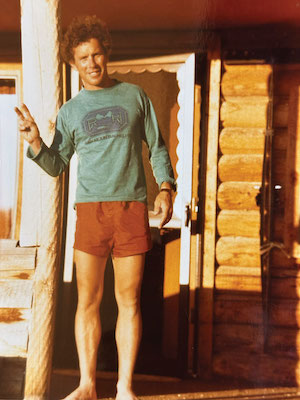
Joe Royer in the early 1980s, courtesy photo
Lamoille, Nevada, by contrast, is not only not a ski town, it’s not even a town. According to the most recent census data, the population is 63. Three of those residents are Joe, Francy and Mike.
“I could not imagine being anywhere else,” says Mike Royer, 36, who has taken over the operation of Ruby Mountain Heli as his parents have “stepped back” from the business in recent years. “I love the Ruby Mountains and the Lamoille area.”
The love Mike feels is what his father felt nearly 50 years ago, and what his mother—at the time a pastry chef working at Deer Valley Resort in Utah—felt when she joined friends on a trip to the Ruby Mountains in the early 1980s, with Joe as her guide. The two hit it off and married soon after, the desolate range and nascent heli-ski business serving as a backdrop to their romance and shared purpose.
“It was one of those leaps of faith,” Francy says. “We just figured it out as we went. We love doing activities together, and we were a great team from the very beginning. It came from a mutual love for the mountains and skiing and adventures.”
Together, the young couple borrowed money, bought total stake in the company that Joe had founded with the help of business partners, and began navigating out of debt and toward a shared vision they both knew could take decades to realize, if it arrived at all.
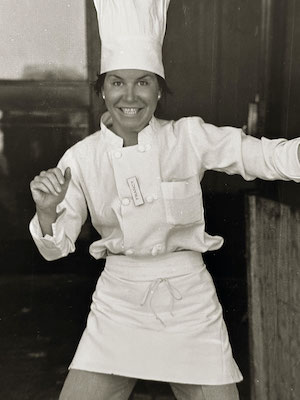
Francy Royer in the early 1980s, when she was still working as a pastry chef at Deer Valley, Utah, courtesy photo
“It doesn’t happen overnight,” Joe says. “It takes years and years.”
The evolution of the operation—from bunking up with guests at a hotel in Elko to hosting groups at a local ranch in Lamoille—reached completion in 2016 with the construction of Ruby 360, a 10,000-square-foot luxury facility at the base of Conrad Creek. The 10-room lodge, which recently expanded operations beyond the ski season to include activities and lodging May through November, is perhaps as well-known for Francy’s cooking as Joe’s visionary heli-ski tours.
“Meeting her stepped everything up,” Joe says. “I thought people didn’t care about the food. I was really wrong. People were coming here to eat, and the skiing was second.”
An only child, Mike spent a lot of his early life with Francy in the kitchen, cleaning, prepping and making small side dishes like salsa and guacamole.
“I never really had a babysitter,” he says. “I grew up in the kitchen with her.” He was learning the craft of cooking and hospitality from the same woman who had on occasion been summoned from the back of house at Deer Valley in the 1970s to accept the compliments of the celebrity class—once from Robert Redford, once from Sidney Poitier.
Of her culinary renown, Francy is dismissive. “It’s not important to me,” she says. “I’m not worried about fame and fortune. I just wanted to create the same warmth that’s in my home.”
Generations of Fun
Guests of the family business—60 percent of whom return at least once—cite that familial warmth as one of the reasons they keep coming back. Mark Ambrose has skied with Ruby Mountain Heli every winter but one since 2005, an experience he describes as the highlight of his year. Francy’s cooking ranks near the top of his extensive list of praise for the family-owned business.
“The food is unbelievable,” he says. “I was kind of a picky eater when I was a youngster, but the first time I went out there, I learned pretty quickly that anything they put out is really delicious. I give them a lot of credit for expanding my palate.”

Dinner is prepared and ready to serve to guests at Ruby 360 Lodge, photo by Matt Bansak
Ambrose, whose father was one of the first guests in the late 1970s, is among a growing list of multigenerational visitors for whom the mountains serve as an intersection of adventure and family.
“When I graduated high school, I started going with my dad and brother and it became a family tradition,” he says. “Over the years, we’ve added friends and gotten to know some of the other skiers. It’s become a small community.”
Francy is delighted by the feedback of her return guests, many of whom the effusive Italian matriarch now considers members of her sprawling extended family.
“You have people retiring from heli-skiing and their children and grandchildren are still coming,” she says. “That’s about as rewarding as you could ask for in a business—for people to trust us with their children.”
Speaking by phone, Francy politely says that she needs to hang up soon; though she has stepped away from daily operations in the kitchen, tonight she is cooking a special birthday cake for a man who first skied with them when he was 8 years old; he has booked the entire lodge for the weekend to celebrate his 50th birthday.
“It’s always a special time when we have two to three generations sitting at the dining room table,” Joe says.
“Some of our guests have been coming since I was born 35 seasons ago,” Mike adds, reflexively measuring his life in seasons rather than in years. “You spend a lot of time with each other and with the crew and the guests, and it’s a special bond. Other operations have tried to do something very similar to what we’re doing, and they don’t have the soul, the family touch. You can’t fake that. We have the soul, and it comes from the family. I really feel like that is the difference.”

Ruby guides give the nightly toast to a table full of ski guests, photo by Matt Bansak
Ambrose has seen enough of the ski industry to discern the exceptional from the merely commercial. His ski trips have taken him to Utah, Colorado, Montana, Wyoming, Idaho, Oregon, Japan, Europe and South America; on one road trip, he skied 150 days at 21 resorts in six different states. But the Royer family keeps bringing him back to rural Nevada.
“It’s pretty rare in this industry to have a family-run business for so long and have that kind of culture,” he says. “We’ve had long friendships with a lot of the staff and guides and some of the pilots. I give a lot of credit to the Royers for assembling that community and cultivating a really tight-knit culture there.”
Ambrose is quick to point out it’s not all kumbaya and campfire songs, however. Good food and found family can only do so much if the mountains aren’t delivering. The mountains, he assures, are always delivering.
“My top 10 days are probably all at Ruby still,” he says. “I just keep having such an unbelievable time that I haven’t felt the need to change it up. The mountains and the terrain are world-class.”

Skiers get a view from the Tower of Babel looking into the heart of the Rubies, photo by Matt Bansak
100 Miles of Terrain
The Ruby Mountains contain 50 peaks over 10,000 feet and 15 peaks over 11,000 feet. The range spans about 100 miles, and the Ruby Mountain Wilderness encompasses more than 200,000 acres of skiable terrain. Storms blowing in from the Pacific Northwest drop an average of 300 inches of dry, powdery snow each winter, blanketing a vast expanse that will reveal itself with great secrecy to no more than a few hundred people each year, the majority of whom will ski perhaps 1 percent of the range.
Spend a season or two at a ski resort, and you’ve seen what there is to see. Spend a lifetime in the Rubies, and you still haven’t even scratched the surface.
Ryan Bailey discovered the Rubies in 2012, when he worked a summer brush-cutting ski runs. A mountain kid from McCall, Idaho, Bailey had drifted around as a rafting guide, a ski guide, a wildland firefighter and a rancher. The summer cutting trail in the Rubies made an impression on him, and when Joe Royer offered a chance to come back in the winter as a guide, he accepted on the spot.
“You might last a day, you might last a week,” he recalls Joe telling him. “But I’ll give you a shot.”
Bailey is in his eighth season of guiding with Ruby Mountain Heli—one of a handful of guides who keep the guest-to-guide ratio at an intimate 4-to-1. In his eight winters in the Rubies, he estimates he’s only skied 10 percent of the range.
“You get different weather and different snowpack, and you move around to different areas, which keeps it fresh,” he says. “You might not go back to the same area for a couple years. The whole scale of the Great Basin is something to experience.”
Ambrose admits that after two decades of skiing in the Ruby Mountains, he’s only recently started to recognize the range.
“It’s so vast and sprawling, you don’t really have the same visual reference points, like you do at Lake Tahoe, for instance,” he explains. “The runs can be very different each year. I think I’m still skiing new places there.”

Skiers descend beneath Ruby Dome, the highest peak in the Ruby Mountains at 11,387 feet, photo by Matt Bansak
The excitement of staring down a new run each day motivates him, but unmoored in the vast wilderness, Ambrose experiences something deeper and more primal.
“The big, empty spaces and the quiet—you just can’t comprehend it,” he says. “It gives you a sense of perspective of your place in the universe. When that helicopter disappears over the horizon, you’re just left there alone in this huge mountain landscape. It’s incredibly humbling.”
Even for the Royers, whose lives have been spent exploring, forecasting, troubleshooting and advertising these mountains, there is always something new to discover about this obscure corner of the high desert.
“There’s not a day that goes by that you don’t learn something,” Joe says. “That’s one of the beauties of it—it keeps you engaged. It’s not like working in the boundaries of a ski area where you see the same thing every day. You’re talking about 100 miles of terrain.”
Good Times, Guaranteed
It’s that exact appreciation of scale that Bailey notices on the faces of first-time guests, many of whom have spent much of their lives in the mountains and ski towns of North America and beyond.
“People aren’t sure what to expect when they come here,” Bailey says. The surprise starts at arrival in Elko, where anyone expecting a Jackson or Sun Valley is confronted instead by a blue-collar town of just over 20,000 residents. “It’s like going back in time to a simpler era of skiing,” Bailey adds. “People talk about the last of the Old West, but the West never really died in Elko.”
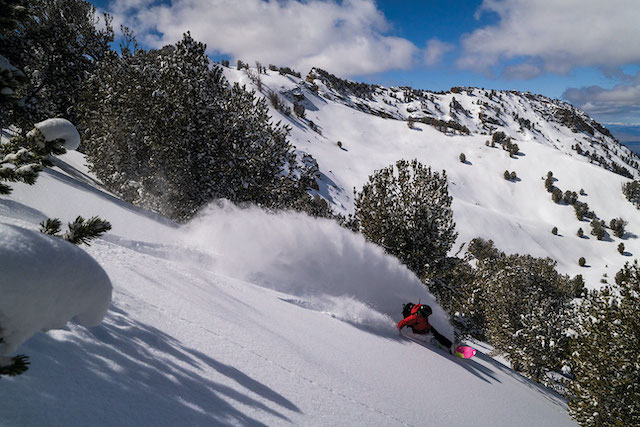
Ruby guide Mic makes a sweeping powder turn in Talbot Creek, photo by Matt Bansak
Coming from the San Francisco Bay Area, Ambrose didn’t know what to expect, but he was far from disappointed when he arrived for his first tour back in 2005.
“I had a vague impression that it was a rugged Western experience—kind of this Wild West cowboy town with these huge mountains,” he recalls. “It’s still part of the appeal for me to this day.”
For Mike, the first direct dose of joy comes on the drive back from the airport to the lodge, when guests see the massive peaks for the first time.
“One of my favorite things is you get people who come out with high expectations, and you blow them away,” he says. “You take that exit at Elko and head south and come over the Elko summit and get your first glimpse of the Ruby Mountains that come towering straight out of the desert floor. It’s a majestic, magical feeling that they bring.”
For guests who have heli-skied elsewhere, in mountain ranges of greater acclaim and publicity, that initial feeling of magic continues during inclement days that would normally relegate skiers to the hot tub or bar.
Unlike most other operators who anchor the success of an entire weekend trip to the viability of their aircraft, which remains grounded during a storm or heavy winds, Ruby Mountain Heli has a reliable and beloved backup.
“Weather won’t get you down at Ruby,” their promotional material promises. “It will get you in the back of one of our Pisten Bully snowcats and to the top of our snowcat skiing terrain in Conrad Creek starting at 10,000 feet.”

A group traverses along a ridge preparing to ski on the east side of the Ruby Mountains, photo by Matt Bansak
The cats, which are based at the lodge, pick up guests directly outside the ski room door, providing safe and warm passage even in the middle of a storm.
“The people who are into this have made the rounds,” Bailey says. “They’ve been to Canada and Alaska. Up there, if it’s not flyable, you’re left sitting. They come down here like, ‘Wow, this is something else.’”
“It’s an underrated aspect,” Ambrose agrees. “If you’re in the cat, it usually means it’s snowing really hard—some of the deepest days I’ve ever had is the cat terrain at Ruby.”
Mike puts it simply: “You’re guaranteed to go skiing.”
That has proven true for Ambrose. In his 20 years as a guest of Ruby Mountain Heli, he has skied every single day but one, when a brutal storm brought hurricane winds and rain at 10,000 feet.
“There’s sort of this miraculous way the weather works out and the guides find the snow,” he says. “I think there was only one tour where we were in the cats all three days—we’ve always gotten at least one day in the helicopter. It’s been remarkably consistent.”

Francy Royer and son Mike in the high alpine of the Ruby Mountains in the late 1990s, courtesy photo
Ruby Mountain Calling
Consistency is one of the pillars of the Royer family business model. Not only does it bring guests back year after year, accompanied by an ever-expanding coterie of friends and family, but it also brought Mike back from college in Utah, where the recent graduate was contemplating the arc of his life.
“They never pushed me to take over the business,” Mike says of his parents. “They wanted me to go out and experience the world and go to school, and that’s what I did.”
What he found at school—first in Montana, then in Utah—was the awareness that, when you live at the base of the Ruby Mountains, there’s no place like home.
“I didn’t realize what a unique opportunity this was until I left and went to school,” Mike says. “I came to understand what a special place this is, and I knew I wanted to come back. I loved growing up in the business and I gained a good appreciation for what my parents have done here.”
While he had spent his early childhood in the kitchen with his mother, Mike spent his later childhood alongside his father, learning the mountain and the business. The combined influence of his parents—hospitality and operations—has equipped Mike to lead Ruby Mountain Heli into its 50th season and beyond.
“I’m getting on in my years, and Mike has a very similar passion that both Francy and I have,” Joe says. “He runs everything: the ski business, the lodge, the food and beverage—he does it all. He’s very talented.”
Joe pauses to holler at one of his dogs, pulls the phone away to check the cell connection, then asks where he left off—praising Mike, he is reminded.
“He’s one of a kind. Anybody who knows him would tell you that,” Joe continues. “To have my family involved—I’m very proud of it. The whole family is.”
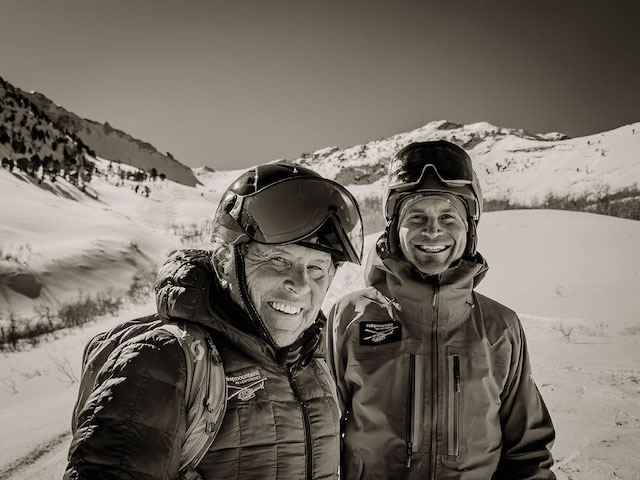
Father and son Joe and Mike Royer on a magical day in February 2025, courtesy photo
In the wholesome and heartwarming competition for who lavishes the highest praise on both their son and family business, there are no clear winners, although Francy makes a compelling case.
“I’m extremely proud of my son, who is extraordinary,” she says. “He’s very professional and even-keeled, and he’s not doing anything unless he does it 100 percent. He’ll never throw in the towel.”
“It was great to have two different visions that came together,” she adds, reflecting on the business model she and Joe developed nearly 50 years ago. “Now, with Michael as the third, we all bring something to the table that is very special.”
As an only child, Mike is no stranger to the affirmation— “They’ve always been my biggest fans,” he says—but he knows it’s rooted less in obligatory parental pride and more in the successful partnership they’ve forged as both family and colleagues.
“It’s a very cool relationship. Not a lot of families could work as well as we do,” he says. “I’ve learned a lot from my folks in watching them over the years, in the business and in their personal life. We’re very fortunate to be in such an incredible place and make a living doing what we love.”
‘Still Pinching Ourselves’
Inhospitable as they may seem, the Ruby Mountains that first appeared to him through the window at 80 miles per hour have revealed themselves to Joe. Never in its entirety, for no range can be fully understood in one lifetime, but in angles and by degrees, rewarding the close attention of the observer. Joe has given the mountains his close attention, and in return they have given him a life he never imagined.
“I was a skier and a bit of an entrepreneur and incredibly lucky,” Joe says. “I didn’t know how to do anything else.”
As a trained pastry chef with a thriving career, Francy did know how to do something else, but she traded it all in for a vision she first witnessed decades ago, and has been following ever since.
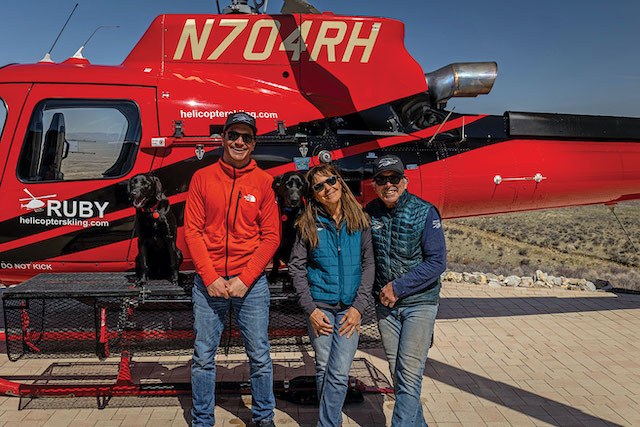
The Royer family, from left: Mike, Francy and Joe, along with Cast and Maze the black Labs, courtesy photo
“We’re still pinching ourselves,” she says, finding time to share one final reflection before rushing off to the 50th birthday party of their longtime guest. “I’ve had occasions where I’ve taught women how to ski powder and we’ve had our last run in the sunshine laughing so hard we couldn’t stand up. You have those moments that are etched in your memory. There are so many of those.”
Nowadays, Francy says, she only gets in the helicopter two or three times a year, but the love she has for the Ruby Mountains runs deeper than business or sport.
“We’re very respectful of this mountain range and what it has provided for us,” she says. “I don’t ski a lot anymore, but I’m just as happy strapping my skins on with my two black Lab dogs walking up the hill, looking around and feeling the sun on my face. I enjoy that more these days.”
As a young college graduate with supportive and successful parents, Mike had other options, too, but leaving the Ruby Mountains was not something he could abide long term. On the phone, he rattles off the million tasks between the end of the year and the official start of the new season. Inventorying, training, forecasting, ongoing lodge and machine maintenance, making time for a reporter. Despite having a hand in every chore, Mike sounds unfazed, something he learned from watching his father.
“People call him the grandfather of heli-skiing,” Mike says. “He’s been at it for almost his entire life. He’s seen so much. It’s such an incredible value to have his presence.”

The Rubies tower over the surrounding high desert of Nevada, photo by Matt Bansak
The way Mike talks about Joe is the same way the guides talk about Mike, whose steady leadership contributes to the deep sense of familial unity.
“There’s no outside people,” says Bailey, fresh off a run. “We do everything from plowing the road to parking the car to running our own forecast center, to tuning, waxing and repairing skis. Whatever needs to be done.
“It’s more like working on a ranch than a ski resort,” he adds, and he has the experience of working both. “It’s hard to explain. To be a part of a family operation in close quarters and everyone has each other’s back. Mike’s out there plowing roads the same as us. Everyone is doing their part.”
For those seeking the ultimate prize of ski touring—helicopter access to some of the most pristine and inaccessible runs available—the options are many. The obvious choice for some will be the vast wilderness and towering peaks of Alaska. Others may enjoy the tourist towns where there are as many wine bars as ski lifts. But there are adventurers left who understand that enchantment still exists in the quiet corners of the contiguous United States, some unheralded dusting of magic rising from the desert floor of the Great Basin, beckoning those who might understand to come and see.
Michael Rohm is a writer and musician based in Portland, Oregon. He dreams of one day spotting the elusive Himalayan snowcock in the Ruby Mountains.
No Comments