



27 Nov Broadcasting From the Shadows
Back when radio ruled, a teen with dreams of becoming a DJ secretly helped operate a South Lake Tahoe station
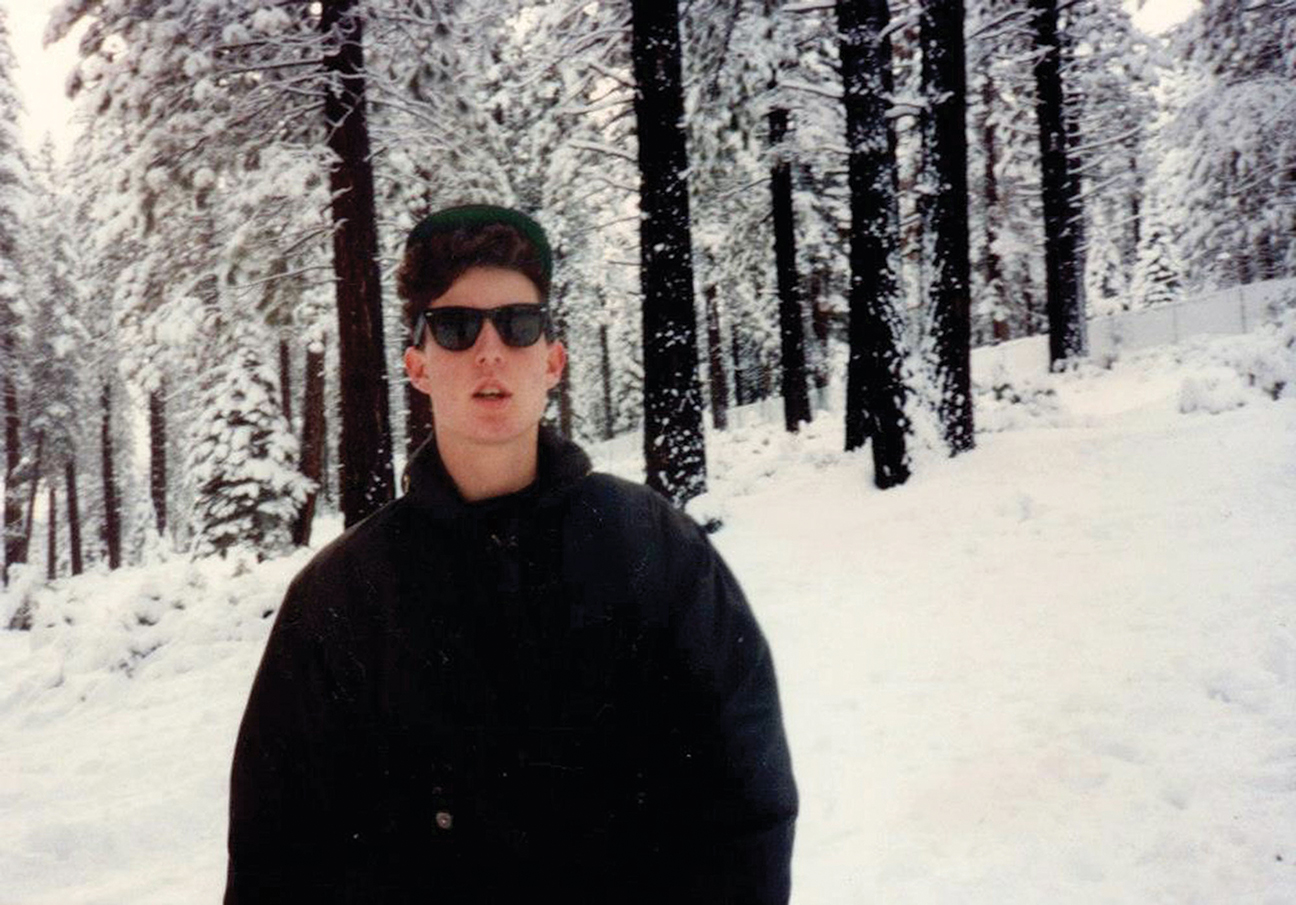
In 1988, I wasn’t just a 16-year-old kid with a constellation of acne mapping my face. On weekends, I had another life.
From midnight until 6 a.m., I helped run KTHO, a Lake Tahoe radio station near El Dorado Beach, while the disc jockey sometimes slept in the engineer’s office. Before long, I was handling the board, running commercials, switching between programs and keeping the music library in order. When it was time for a live break, I opened the microphone and gave listeners around South Lake Tahoe the time, weather and station identification.
Management had no idea a teenager was even in the building.
Stealth Missions to Charlie
Getting there was part of the adventure.
On Friday nights, I would slip out of the house dressed in dark clothes and catch the 11:30 bus on Highway 89. My mother eventually figured out what I was doing because she was no fool. She didn’t exactly approve, but at least she knew where I was.
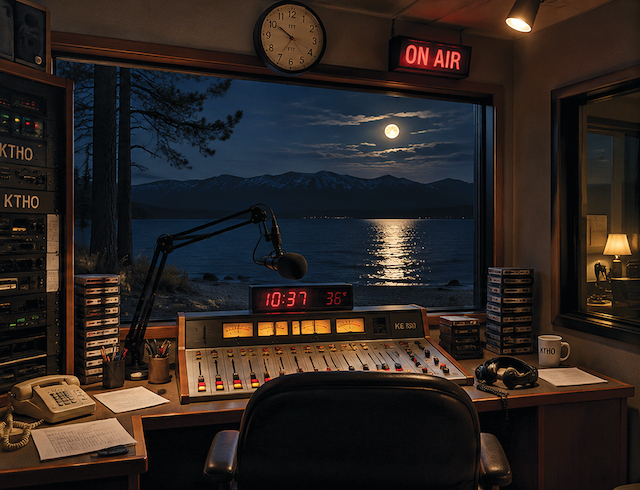
An AI-assisted image of the KTHO broadcast studio in
South Lake Tahoe, photo reconstruction by Matthew Roberts
At that hour there were rarely many passengers on the bus, and the ride seemed to take forever. For most of the trip, you couldn’t see the lake. Then, as the bus approached El Dorado Beach, Tahoe finally came into view. I loved that moment.
Waiting for me at the station was Charlie Foxx, though that was not his real name.
Charlie wasn’t much older than me. He was wiry, with long black hair and wire-framed glasses, and looked more like an ’80s metalhead than the person you might imagine after hearing him on the radio. He had the kind of look that made me think he probably played Dungeons & Dragons.
Then he opened the microphone. Charlie sounded like he had been broadcasting for 20 years. His voice was deep, smooth and polished. It didn’t match the guy at all, and I loved that about him.
Maybe that was one reason we connected, as my voice had dropped so low that I sounded considerably older than the pimply teen I was.
Charlie usually had coffee going by the time I arrived, and we drank a lot of it. The overnight shift was not six straight hours of spinning records. Much of Charlie’s job involved switching between the Larry King Show and network news, then coming in with the time, weather and station ID. From about 4 a.m. until 6, it became more like a traditional radio shift with music and local commercials.
Learning the Radio Craft
At first, I watched everything he did. Then came the questions, and there were plenty of them. Charlie answered every one.
He showed me how the board worked, where everything was kept and what had to happen at the top of the hour. Radio had a rhythm to it. Mess up that rhythm, and everybody listening knew something had gone wrong.
As I earned his trust, Charlie started letting me do things myself. Within a couple of weeks, I could run the board. That’s when things really got interesting.
My fascination with radio had started years earlier in Phoenix. When I was little, my mother called a local rock station so I could request a song. The disc jockey heard a kid on the phone and put me on the air. Hearing my own voice come through the radio was magic.
Years later, I had my own tiny station in my bedroom, although calling it a radio station is generous. I had two cassette decks, a turntable, a Radio Shack mixer, a cheap microphone and a small transmitter. The signal might have reached a block. Maybe. Anybody who wanted to listen would have needed to know exactly where to find me on the dial, and there was a very good chance nobody was listening anyway.
But I took it seriously. I listened to radio stations, wrote down public service announcements and recorded my own versions onto cassette so I could play them during my broadcasts. Apparently, even a radio station with no listeners had public service obligations.
Another Tahoe broadcaster who encouraged me was Bill Kingman. At the time, Bill was working for KRLT and KOWL, which operated out of the same building. He built the little transmitter I used at home.
The stations sometimes gave me boxes of 45s they were getting rid of, and I hauled those records home however I could, sometimes on my bike and sometimes carrying them. Those were some walks. Boxes of records get heavy fast, but I didn’t care because there was gold buried in them. I never knew what I was going to find.
An Unlikely Mentor
By the time I started spending nights at KTHO, Charlie understood exactly how serious I was. We would sit in the production room next to the studio and make material for my little bedroom station. Commercials, sweepers, promos, teasers, station IDs, whatever we could come up with.
That meant something to me because Charlie wasn’t treating it like some cute hobby a kid had. If something sounded bad, it sounded bad. Do it again, he’d say. He treated me like someone learning radio.
KTHO quickly became my weekend sanctuary. There was always coffee, terrible DJ audition tapes to listen to and that unmistakable smell of an old radio station. Warm electronics and dusty equipment mixed with years of people sitting inches from the same microphones. Coffee, cigarettes, bad breath, whatever somebody had eaten before coming on shift.
It wasn’t glamorous, but to me the place was perfect.
The station’s music library was enormous, and at some point keeping it organized became my responsibility. Charlie got the credit, which didn’t bother me in the least. I was hanging around a real radio station and being trusted to do things most kids would never get to do. For the first time, I felt like I belonged somewhere.
As the weeks passed, Charlie became comfortable enough to leave me at the board while he handled production work elsewhere in the station. Eventually, he became comfortable enough to sleep. He would disappear into the engineer’s office and crash while I kept things moving.
‘Charlie, Wake Up’
Charlie was a heavy sleeper. That became important one night when I heard someone knocking at the station door.
I was sitting in the broadcast booth. Charlie was asleep, and whoever was outside kept knocking. To get to Charlie, I had to leave the booth and pass the same door where someone was standing on the other side. I moved as quickly and quietly as I could, hoping they wouldn’t hear me and realize somebody else was running around inside the station.
Once I made it to the engineer’s office, I was quietly frantic. Charlie was out cold. I grabbed his shoulder and shook him.
“Charlie, wake up. Somebody’s at the door.”
Barely a response. I shook him harder, then started lightly smacking his face, trying to wake him without making noise.
“Charlie, come on. Wake up.”
Another knock.
I shook him again and gave his cheek another smack.
“Charlie, wake the f**k up!”
Finally, his eyes opened.
He pulled himself together as best he could and went to answer the door while I stayed hidden in the dark engineer’s office, listening and wondering who had shown up in the middle of the night.
It turned out to be a DJ from an earlier shift who had forgotten his headphones. He grabbed them and left, never knowing I was there. Then Charlie and I went right back to what we had been doing, which shows how comfortable we had become.
Dead Air
Another night, we created our own problem when we decided to run over to Safeway for snacks. Our logic seemed perfectly sound. Larry King was on. We had time.
Then we got stuck behind a cashier who seemed to move slower every time we looked at the clock. Charlie and I started getting nervous as Larry got closer to a break. We needed to be back at KTHO.
When the network went to commercial, nothing was running on our end. Dead air.
When listening to radio, a few seconds of dead air feels long. Several minutes feels like the station has fallen off the face of the earth.
Knowing this well, Charlie and I were sweating bullets trying to get out of Safeway and back to the station. We finally made it and switched over to the news, but I’m pretty sure we broadcast eight or nine minutes of absolutely nothing.
Nobody called or came storming through the door, though. Somehow, once again, we got away with it.
The Perfect Song for the Moment
The best part of those nights came just before dawn.
From the broadcast booth, I could watch Lake Tahoe slowly emerge from the darkness. The mountains took shape first, followed by the water. Then the sun began cascading golden rays across the lake, turning the surface into something almost ethereal.
That was when I would cue up Here Comes the Sun by The Beatles, sitting behind the board as George Harrison sounded through the monitors and morning light spread across Lake Tahoe.
The station was quiet. Charlie might have been asleep in the engineer’s office, and South Lake Tahoe was just beginning to wake up. The song seemed perfect for the moment.
All these years later, that image remains burned into my memory.
Losing a Friend
Charlie and I carried on this way for more than a year. Then one weekend, I made a teenage decision I did not understand until later. I decided to hang out with my friends instead of going to the station.
There was nothing unusual about Charlie falling asleep that night. He had done it plenty of times before. The difference was that I wasn’t sitting behind the board to cover for him. The program director found Charlie asleep in the engineer’s office, and he was fired.
Charlie had no choice but to leave Tahoe and move back in with his parents in Placerville. I knew he had struggled with things in his life, and the radio job in Tahoe had meant something to him. It was a chance.
Not long after he moved back home, I called his parents’ house. His mother gave me the news. Charlie had died from an overdose.
I remember the shock of hearing it from her and the finality that came with it. Charlie was gone. There wouldn’t be another overnight shift, another pot of coffee, another terrible DJ demo tape or another chance for me to tell him what those nights had meant to me.
I had never really thanked him. That bothered me then, and it still bothers me now.
Charlie taught me how to run a radio board, but that may have been the least important thing he gave me. He took a 16-year-old kid seriously and trusted me with responsibilities nobody else would have.
During those nights behind the microphone, I began to find confidence in myself. For the first time, I felt pride in what I could do and found somewhere I genuinely belonged. I just never got the chance to tell him.
Eventually, I did work as a disc jockey at a radio station in Gardnerville, Nevada. Years later, when Internet broadcasting became possible, I ran a moderately successful show and had the chance to interview some famous people.
Radio stayed with me. So did Charlie.
Every once in a while I hear Here Comes the Sun, and I am back in that studio at 16, coffee nearby, warm equipment in front of me and Lake Tahoe glowing outside the window.
Charlie is asleep in the engineer’s office. And for a few hours in the middle of the night, the radio station is ours.
Matthew Roberts, an investigative journalist and editor, attended South Tahoe High School and lived on Tahoe’s South Shore until he was 19. He now lives in New Orleans.
No Comments