



27 Nov Reflections of a Legendary Day
Known for his even keel and lack of ego, longtime Tahoe resident Tom Day excelled on both sides of the lens during an esteemed career in professional skiing
The wind is blowing up Headwall Face, revealing the contours of the iconic Palisades Tahoe run. Snow swirls and settles on the nearby lift, which is closed for the season. It looks like the kind of scene Tom Day might film.
He thinks so, too, and takes out his camera. It’s just an iPhone, not the bulky RED he’s accustomed to carrying, and the skiers he’s with are not professional athletes, but his wife and two adult children. Headwall is a family favorite, and they’ve traversed over to enjoy one of Tahoe’s timeless descents.
“When the wind blows just right, it’s a beautiful face,” says Day, speaking by phone from his Tahoe home. “We took less than 10 minutes, and I filmed all three of them skiing down it.”
The two-minute edit of those descents is what most ski dads think their home videos look like, until they actually see the footage. Set to the crooning harmonies of a Crosby, Stills, Nash & Young song, Day’s footage shows in tight composition and slow motion the elegant turns of his family, one by one, as they flow down the face, the slate sky heavy above them. In his steady hands, the frame reveals the breathtaking valley below.
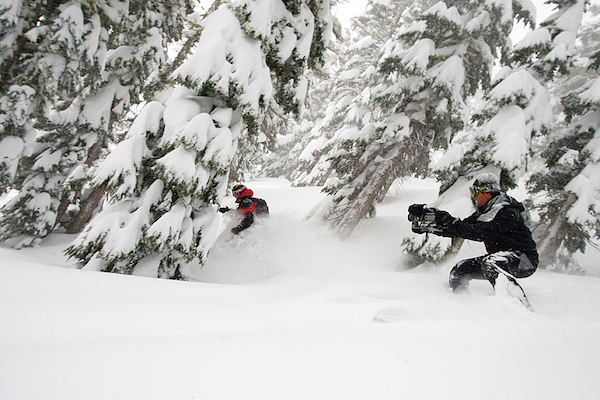
Tom Day follows Jonny Moseley through the trees during a Warren Miller shoot at Palisades Tahoe on February 17, 2009, photo by Keoki Flagg
It’s not a clip that will end up in a ski movie, but Day isn’t the type to pull out his camera only when there’s a paycheck on the other end.
“It’s seeing a moment and being able to switch gears and grab it,” he says.
Being able to switch gears has defined Day’s career, first as an athlete in front of the camera, and then as an artist behind it. He’s chased Arnold Schwarzenegger as a baddie on skis, filmed mountain action sequences for Hollywood movies like Molly’s Game and Vin Diesel’s XXX, and directed many of the most famous skiers in the world down many of the most famous mountains in the world.
He also builds and repairs decks, which is what he’s taking a break from on this pleasant fall day in Tahoe. He’s worried about missing this pocket of sunshine before the weather turns, he says, but he can spare a few minutes between nailing boards to talk about his storied career as one of the best—or at least most consistent—ski cinematographers of the last half century.
In coordinating this interview, over short text messages spanning several days, Day mentions being in the middle of a job and keeping an eye on the weather. Naturally, I assume he is deep in Alaska’s Chugach Mountains, where he’s worked before, or somewhere in the Swiss Alps, where he’s also worked.
When he mentions that the weather-dependent work is repairing a deck for a Tahoe friend, I’m surprised. By the end of our call, however, my surprise that a man like Day also works on decks turns into of course a man like Day also works on decks. He’s as solid as they come.
Formative Lessons
In writing about the history of snow sports, you learn about the bad boys, the ego trips, the burnouts and flameouts, the athletes whose talent is eclipsed only by their bad judgment, their bad luck or both. Daredevils with skill can get a spotlight for a season, but skill alone will not provide passage through a long career of injuries, budget cuts, cultural shifts and the fundamental facts of aging.
To make it in a ski community for 40-plus years, as Day has done in Tahoe, requires vision, character, humility and some unnamable quality, which is perhaps best defined as the willingness to pick up a hammer.
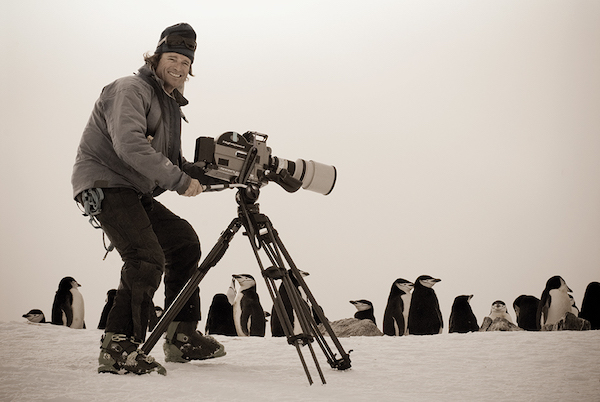
Tom Day films a chinstrap penguin rookery on the Antarctic Peninsula while on assignment for Warren Miller Entertainment in November 2009, photo by Keoki Flagg
Scot Schmidt, another enduring skiing icon who rose to fame in Tahoe, knows what it takes to make it for the long haul. Everything Day has, he says of his longtime friend and collaborator, is well-deserved.
“He was dedicated,” Schmidt says. “He would get the job done. You could count on him.”
Day learned his work ethic—and many of the skills that would come to define his career—from his father, a “hobby handyman around the house” and ski patroller at Bolton Valley Resort in Vermont, 30 minutes from their home in Montpelier. His dad was also an amateur photographer, and a young Day spent much of his childhood emulating the older man, either on skis or snapping pictures with his pocket Instamatic.
For Day, who grew up in the 1970s in Vermont, the American West loomed large. Day still remembers the formative magazine articles, the photo spreads, the ski films you could watch only in theaters. The modest slopes of the local family resort had never seemed so meager.
“It just looked awful nice,” Day recalls of those distant mountains. “East Coast skiing can be challenging in its conditions and terrain.”
True to character, Day sees only the value of learning to ski in adverse conditions—ice, narrow runs, dense stands of trees.
“The East Coast gives you such a solid foundation for skiing,” he says. “The conditions really make you use your edge. You have to be quick. It’s much tighter, more compact skiing.”
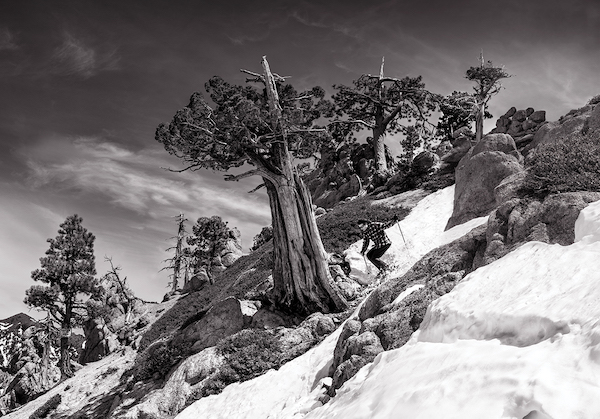
Tom Day skis the Rock Garden at Palisades Tahoe in April 2021, photo by Keoki Flagg
Schmidt, who learned the craft in his native Montana—a state that proves God must have a soft spot for perfect powder—can easily identify a skier from the other side of the Rockies.
“A lot of the East Coast skiers all ski the same to me,” he says. “They learned to ski anything and not fall.” He refers to it as “survival technique,” and noticed it in Day the first time they descended a peak together.
“His technique wasn’t very dynamic, but he was super solid. He was really consistent. I don’t remember him as a flashy skier, but you could take him anywhere.”
And anywhere was where Day wanted to be—anywhere but Vermont. When he was still a student at Champlain College in Burlington, Day and his father headed west on a short ski trip to Palisades Tahoe, then called Squaw Valley, where his brother Jon had settled during a one-year break from school.
Day couldn’t believe what he was seeing, and what he was skiing. “This is like Tuckerman Ravine with chairlifts,” he remembers thinking, referencing the legendary steep southeast face of Mount Washington in New Hampshire.
The memories of that trip loomed large in Day’s mind, and when he graduated in May, he returned to Tahoe City with all his belongings and a singular goal: to ski every day come winter.
Life in a Skier’s Paradise
Arriving in the early summer, Day had a few months to figure out the prerequisites of adult life before the ski lifts opened.
“I was going from a school routine to all of a sudden being in real life,” he says. “Get a job, pay expenses, be responsible.”
Tahoe in the 1980s was not an easy place to find lucrative work, he says. An ever-rising tide of ski bums were fighting for the same few low-paying jobs, and all he could get was work as a dishwasher at Victoria Station. They offered him $3 an hour. It was enough for rent, food and a season pass—priced back then at $475—but just barely.
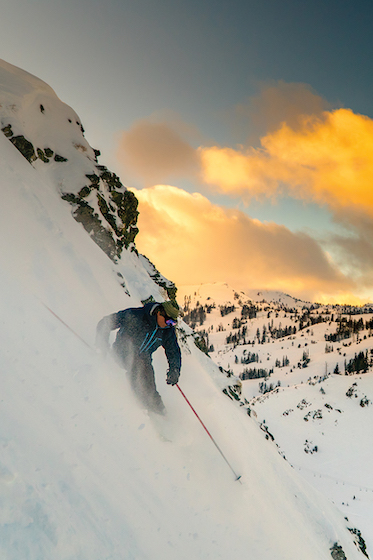
Tom Day skis Chute 75 at Palisades Tahoe, photo by Court Leve
It was important to Day that he buy the pass himself. Many of his peers worked for the ski resorts in exchange for lift tickets, but Day didn’t want his mountain access to depend on the whims of his employer. He felt more comfortable separating his business from his pleasure.
After a month in the kitchen, Day doubled his take-home by switching to property management at a condo development called Rocky Ridge in Tahoe City. He worked alone, checking repair items off a list each day, sharpening the skills he learned from his industrious father. A fall gig with an excavating crew bumped him up to $7 an hour, and then it was mid-November and the first real snow of the year.
Hearing Day describe the financial and practical minutiae of his first summer in Tahoe in 1982 is not unlike watching a squirrel gather acorns and bury them in the yard.
“Those first four months I got a bank account, got my housing squared away for the winter, and put money away so that I could eat and pay rent and utilities until summer,” he recalls. “When the ski lifts opened, I was ready to focus on skiing.”
He picked the right winter to do it: That 1982-83 season still ranks among the snowiest on record in Tahoe.
“This is why I wanted to be here,” Day remembers thinking. “I’d just turned 21. I couldn’t imagine anything better. I just thought that was average.”
Never one to abandon his pragmatism entirely, even during such an unpragmatic winter, he took a night job as a janitor, if only to keep his savings account hovering somewhere between concerning and catastrophic.
“It never crossed my mind to think long-term,” he says. “I skied all day and cleaned at night. At 20 you don’t have to look too far down the road when ski season has started. It’s just the next day.”
There was no shortage of twentysomethings with the same idea, and Day made friends quickly. “It was seamless,” he says, comparing that first winter in Tahoe to the sleepaway camp at Lake Fairlee in Vermont, Camp Billings, where he spent part of each summer as a boy.
One of those early friends was Schmidt, already well-known in the ski world for his racing prowess and freeskiing style. In 1982, he was still a few months away from beginning his global domination in freeskiing as a Warren Miller poster child, but even in those early days, he was seen as a man marked for success.
“I looked up to Scot before I knew him,” Day says. “He was such an impressive skier.”
That winter, the two collaborated briefly on a clothing catalog shoot for a Japanese brand—Schmidt because he was scouted by the marketing team, Day because he got off the right lift at the right time—and they connected over the experience almost as much as the $100 they earned for the day of shooting, which Day compared to “hitting the jackpot.”
“That’s where I really started skiing with Scot,” he says. “We started freeskiing that winter.”
Right Place, Right Time
Freeskiing, which in this context is loosely defined as anything that takes place beyond groomed runs and trails—often requiring a hike or, at minimum, a traverse from the nearest lift—has, technically speaking, existed as long as people have been strapping their feet into thin planks of wood and dropping down a mountain.
But our modern understanding of the discipline was shaped in the post-’60s disavowal of Cold War uniformity: clean-shaven young men carving tracks in the snow as predictable as their crew cuts. Freeskiing emphasized the word free, and freighted it with all the promises those four letters implied. No longer shackled to stopwatches, Eisenhower-era coaches and matching snowsuits, freeskiers devoted everything to style, originality and first descents of increasing brazenness, commensurate with the unfolding grandeur of the ever-expanding backcountry.
Few backcountries were as prime as the Sierra Nevada around Lake Tahoe, and few descents were as brazen as those accomplished by, among others, Schmidt, who would show across more than 40 films what could be done when a skier could match the environment.
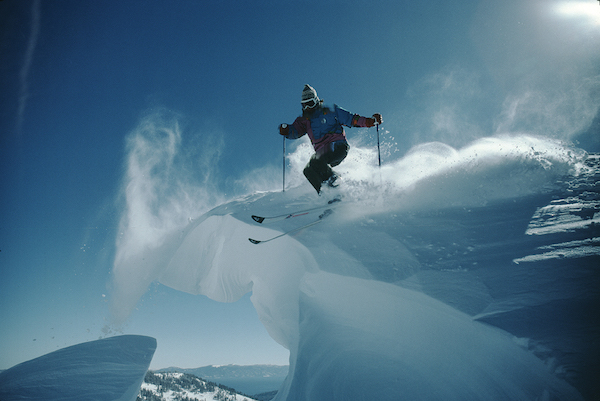
Day does some cornice dancing on Estelle Bowl at Alpine Meadows during a Skiing Extreme film shoot, photo by Eric Perlman Productions
That winter, he would star in his first Warren Miller film, released in 1983 with the name Ski Time, which would change the trajectory of athletes known and unknown, directly and indirectly.
Day remembers seeing that film in theaters, back when a Warren Miller production was the event of the year for a die-hard skier.
“Warren Miller was big,” Day says. “This was before VHS. You had to go to a theater to watch it.” There on the big screen, in the dark theater, were the people and places Day was building his life and identity around. “It was pretty cool to see people you knew and to recognize parts of the mountain,” he adds.
At the time, that’s all it was: celebrating a friend’s well-deserved recognition. Day couldn’t have guessed the result of Schmidt’s newfound fame.
By the ’80s, Miller wasn’t personally filming his ski movies anymore, and when he saw the footage of Schmidt, he wrote an effusive letter bordering on fan mail.
“He said the footage from Squaw was the most spectacular he’d ever seen,” Schmidt recalls. “In the letter, he added, ‘Choose your favorite skier and have him join us.’”
The decision was easy. When Schmidt had first met Day the year before, the raw talent was obvious. But there was something else, something more enduring than skill alone.
“I liked his demeanor,” Schmidt says. “He was quiet, humble and a good skier. He wasn’t a bad boy or a troublemaker like some of those other guys. Tom was solid.”
Schmidt wrote back to tell Miller he had the perfect skier in mind. “He was an obvious top pick. Great to travel with, good on his feet, not making bad decisions. I don’t know who else I would have considered at the time.”
It was only his second winter in Tahoe and Day was about to star in the very productions he’d admired since childhood.
“When I watched Warren Miller movies when I was young, I thought it was so cool to see people ski,” Day says in an interview on the Warren Miller website. “You could see little details that your eyes don’t catch when things happen normally. I think that’s why I wanted to ski in a Warren Miller movie. I wanted to see what my skiing looked like.”
Camera Calling
For a decade or so, Day kept up with Schmidt in front of the camera, at least to the extent possible, including the iconic scene in True Lies where Schwarzenegger is chased down Donner Summit by terrorists on skis. But a seed had been planted in Day’s mind from his first starring role, when Warren Miller cinematographer Fletcher Manley filmed their segment entirely by himself.
“The first day that Fletcher Manley filmed Scot and me, I had no idea what was going to happen,” Day recalls. When he saw that it was one man with a backpack, he remembers thinking, “Wow, one guy can do all this?”
Everything he watched Manley do, he’d already done some version of himself: lug a camera into the backcountry, shoot film and ski. “The only thing that was different was the camera was a little bigger and he had a tripod,” Day says.
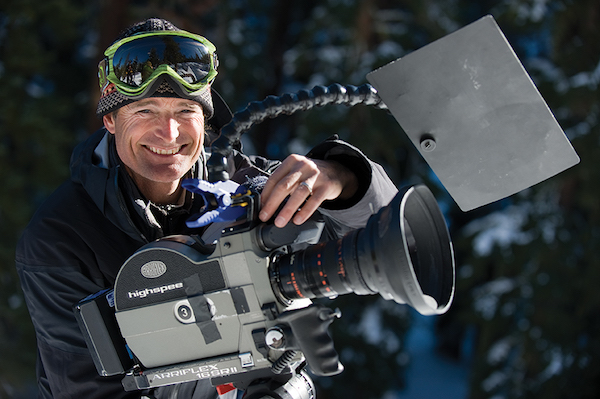
Tom Day on assignment for Warren Miller Entertainment in January 2009, photo by Keoki Flagg
With each subsequent shoot, Day paid as much attention to what was happening behind the camera as he did to his own role in front of it.
“The cameramen recognized my love for photography, and they taught me as I was skiing for them,” Day says. “They let me change their roll of film, and gave me a hands-on feel of how a camera operated. They let me take the camera and shoot establishing shots. They were so good at teaching me. If not for that, there’s no way I would have had the opportunity.”
The ability to ski and shoot, he adds, placed him in a rarefied community. “When I first started, there were not a lot of cameramen filming skiing. You had to be a good skier to carry your camera pack. That made the pool to pick from pretty small.”
Combined with his growing interest in filming, Day recognized, too, the challenge of maintaining a career as a film star. He wasn’t Scot Schmidt, and even Schmidt had a growing crop of young competitors to contend with.
“I knew that unless I got into teaching or guiding, my ski career was going to be short-lived,” Day admits. “Every shoot I was on, I was watching the cameramen. They were busy all day long. I always liked being busy, so I gravitated to what they were doing.”
Schmidt saw the wisdom in Day’s decision to step out of the limelight. “You get to a point where you realize you’ve got to make some choices,” he says. “I think it was a good move for him. Unless you’re picking up tons of endorsement deals, you have to do something. A lot of the best skiers became cameramen.”
Consummate Professional
For the next 40-plus years, Day traveled the world with film crews. But not before cutting his teeth locally.
In fact, it was Tahoe-based filmmaker Eric Perlman who gave him his first opportunity, hiring Day to help document some of the most daring freeskiers of the era for his Skiing Extreme series in 1988.
“Eric really gave me the green light right when I was transitioning from a skier to a cameraman,” Day says. “That was a big transition for me, and a great opportunity for me to learn.”
Perlman also connected Day with Tahoe-based snowboarder and filmmaker Mike Hatchett of Standard Films. After the two hit it off during a shoot on Donner Summit, Hatchett brought Day on board to film Standard’s iconic Totally Board (TB) series.
“We collaborated really nicely and both enjoyed it very much,” Day recalls of that day in the early ’90s. “Then Mike came to me a few months later and said he was going to start making snowboard films and asked me to help. … TB2 was the first film I worked on, and then I ended up working for Mike for 10 years. It was a really good time in my career, that’s for sure.”
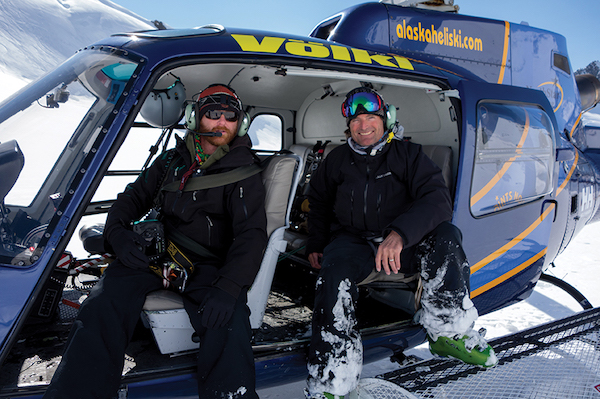
Tom Day, right, with friend and fellow photographer Court Leve, photo courtesy Court Leve
With valuable experience under his belt, including a stint with Steve Winter of Real Adventure Films, which would later become Matchstick Productions, Day was hired by Warren Miller on a part-time basis around 2001. By 2003 he was the director of photography.
Every winter from December to May, he found himself setting up shots in exotic locales in nearly all the major ski destinations for nearly all the major ski stars. His own reputation as a talented freeskier gave Day a directorial gravitas, and he built rapport with the athletes.
Court Leve, originally from Missouri, was trading photography and marketing services for room and board with Points North Heli-Adventures in Alaska’s Chugach Mountains when he met Day on a shoot. Leve accompanied the team, and quickly ingratiated himself with the crew.
“Warren Miller saw my work and needed a photographer,” Leve says. Living as a “vagrant”—his words—made him an easy hire. “We don’t need to buy him a plane ticket or lodging,” Leve says of their logic. “It was an easy situation.”
It was there in Alaska that he saw exactly how Day garnered so much respect from the cast and crew. It wasn’t through words or emotions—Day is famously humble—but through his actions as a fearless skier and gracious collaborator.
“There’s a joke,” Leve says. “Tom Day: best skier on the mountain. I don’t know many people who can keep up with him for an entire day of skiing. He has a lot of street cred.”
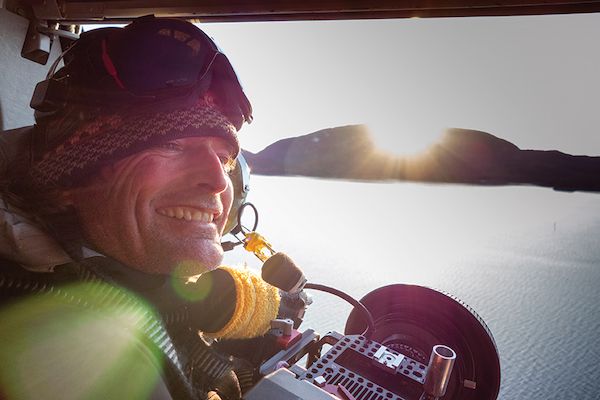
Tom Day in a helicopter heading home from a day of shooting over Prince William Sound in Alaska for Warren Miller Entertainment, photo by Court Leve
Leve identified himself as the weak link in the operation in Alaska, but insists that Day never lost patience with him or with anyone. The only time Leve noticed a hint of emotion was a brief moment when Day was struggling to load film, and may or may not have muttered the word “dammit” under his breath.
“He was super even-keeled,” Leve says. “He has zero ego. If I said, ‘Hey, look at this,’ he’d say, ‘Let’s check it out.’ We would bounce ideas off each other—we were in tune.”
Leve continues to carry those lessons with him.
“I learned so much from him,” he says. “How to work with people, how to manage time, how to manage clients. What a great crash course to learn from one of the best in the industry.”
Day admits that one of his greatest joys as a director is inviting opinions from anyone involved with the shoot.
“I like bringing everyone in,” he says. “It was my job to make sure something came back, but during the process, I really tried to keep everyone involved as much as possible. I thrived on ideas from the crew, whether it was a skier or an assistant cameraman.”
The least likely, but most rewarding, source of ideas came from Day’s own son, Danny, who learned the family trade on Warren Miller shoots in Europe.
“My parents figured the best way to still be together was to go with him; otherwise, he’d be away from home for weeks, a month at a time,” Danny says. “It was a nice way to see different parts of the world.”
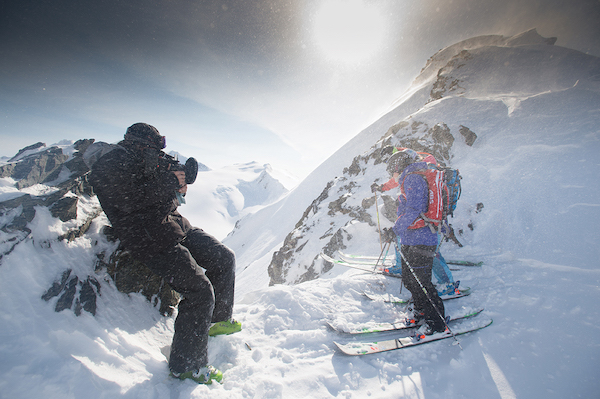
Tom Day on a shoot with Ingrid Backstrom, Jess McMillan and Chris Anthony for Warren Miller Entertainment, photo by Court Leve
Seeing different parts of the world transitioned into learning his father’s trade firsthand, first as an informal, unpaid assistant, before gradually assuming more responsibility as he got older. Once a paycheck was involved, his father told him: “If you want to still keep working for me, that’d be great, but you have to step up your game.” He did.
Working with his father soon led to jobs elsewhere, including on the National Geographic show Life Below Zero, where Danny climbed the ranks on his way to becoming director of photography. When a crew member dropped out last minute, the show’s executives asked Danny for a recommendation. His father was the obvious choice, but he remembers telling them, “He’s overqualified to be my assistant.”
A producer reached out to Day. “Tom, I know you have a lot of experience as a cameraman,” Day recalls. “I have to ask: Are you able to take directions from your son?”
The answer, Day says, was a very easy “yes,” and in 2021, father and son won an Emmy for their work on the show.
“It’s pretty cool how lucky I was to learn the film skills from my dad and be able to spend that much time with him to mix work and good, quality father-son time,” Danny says. “Combining the work we love with our favorite sport is the perfect combo. He brought me into that world pretty seamlessly. He was a great mentor.”
End of an Era
Every year since the early ’80s, Day has been an essential part of a Warren Miller production. That historic streak just came to an end: The company has hired all new cameramen, producers and editors.
“I get it,” Day says. “If you want change, the first thing you do is change up your cameraman. I was thankful they kept me going for as long as they did. I felt at any given moment they could send me out to pasture.”
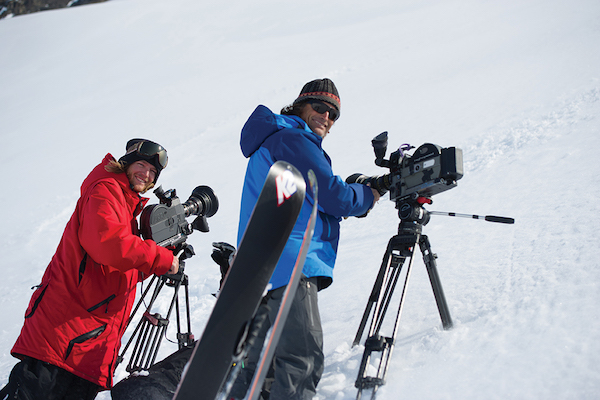
Tom Day and his son Danny on location with Warren Miller and Points North Heli-Adventures deep in the Chugach Mountains while working on Flow State in 2012. The father and son were shooting a segment with Travis Ganong and Mitch Tölderer, photo by Court Leve
Day admits he wasn’t quite ready to go, but also appreciates the chance to slow down after 40-plus high-octane winters traveling the world. “It was a lot of pressure for all those years, and the pressure kept adding up because you wanted it to be better than anything you’ve done before.”
That doesn’t mean he’s done working. He recently wrapped a shoot for a Michelob Light Super Bowl commercial, and it’s those shorter jobs he prefers now, a few days in and out. More time at home. More time on the slopes.
“For so many years, I walked that fine line of being totally content skiing, or totally content filming,” he says. “There’s nothing that thrills me more than skiing every day, and not having to do something else.”
Day has skied on all seven continents, but today he’s just as likely to be cruising down Headwall with his family.
“We ski together quite a bit here at Palisades,” Danny says. “A lot of times we don’t even plan to ski together. ‘Oh, there’s my dad over there,’ then we’ll split ways, then reconvene. You just know you’ll run into each other during the day.”
It’s a fitting scene: not on a podium or a poster, but on a hill he knows by heart, with the people he knows best. Tom Day, in the right spot at the right time, the light beautiful, the frame perfect, even if there’s no camera present. It’s all a movie.
Michael Rohm is a freelance writer based in Portland, Oregon. Sadly, his frequent reporting on skiers has done nothing to improve his own skills on the slopes.
No Comments