



27 Nov The Enduring Legacy of a Sierra Treasure
Founded in 1946 with a single rope tow and a welcoming vibe, Sierra-at-Tahoe retains its friendly charm 80 years later
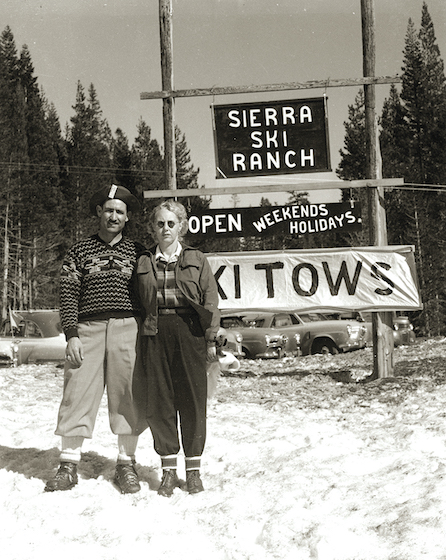
A couple poses for a photo in the early days of Sierra Ski Ranch, photo courtesy Sierra-at-Tahoe
It’s fun to imagine what an après-ski tailgate at Sierra-at-Tahoe would be like if all the South Shore ski area’s generations could somehow attend.
There’d be the knit-sweater-wearing originals with their leather boots and wood skis rolling up in prewar Plymouths chopping it up with the freewheeling longhairs of the 1960s and ’70s, decked out in their equally perilous skinny skis and jeans. Early wild-style snowboarders of the ’80s and ’90s would be there, too, mingling with the tall-tee-sporting jibbers of the 2000s and fat-skied powder hounds of the 2010s and beyond. Heck, maybe even the leashed tiger that made the rounds at one of Sierra Ski Ranch’s annual winter carnivals in the ’80s would make an appearance.
It’s likely everyone would be in awe of the world-class talent the resort has produced and the snow-loving community it has fostered over the decades.
“I could always go, and I could always meet up with people that I enjoyed being with,” says Shingle Springs resident and author Chris Couper, who published a detailed history of the resort, From Ranch to Resort: The History of Sierra at Tahoe, in 2021.
“I just like the way it became a fun family resort,” says Placerville native and longtime Sierra skier Sue Perpall. “It’s pretty low-key and casual, I guess you can say.” So casual, Perpall notes, that some of those not-quite-current ski fashions of eras past (think jeans and gaiters) still make unironic appearances on the slopes.
Sierra-at-Tahoe celebrates its 80th anniversary during the 2026-27 season. Now spanning 2,000 acres, the ski area is largely unrecognizable from the original Sierra Ski Ranch, which started as a single rope tow just west of the resort’s current location. Its reputation as a welcoming, family-friendly spot that can get buried in some of the deepest snow in the Sierra remains intact.
“Word soon got out about how friendly the area was,” Couper writes of the formative days at Sierra Ski Ranch in From Ranch to Resort. “One of the earliest experiences was a lodge with a huge fireplace where everyone could gather on stormy days or at the end of the day to share their stories. You were a part of a family because you were all sharing.”
A Pioneering Spirit
Although the Sprock family would become synonymous with Sierra Ski Ranch’s history and lead the ski area’s development through the resort boom of the ’50s, ’60s and ’70s, West Virginia native Ray Barrett had the initial vision for an Echo Summit resort that would eventually become Sierra-at-Tahoe.
Born in 1916, Barrett settled in Sacramento in the 1940s and attended Sacramento City College, where he became active in the college’s ski club. He took regular trips to the mountains, including one to the recently opened Sugar Bowl Resort on Donner Summit, where he met his wife, Jenis, according to From Ranch to Resort.
“Ray was so enamored with the ski environment that he thought it would be a good idea to open a small, weekend only ski hill on the highway to Lake Tahoe, US 50,” Couper writes. “He found a little open area by the side of the highway and believed it would be the perfect location for a winter sports area.”
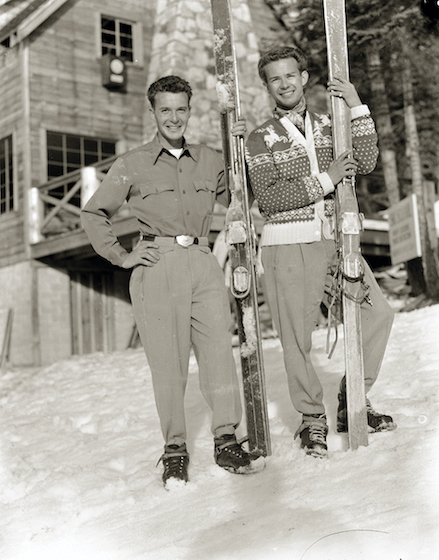
Wooden skis and sweaters ruled in the earliest years of the resort, photo courtesy Sierra-at-Tahoe
After contacting the U.S. Forest Service about requirements to establish an 80-acre ski area, he enlisted the help of his brother Floyd, Floyd’s wife Audrey and some collegiate ski enthusiasts to launch the project.
“Preparations for a ski-run and tow have already begun in the Lake Tahoe area, 5 miles above Strawberry Lodge at the 42 mile store,” stated a November 1, 1946, announcement in the Pony Express, a weekly Sacramento City College magazine. “Last Sunday five of the more zealous ski fans journeyed to this point where with much flourishing of axes, etc. a space was cleared for the 1,000 foot run.”
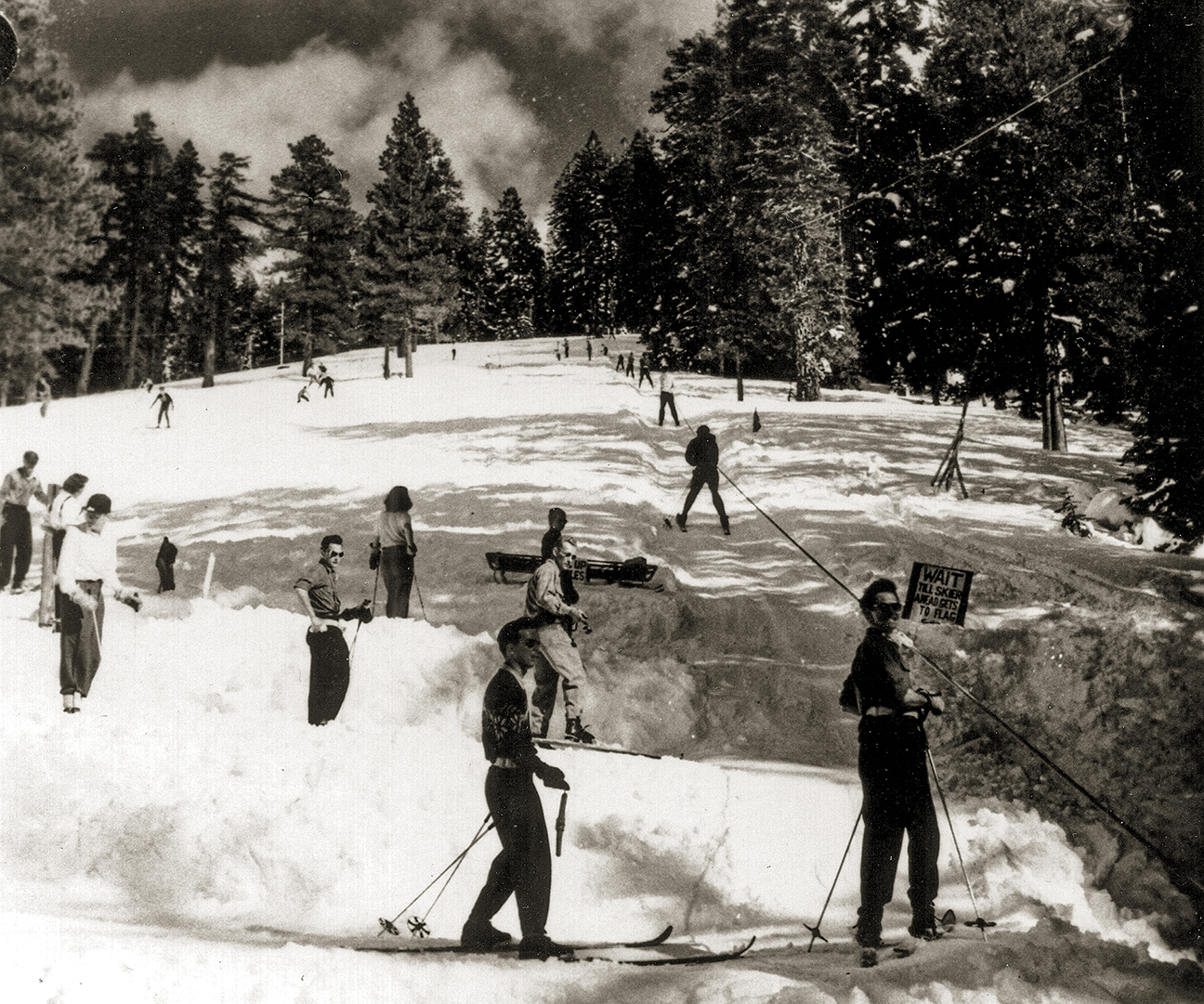
About two months later, on December 21, 1946, Sierra Ski Ranch officially opened to skiers. It wasn’t much more than a small coffee shop fashioned from surplus trucks and a rope tow that modern skiers may look right past, but it offered more than a few thrills for its time.
“It was just over 750 feet long and used a combination of living trees and poles to house the pulleys for the tow with a power box at the bottom,” Couper writes. “It ascended about 160 vertical feet up the hill and gave skiers a brief but exhilarating ride down to the coffee shop area where they could take the lift up again and again.”
In no small part due to its proximity to Sacramento, the area proved to be a popular draw, with skiers parking haphazardly along the highway to get their turns. The Barretts rapidly expanded the resort, opening a 30-by-50-foot lodge using trees felled on-site and adding additional rope tows by the 1948-49 season.
Homesteading a ski area in the Sierra Nevada proved to be no easy feat, especially when it came to managing the dozens of feet of snow that piles up along the Sierra Crest, Couper says. Echo Summit still holds the official California 24-hour snowfall record of 67 inches received between January 4 and 5, 1982.
Floyd and Audrey Barrett used a 1915 Ford Model T to commute to the resort from their home 6 miles away, and the often-punishing environment was among the couple’s considerations in selling the resort to Vern Sprock in 1953.
Ray Barrett and, subsequently, Vern Sprock, were among the first wave of American ski area entrepreneurs to find they had only scratched the surface of alpine skiing interest in California.
“Editors of Ski Magazine proclaimed that ‘the socioeconomic force of the leisure boom in the 1950s changed American skiing in less than a decade from a slightly eccentric preoccupation of a few thousand people to a mass participation sport with the number of participants exceeding a half million,’ and this is reflected in postwar Sierra Nevada ski area development,” writes Connor Villines in The California Ski Boom: Tourism, Urban Growth, Environmentalism, and Social Diversity in Sierra Nevada Ski Areas, 1960-1980.
Sprock, along with his wife Bobbie and kids Kathy and Peter, fed the appetite for Northern California skiing at Sierra Ski Ranch with 40 years of ambition and dedication. Even at the start of his run at the helm, Sprock knew four rope tows were not going to be enough to hold the attention of skiing’s rapidly growing audience.
“At this time the Edelweiss Resort, just west of Sierra Ski Ranch, was probably moving into its prime,” Couper writes. “Also growing was Nebelhorn area on the crest of Echo Summit in addition to numerous little pop-up rope tows scattered about the Echo Summit area. To make matters worse, the small South Lake Tahoe Bijou Skiway (later Heavenly Valley) ski area was starting to attract interest.”
New Access, New Amenities
Born in 1921, Sprock developed a lifelong passion for the mountains, operating Tamarack Pines Lodge near Echo Summit before buying Sierra Ski Ranch.
“My father was a farmer and he thought I was crazy going to the mountains,” Sprock is quoted as saying in Robert Frohlich’s Mountain Dreamers: Visionaries of Sierra Nevada Skiing. “To me, the high country was big and wild. It was an interesting lifestyle.”
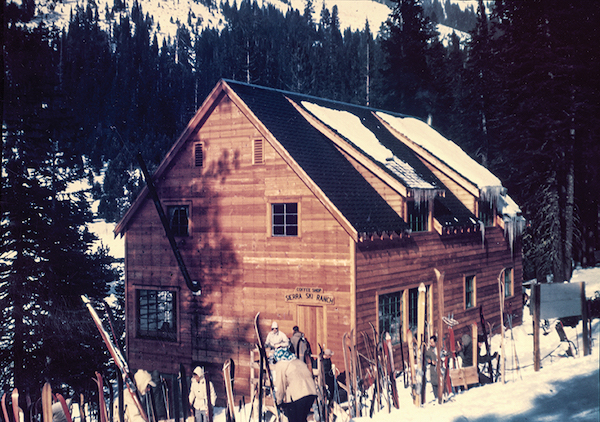
Sierra Ski Ranch’s original rustic lodge, photo courtesy Sierra-at-Tahoe
After purchasing Sierra Ski Ranch, the first big project was creating a parking lot to ease congestion along the highway and aid access for skiers. The Sprocks also quickly expanded on-hill offerings, installing two new Poma lifts before receiving news that their vision for the area may need to change.
In the late 1950s, the California Division of Highways informed Sprock it was planning to realign U.S. Highway 50 over Echo Summit to accommodate increasing traffic to Lake Tahoe and mitigate avalanche danger on the existing route. The new alignment would have sent the highway directly through Sierra Ski Ranch’s lodge and parking lot. Sprock took the potential catastrophe as an opportunity to find a new home for the resort. He found it in the cascading slopes of the nearby 8,852-foot Huckleberry Mountain.
The U.S. Forest Service approved a master plan for the new Sierra Ski Ranch in 1966, and the reimagined area opened in December 1968. The ski ranch now included parking for 400 cars and a 10,000-square-foot lodge, as well as a rope tow and Poma lift from the original location and something those familiar with the resort today may recognize—the Nob Hill chairlift. The 3,600-foot-long two-person chairlift rose 845 feet and added advanced and expert terrain, opening new experiences for skiers.
Additional lifts soon followed. Beginner and intermediate access via Rock Garden arrived in 1970. The true start of the modern on-hill experience arrived with the opening of the Tahoe Queen chairlift in 1972. One of the first chairlifts installed by Sikorsky Skycrane helicopter in the U.S., the Tahoe Queen took skiers to the top of Huckleberry Mountain, near where Grandview Express unloads today, Couper says.
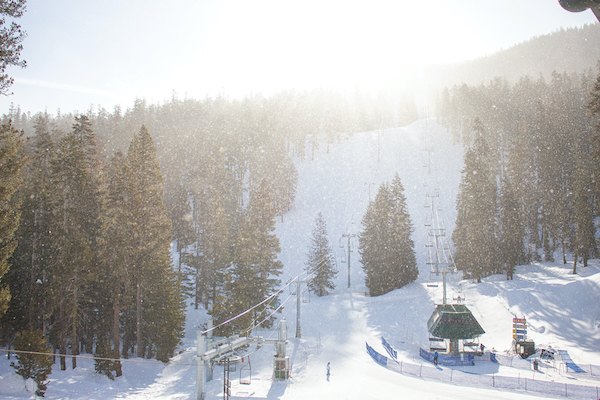
Sierra-at-Tahoe is now one of the larger resorts in the Tahoe area, with about 2,000 skiable acres, photo courtesy Sierra-at-Tahoe
“The lift opened up an enormous amount of new terrain that Vern had envisioned when he first started exploring and skiing the area back in the 1950s,” says Couper. “There were runs for all levels of skiers and exceptionally fantastic powder runs for experts, but also the longest run in the resort, the new Sugar n’ Spice, for novice skiers at almost 2 and a half miles in length.”
Lifts on the backside of the mountain opened an additional 250 acres in 1980, and West Bowl incorporated another 600 acres in 1982. By the early 1990s, the Sprocks had turned a small lodge and four rope tows into a destination including nine chairlifts, three dining areas, two lodges, state-of-the-art snow grooming, a ski school, shops and a medical clinic.
“At this point, the Sierra Ski Ranch team, driven by the vision of Vern and the execution of Bobbie, Kathy and Peter, along with hundreds of employees, had created one of the finest and most loved winter resorts in the Tahoe basin,” Couper writes. “They had executed about everything Vern and the USFS had planned for in the 1966 expansion plans. The ski area now occupied approximately 2,000 acres with 310 acres on 37 developed trails.”
Despite the consistent advances, Vern and Bobbie Sprock had more in mind. Couper says they developed a concept for an expansion project that would have added up to 11 new lifts, two hotels, 200 condominium units and a tram, but the plan never came to fruition, and the Sprocks ultimately sold the ranch to the Fibreboard Corporation in 1993.
Unprecedented Terrain
Under corporate ownership (Booth Creek Ski Holdings took over in 1996), the ranch was rechristened Sierra-at-Tahoe and entrusted to newly hired vice president and general manager John Rice, who continued to push the resort further into industry-leading directions while working to maintain the dedication of guests and employees alike.
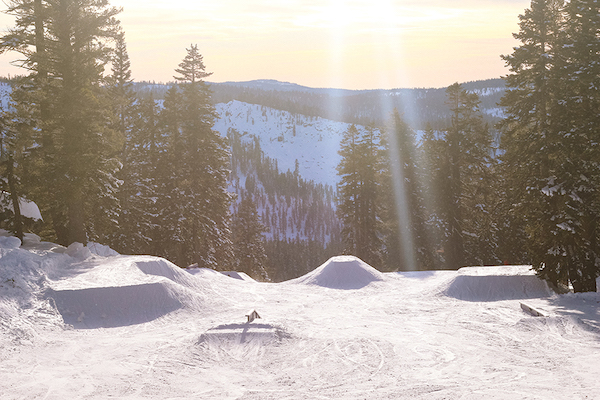
Sierra-at-Tahoe’s terrain park in 2007, photo courtesy Sierra-at-Tahoe
Much of the lift access solidified into what skiers and riders enjoy today shortly after Rice arrived, with previous lifts known as Sensation, XTC and Slingshot getting replaced with Grandview Express, Easy Rider and West Bowl Express in 1996. Five backcountry gates also opened to Huckleberry Canyon in 2001, providing another swath of technical terrain for expert skiers and riders.
World-class terrain parks became a defining characteristic of the resort in the 2000s, with concepts like “The Circuit,” where park enthusiasts could continuously encounter terrain features on laps from the top of the mountain, contributing to the acclaim.
Sierra Ski Ranch opened to snowboarding under Sprock’s leadership in 1989, but it was Rice who turned Sierra-at-Tahoe into a nationally recognized destination for freestyle pursuits. Instrumental in creating some of the first terrain parks at Big Bear Mountain Resort in Southern California, Rice saw the potential in the skateboard-influenced jumps, halfpipes, rails and boxes that would become standard at ski resorts nationwide.
“When I brought that up to Sierra, snowboarding was allowed, but nobody around the lake had embraced it fully,” Rice says.
Rice’s willingness to experiment and the embrace of freestyle creativity helped spur an outsized level of athlete success that not even Rice could envision for a mountain that puts more energy into creating a friendly vibe than dominating on a world stage.
Sierra freestyle skier Travis Ramos won a World Cup moguls event in 2001 and was crowned national champion in 2002, while Sierra’s Travis Cabral followed by winning the World Cup moguls championship in 2003. In 2006, Sierra rider Hannah Teter won the Olympic gold medal in women’s halfpipe and South Shore native Jamie Anderson became the youngest medalist ever in the Winter X Games, kicking off a run for Anderson that would include gold at the Winter X Games in 2007 and culminate in a gold medal in the first Olympic snowboard slopestyle event at the Sochi Games in 2014. Sierra skier Maddie Bowman joined her by winning gold in halfpipe at those same Olympics.
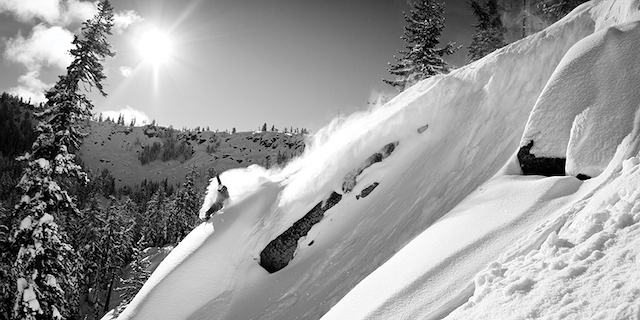
Zach Bragdon in Huckleberry Canyon, which opened to skiers and riders in 2001, photo by Nathan Vetter, photo courtesy Sierra-at-Tahoe
Bowman credits Rice and his team with always being open to new ideas and supporting young athletes, even when their ideas didn’t always have a readily available precedent.
“I feel like Sierra is a place where you can express yourself, and you’re celebrated for that,” Bowman says.
Reaching young people on Tahoe’s South Shore and the greater Sacramento region was always central to Rice’s blueprint. He notes a longstanding program at the resort that provides free season passes to South Shore students who earn straight A’s. About 400 free passes are distributed each year to students, Rice says.
“If there was an event involving youth, we were there,” Rice says of the resort’s community involvement.
In addition to supporting young skiers and snowboarders, Rice also emphasizes making employees feel a real affinity with the resort, no small task in a seasonal and sometimes fickle ski industry.
“We did create a place, I believe, that people can feel connected to and feel like they matter in life,” Rice says.
New Mountain, Same Vibes
The long-tenured general manager left Sierra in 2024 to become president of Ski California, but he was at the helm when the resort witnessed its most dramatic change since Vern Sprock relocated to Huckleberry Mountain.
The Caldor Fire, which started on August 14, 2021, near Grizzly Flats in El Dorado County, went on to burn more than 220,000 acres, including about 80 percent of Sierra-at-Tahoe. After the fire, what were once wind-protected tree runs became open bowls. The monumental shift is forcing resort operators to learn new ways to manage the ski experience on what is now a very different mountain.
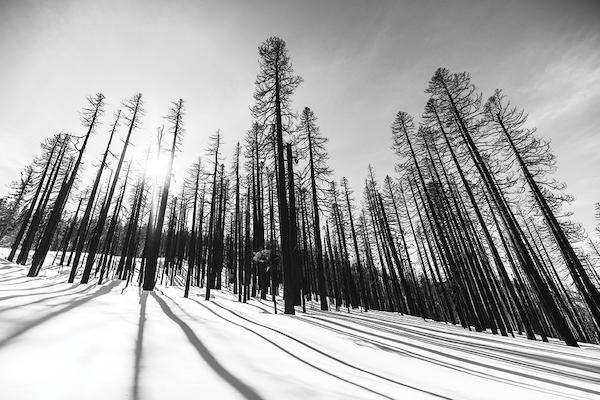
Sierra-at-Tahoe after the Caldor Fire, photo by Brian Walker, courtesy Sierra-at-Tahoe
The heartbreak over what burned is real, but there are silver linings to be found using the right set of eyes, Bowman says. While she never spent much time in the resort’s West Bowl before the fire, untracked powder laps can now be had well into the afternoon on the right days, she says.
It also took Rice some time to embrace the new feel of the mountain, but he knows not all was lost to the flames.
“The vibe is still there,” he says. “It’s just a good scene. It’s still got its soul. It’s still got its culture.”
The tree skiing is on its way back as well, albeit slower than most would prefer. Before the 2026-27 season, the resort completed its Caldor Fire reforestation project with the U.S. Forest Service and El Dorado Resource Conservation District, which included the planting of more than 60,000 saplings to provide more tree skiing to future Sierra skiers.
“We have made significant progress since the fire, while recognizing that recovery of this scale does not happen overnight,” says Dan Healy, who took over as Sierra-at-Tahoe’s vice president and general manager in 2024. “Our focus is not simply on replacing what was lost, but on rebuilding thoughtfully, improving resilience and preparedness, and making investments that position Sierra for the future.”
Creating a familiar Sierra feeling will require the resort to stay focused on building its community of dedicated followers, Healy adds.
“We want Sierra to feel approachable, relaxed and fun, whether someone is skiing for the first time or has been coming here for decades,” Healy says. “Growing that reputation means continuing to remove barriers to participation, creating opportunities for families and communities to experience the mountain together and never losing the personality that makes Sierra feel different from a more corporate resort experience.”
Anniversary celebrations are planned throughout Sierra-at-Tahoe’s 80th season, including displays of historical photos in the resort’s Aspen Café and the debut of a short film highlighting its history and community.
Despite all that has changed over the years, there is plenty that remains the same, Healy says: “Sierra’s history reminds us that you can continue to evolve without losing the culture and personality that made people fall in love with the mountain in the first place.”
Adam Jensen is a former South Lake Tahoe resident currently residing in California’s Central Valley. His not-quite-current ski jacket was briefly back in style last season.
No Comments