



27 Nov Monsters on Ice
After two successful seasons, and with attendance on the rise, the Knight Monsters have proven that professional hockey can thrive at Lake Tahoe
“The game sells itself” is a hockey mantra.
The din of steel skates scraping across ice on a fast break. The percussive thud of Plexiglas and polyethylene as someone’s body smashes into the boards. The thwack of a carbon fiber stick on a vulcanized rubber puck as a shot is loosed from the blue line.
These sounds will in turn cause a crowd to roar, and pull out their wallets for a beer, for popcorn and for tickets to the next home game.
Three years ago, a group of money guys from Florida bet that they could sell the sport at Lake Tahoe. So far, they’ve proven right.
The Tahoe Knight Monsters are skating into their third season at Stateline’s Tahoe Blue Event Center this winter. In their first two years, the team outpaced attendance projections, made the ECHL playoffs twice and slotted themselves into Nevada’s professional hockey scene in a way that has impressed hockey industry watchers.
This year, the Knight Monsters head into a new era. Gone are the only head coach and captain the franchise has ever known. The ECHL’s continued expansion means they’re no longer the newest kids on the block. Will the Knight Monsters enter their adolescence with the same success they showed in their infancy?
Big Skates to Fill
Big changes are underway at the top of the Knight Monsters’ on-ice leadership team.
In June, captain Luke Adam announced his retirement. In July, head coach Alex Loh was called up to serve as assistant coach for the Henderson Silver Knights in Southern Nevada.

Former Tahoe Knight Monsters captain Luke Adam, who played at center in 139 of 144 regular-season games before this year and all 12 of the team’s playoff games, announced his retirement in June, photo courtesy Tahoe Knight Monsters
“Coach Loh was a great leader and an important part of establishing the culture, with two playoff appearances in the first two seasons of the franchise,” says Brenden Paul, the broadcast and communications manager for the Knight Monsters. “Luke brought a great veteran presence to the locker room, as a guy with almost 100 games in the NHL and 900 games as a pro.”
Adam, a native of Newfoundland, Canada, played at center in 139 of 144 Knight Monsters regular-season games before this year and all 12 of its playoff matches. The 36-year-old retired to Arizona, where he and his wife are raising two boys.
“I went into last season knowing it was going to be my last year,” says Adam, speaking from his sunny office while his 9-month-old son crawls at his feet. The captain notched 47 points, up from 39 the year before. “It was nice to end it knowing you could still play, and going out on your own terms.”
Loh sold Adam on coming to Tahoe before the Knight Monsters’ inaugural season after he had spent eight years in Europe.
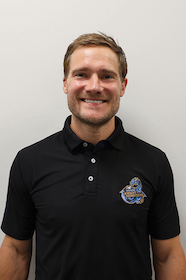
First-year head coach Connor Jones is a 36-year-old former NHL player, photo courtesy Tahoe Knight Monsters
“Alex was like, ‘If you come, we couldn’t be happier to have you.’ And that was nice. It’s nice to be somewhere you’re wanted,” Adam says. So he arranged a visit to Tahoe, a place he only knew from pictures. “When the team was announced, I was like, ‘That’d be a cool place to play.’ Once I got there, and got to see everything, got to see the lake, I was like, ‘We’re not going anywhere.’”
Loh exited because of a promotion. Tahoe is affiliated with the Vegas Golden Knights organization, which includes Henderson as its top minor league team.
Replacing Loh is Connor Jones, a 36-year-old retired forward who played for the NHL’s New York Islanders and scouted for the Golden Knights. Most recently, he served as an assistant for a highly successful Princeton University team.
“He’s a high work-ethic, high-intensity guy,” Paul says of Jones. “Tahoe’s gonna have one of the hardest-working teams you’ve seen on the ice.”
The Knight Monsters hired Jones in July, the second latest of any coach in the ECHL, notes Garrett Hunter, who runs the @ECHLInsider YouTube account. Hunter is an enthusiastic 20-year-old Floridian who uses his account to follow the league closely, documenting everything from highlights to transactions to jersey rankings.
“With that comes a little less time to acclimate,” says Hunter. “He’ll have a little bit of a challenge, coaching a roster he didn’t fully choose.”
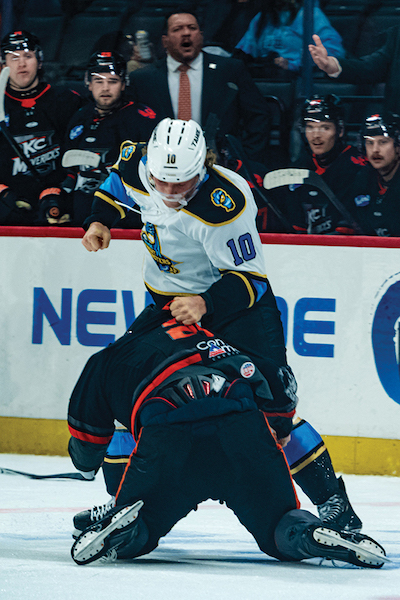
Tahoe Knight Monsters defenseman Tucker Ness gets the upper hand in a scuffle against the Kansas City Mavericks, photo courtesy Tahoe Knight Monsters
Knights on the Rise
That said, the Knight Monsters have established a tough reputation around the league, Hunter adds.
“I’ve heard a lot of good things about Tahoe,” he says. “They’ve gone past expectations with an opening-round playoff victory against Wichita in year one and a second appearance last season.”
Both years, the Kansas City Mavericks swept the Knight Monsters out of the playoffs, and KC remains the class of the ECHL’s Mountain Division.
“They’re the team to beat,” Hunter says. “A lot of teams are trying to scheme up a way to beat them head-to-head, or to win enough to avoid them in the first round.”
Defense could be a strength for the Knight Monsters, led by Bobby Russell and Tucker Ness, Hunter says. He also points to goalie Jordan Papirny as a major bonus for the club. (Papirny signed an offseason deal with Henderson but began the season with Tahoe.)
“To retain him in the organization is a big deal,” Hunter says.
Cam Hausinger, a forward from Alaska and a six-year ECHL veteran, also signed with the team in the offseason and should contribute offensively.
An ECHL team will host between six and 12 players signed to AHL or NHL deals over the course of the season. The league has slowly become a credible place to get hockey players ready for the next level—in June, ECHL alum and goalie Brandon Bussi helped the Carolina Hurricanes lift the Stanley Cup in their victory over Vegas.
“When I turned pro [in 2010], the East Coast League was kinda looked at as a graveyard,” says Adam. “That’s not the case now. It’s becoming more of a developmental league. Teams will send guys on NHL contracts to the ECHL and have a plan for them to be part of the organization for quite some time.”

Knight Monsters forward Cam Hausinger wins a face-off against the Kansas City Mavericks, photo courtesy Tahoe Knight Monsters
Whether a former Knight Monster will advance to the NHL is still something of an open question. The team has hosted four former NHL players—Adam, forwards Casey Bailey and Chris Brown, and goalie Zane McIntyre—but no Tahoe alumni have reached the NHL.
The odds are against them, as only about 25 ECHL alumni advance to the NHL in a given season, out of the 800-plus who skate in the league each year.
Vegas is an especially tough roster to crack.
“The [Golden] Knights just don’t get impact from younger players,” says Ken Boehlke, who runs SinBin.vegas, a website that has tracked the Knights’ every move since Vegas was awarded a franchise in 2016. Boehlke, a Vegas resident, has a sharp, no-nonsense attitude about the organization’s developmental pipeline. “It’s just not the way the organization is run. That may change at some point, but it hasn’t yet.”
Vegas builds its roster through aggressive trades and free agent signings, packaging young prospects off to other teams in return for immediate veteran impact. It’s a tightrope the organization has walked successfully so far. The Golden Knights have made the playoffs in eight of their nine seasons in the NHL, advancing to the Stanley Cup Finals three times and winning once in 2023.
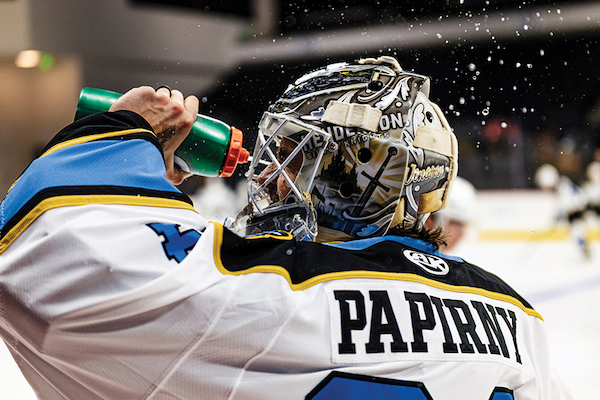
Goalie Jordan Papirny is among the top talents on the Knight Monsters’ roster, photo courtesy Tahoe Knight Monsters
Still, one former Knight Monster is catching Boehlke’s eye. Twenty-two-year-old Trent Swick is a 6-foot-7, 225-pound defenseman who spent 67 games with the Knight Monsters last year and began this season with Henderson. In 2025-26, Swick notched 50 points, good for fifth on the team.
“He’s a big kid who moves better than you’d think,” Boehlke says. “He takes the puck away from people and did really well in preseason. If I had to bet on it, I’d say he plays NHL games.”
While Vegas hasn’t selected a Knight Monster for its roster, the organization’s bonds with Tahoe are visible, says Adam. Player development personnel and Henderson General Manager Tim Speltz are commonly seen at Tahoe games and practices, which is a boon to players who are on deals with the higher leagues and players on ECHL-only contracts.
“The younger guys who want to move up, they know, ‘Hey, there’s eyes here,’” Adam says. “They know they can impress these guys.”
Selling Success
The players aren’t only making an impression on hockey insiders, but the South Tahoe community as well.
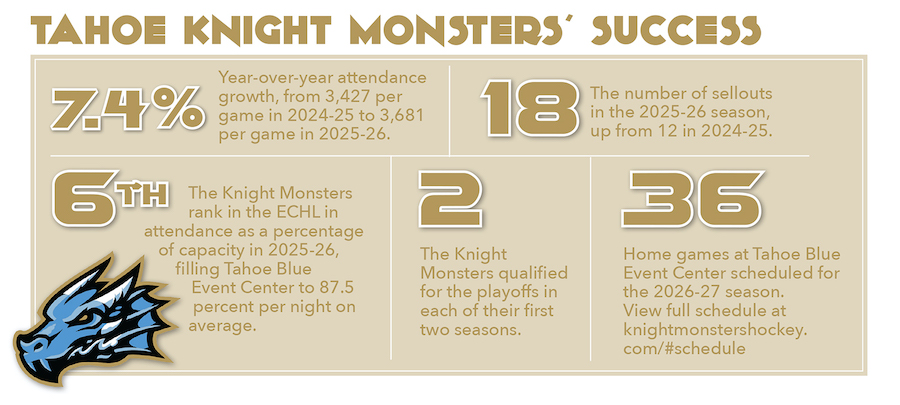
In the team’s first season, it sold an average of 3,427 tickets per night in the 4,200-seat Tahoe Blue Event Center. Last season, that number jumped 7.4 percent, to 3,681 nightly, with 18 sellouts compared to 12 the year before, Paul notes.
“The community has been very supportive of the team, and it’s been great,” says Kevin Boryczki, general manager of the Tahoe Blue Event Center. “I was amazed even at the first couple of games how many people were in Knight Monsters jerseys. Almost 90 percent of the fans in the building were in Knight Monsters gear.”

Fans fill the seats on opening weekend in mid-October at Tahoe Blue Event Center, photo courtesy Tahoe Knight Monsters
The team and Tahoe Blue, which is owned by the Tahoe Douglas Visitors Authority, partner to market the team with a locals-first approach.
That starts in the offseason, when the team markets its season tickets to the locals most likely to buy the multi-game packages, Paul says.
Entry to the season ticket club, called the 1645 Club in reference to Lake Tahoe’s depth, starts at $403 per seat for a half season and $700 for a full season, and stretches up to $3,000 per seat in premier locations.
Single-game tickets, which are sold on Ticketmaster, were listed at $70.50 for two for the October 23 season opener, with tickets on the glass going for $243.20 for a pair. Suites fetch $100 per person, and club seats go for $75 each.
While the Knight Monsters do try to sell tickets to tourists during peak ski season, courting Tahoe’s full-time residents has been a key to the club’s sales success. “The locals, you’ve got to get them out to the game,” Paul says.
The club hosts numerous special themed nights to connect with the community, including first responder nights, a “School Day” and a “Powder Hounds” weekend where the team rebrands itself in Powder Hounds gear for a three-game set.

The October 28 match against the Mavericks was Pucks N’ Paws night, photo courtesy Tahoe Knight Monsters
“The fan support kept getting better and better while I was there,” says Adam. “You need to have at least half the arena full with locals every night. You’re gonna get the tourists, but without the local support, you can’t survive.”
The team also occupies a unique niche in Stateline, where nighttime entertainment revolves around casinos and bars.
“You can’t take your 9-year-old kid there and have him play the slot machines,” Paul says with a laugh. “So you’ve gotta find an option where you can entertain the whole family, and I think the Knight Monsters have done a good job of marketing to the families, marketing to the locals and marketing to the tourists who will jump into the area.”
Boryczki also points to a popular program from last year in which a shuttle bus would pick up Reno-based fans at the Silver Legacy Resort Casino and bring them to games and back down again afterward. Last season, tickets for a bus ride and a seat in the arena cost $50 per person.
“People kind of fear the weather: ‘What is it going to be like going up over the pass?’” says Boryczki. “So this is a way we’re able to offer a program that takes that worry off their plates.”
The Knight Monsters commonly schedule 3 p.m. Sunday games (nine are set for this season) to get Reno fans to and home from the games at a reasonable hour, Paul says.
Growth Industry
Courting that support is key to survival. Despite the sport “selling itself,” minor league hockey isn’t foolproof.
Since a Florida ownership group including former NFL quarterback Tim Tebow bought the Tahoe franchise in 2023, an ECHL team in Newfoundland folded and another in Utah packed up and moved to New Jersey in search of fans and ticket sales. In March, the Iowa Heartlanders suspended operations for this season, and it’s unclear whether they’ll rejoin the league in the future.
Still, the ECHL, at 30 teams, added franchises in New Mexico and North Carolina since Tahoe joined along with the Bloomington (Illinois) Bison in 2024. The league will add another team next season in Augusta, Georgia, also under the Tebow group’s ownership.
That’ll boost the total to 31, up from 27 just three years ago, and bring it nearly in line with the 32-team AHL and NHL, the top two rungs on the professional hockey ladder.
“The state of ECHL hockey is very healthy,” says Paul. “With the old minor leagues, you’d see a lot of turnover, but the ECHL has been very stable. I’m always seeing teams stick around for at least 10 years, and in most cases even longer.”
The league’s leadership has a stated goal of adding a 32nd team at some point, so the growth game may not be over yet.
New franchises only need to look at Tahoe for a successful early blueprint.
Kyle Magin is a writer and editor based in Durham, North Carolina. He’s a proud Caniac.
No Comments