



27 Nov A Future Steeped in Tradition
A pioneer among ski resorts in the Tahoe region and beyond, Sugar Bowl continues to forge ahead with the same forward-thinking ethos and independent spirit that have defined its character since the beginning
One suspects Hannes Schroll, the Austrian ski champion and instructor, had a presentiment about recreational skiing when he stood before Mount Lincoln and Hemlock Peak in the summer of 1937.
After all, he was standing on what would become the birthplace of lift-serviced skiing in California, as well as the site of a one-of-a-kind giant slalom race that would soon put Schroll’s new Donner Summit resort on the map.
More than 85 years after firing up its first chairlift, Sugar Bowl Resort continues to embrace its boundary-pushing past while investing in terrain and events that offer a glimpse of an exciting future in skiing and snowboarding.
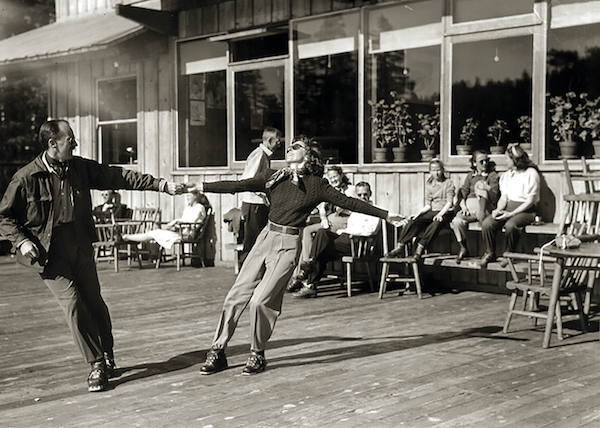
Walt Disney, an early investor in the resort, dances with a woman on the lodge deck, photo courtesy Sugar Bowl Resort
Ahead of its Time
In March 1938, Schroll bought 696 acres of steep alpine terrain on Donner Summit from the Pilcher sisters—whose parents had purchased the land from the Southern Pacific Railroad for $10 in 1923—and began raising money to build a chairlift.
He sought investors like Walt Disney, who contributed $2,500 to become an early investor in the project. Schroll immediately renamed Hemlock Peak after his famous friend.
He called the resort Sugar Bowl in honor of the particularly crystalline snow that fell in abundance along the Pacific Crest. The area was also one of the only places in the region accessible by car in the winter, thanks to the recently opened U.S. Highway 40.
So Schroll set about raising $75,000, mostly through a unique financial vehicle that encouraged homeownership within the resort boundaries, where the new residents would also become investors with a stake in the resort.
Schroll used that money to build the first chairlift in the state—and the second in the country—employing miners from Nevada City to install 13 towers spanning the 1,000 vertical feet from bottom to top of Mount Disney. He also built the Sugar Bowl Lodge with Tyrolean-style accommodations, which, when taken as a whole, became the template for the ski model that would come to dominate winter recreation in the American West.
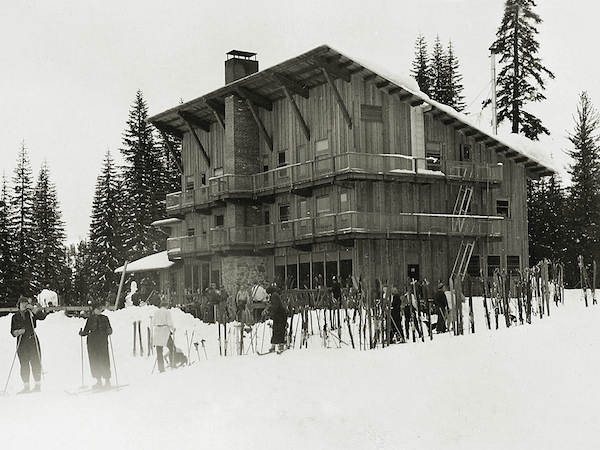
The original Sugar Bowl Lodge, photo courtesy Sugar Bowl Resort
It began inauspiciously, as the grand opening took place on December 15, 1939, when the fickle Tahoe weather decided to be uncooperative. There was not enough snow, and Schroll installed a skating rink instead. A blizzard hit in early January, however, and skiers began pouring into the new resort with gusto.
Schroll leveraged his Hollywood connections. Sugar Bowl was featured in The Art of Skiing, a popular 1941 Disney cartoon, and also provided the setting for a Greta Garbo feature released the same year.
Walt Disney himself was an early patron among a stream of celebrities who soon followed. Errol Flynn, one of the original Hollywood playboys, used to relax on the lodge porch and watch the skiers stream by.
Sugar Bowl also used events to draw serious skiers from around the world. In April 1940, mere months into the resort’s operation, Schroll hosted the first Silver Belt race, a giant slalom that began atop Mount Lincoln and proceeded off-piste through the natural contours of the steep gully. Gretchen Fraser and Friedl Pfeifer won the first contest, which continued to attract elite alpine ski racers for decades to come.
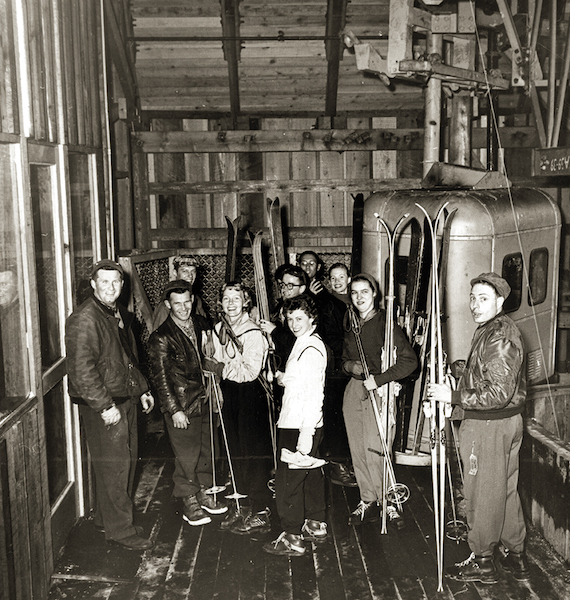
Sugar Bowl skiers waiting to load the original Magic Carpet gondola, photo courtesy Sugar Bowl Resort
Thus, Sugar Bowl’s model of offering convenience and luxury for recreational skiers while attracting world-class athletes ready for a challenge hearkens back to its very beginnings.
It was the pioneer in the region, opening a full decade before Squaw Valley (now Palisades Tahoe), which opened in 1949. Heavenly came next in 1955, followed by Alpine Meadows and Homewood in 1961, Mt. Rose in 1964, Boreal in 1965 and Diamond Peak in 1966. Kirkwood and Northstar came along in the early ’70s. (See page 110 about Sierra-at-Tahoe’s history.)
In terms of the greater American West, Sun Valley preceded Sugar Bowl by three years, opening in 1936 with the world’s first chairlift.
Remaining true to its progressive roots, Sugar Bowl has also evolved through the decades. The resort introduced the first gondola in the American West in 1953, cutting a 40-minute sled ride across Van Norden Meadow to just 7 minutes. It expanded its terrain to Mount Judah with the Jerome Hill chairlift in 1994 and the Judah chair in 1996, built the Summit Chair to the peak of Mount Judah in 2009 and added the Crow’s Peak chair in 2014, unlocking new advanced terrain.
Entering the 2026-27 season, Sugar Bowl has drawn on its resident-owned model to fund a roughly $100 million renovation.
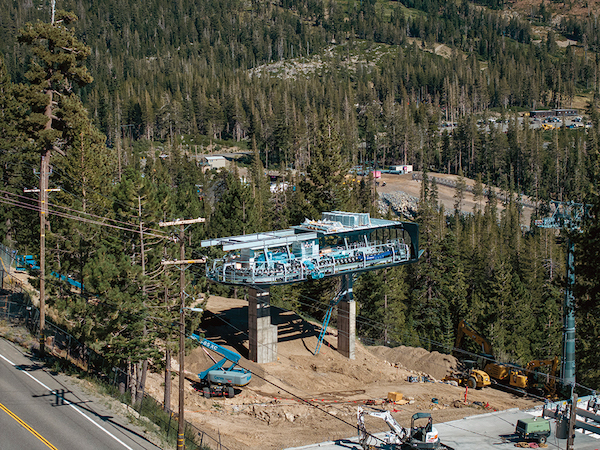
As part of a roughly $100 million investment in the resort, Sugar Bowl replaced its Emerald Gondola from 1983 with a new eight-passenger Doppelmayr D-Line system in 2026, photo courtesy Sugar Bowl Resort
“There’s a difference between Sugar Bowl and everyone else, because Sugar Bowl is owned by its community,” says Sugar Bowl CEO Bridget Legnavsky. “We have this community of people that own it that are just very authentically investing in the experience. They want it to hold onto its heritage, hold onto its deep-rooted community and hold onto its love for the sport.”
In this spirit, Sugar Bowl replaced its old gondola, restored the historic Village Lodge and overhauled the Main Lodge. It also committed to building and maintaining a full-size terrain park and reinventing the Silver Belt, continuing its long history of hosting unique contests that stand out in a crowded competition landscape.
This comes as consolidation, corporate conglomerates and mega-pass models dominate the broader ski industry.
Sugar Bowl is ready to mine the traditions of its past to forge a new future, all while weathering the winds of change with its characteristic independence.
Building Terrain
Sugar Bowl has invested more than $3.5 million in terrain parks at a time when many resorts are downsizing theirs.
“I grew up in a time where most terrain parks were being scaled back,” says Xander Guldman, a 28-year-old professional skier and Sugar Bowl athlete ambassador. “For the bulk of my developmental years, I really just didn’t ski park, because very few mountains had good parks.”
Labor costs are part of the reason. A modern terrain park requires designers, specialized snowcat operators and crews to maintain features throughout the day.
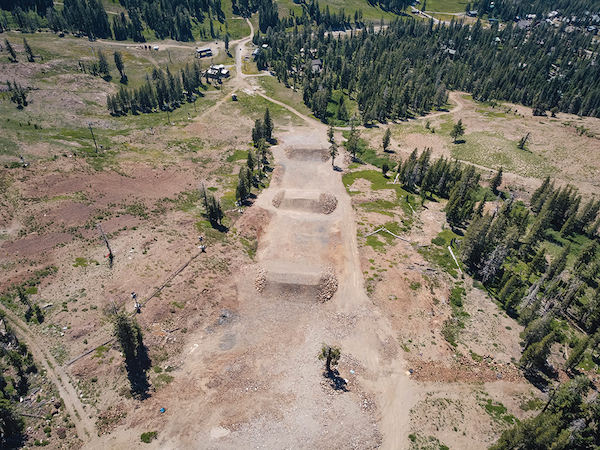
A jump line in Sugar Bowl Parks, photo courtesy Sugar Bowl Resort
“Doing a terrain park right takes a pretty good investment of time and expertise,” says Paul Raymore of Diamond Peak, which keeps its park focused on local riders. “Maybe those resorts that have moved away from parks haven’t really been able to show the ROI on that investment.”
Liability looms over all of it. In 2007, a Washington jury found the Summit at Snoqualmie partly responsible for a skier’s paralysis from a terrain park jump, and the resort’s share of the judgment came to $14 million.
The skier’s attorney successfully argued that the jump was shaped by eye rather than engineered. The verdict galvanized the industry, which responded with mandatory helmets in parks, restricted access to expert features and clearer labeling.
More recently, a 2025 Colorado verdict against Vail Resorts, though over a chairlift fall, weakened the liability waivers resorts have long relied on, and the National Ski Areas Association warned that such verdicts threaten insurance availability, especially for smaller and independent ski areas.
“A lot of resorts, they just thought parks should be huge, and so they built huge parks, but their demographic didn’t support that product offering,” says Mike Schipani, Sugar Bowl’s terrain parks manager.
Schipani worked for nearly two decades building Northstar’s highly regarded terrain parks before joining Sugar Bowl to help implement Legnavsky’s vision.
“Where I was at, I wouldn’t call it fading away, but they were ambiguous in terms of their future commitment of what they were going to do,” he says. “Whereas here, the future was pretty clear.”
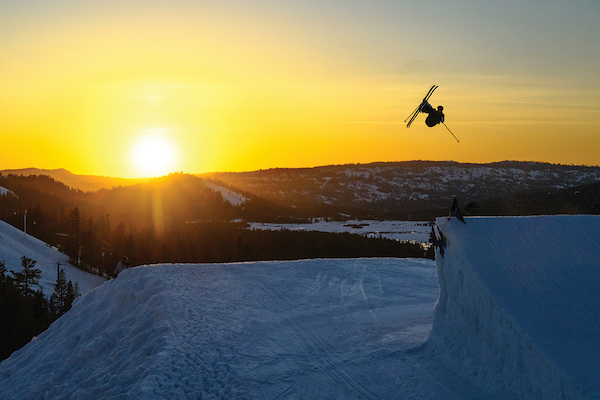
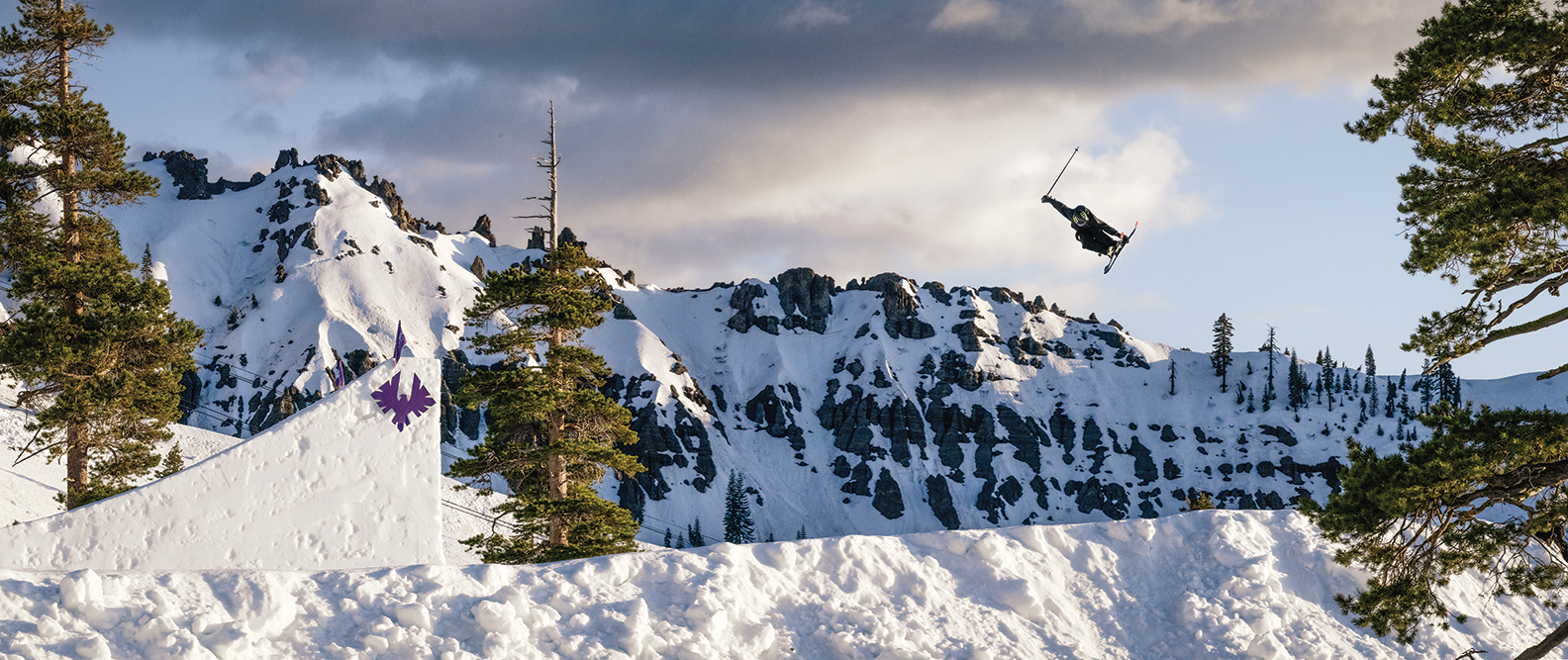
A skier soars over a jump as the sun casts its last rays of light over Sugar Bowl during a private photo shoot in 2025, photo by Jake Pollock, courtesy Sugar Bowl Resort
Passion Project
Legnavsky announced the construction of Sugar Bowl Parks in 2024 but foreshadowed her commitment when she was introduced as CEO and president of the resort in 2022. At the time, she said her mission was “making sure we maintain relevancy by keeping Sugar Bowl cool.”
Legnavsky arrived at Sugar Bowl and saw the resort had a demographic profile that skewed older.
“We had a real problem with youth at Sugar Bowl,” she says. “You know, really low levels of youth.”
She also noticed that while Lake Tahoe was a renowned ski destination replete with several large resorts, it lacked the high-end facilities to train young athletes for freestyle skiing and snowboarding.
“When I came here, I was sort of shocked that there weren’t the facilities in Tahoe to allow our kids to get to the top level and get up to World Cup level, because they need a full-size park to do that,” she says.
Sugar Bowl’s parks are built as a ladder, from jumps as small as 5 feet in The Falconry to Peregrine Ridge’s 25- to 40-foot jumps to Golden Eagle’s 45-, 50- and 65-foot line.
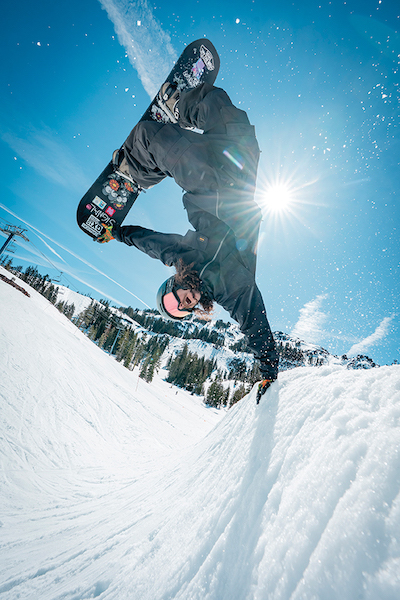
Truckee-based pro snowboarder Matt Carlyle with a stylish handplant in Sugar Bowl Parks in March 2026, photo by Vincent Zacha-Herthel, courtesy Sugar Bowl Resort
The park complex sits at the heart of the resort, making use of the speedy Christmas Tree Express chairlift for quick laps.
“There’s one really distinguishing factor about the Sugar Bowl Parks, and that’s the three-pack large jump line on Golden Eagle,” says Guldman. “It’s the only place in Tahoe that’s gone through earthworks … so as soon as there’s snow on the ground, they can make a proper 60-foot jump.”
Legnavsky says her commitment to parks stems from her experience at Cardrona in her native New Zealand, where she helped build comparable freestyle training grounds that paid considerable dividends for the resort.
“When I look back on my time in Wanaka, our whole crew went to the Olympics,” she says. “All those kids that grew up at Cardrona went as a team to the Olympics.”
Legnavsky, who was general manager at Cardrona and Treble Cone before coming to Sugar Bowl, helped implement a halfpipe and World Cup slopestyle course, which became the only one in New Zealand and Australia.
As a result, the resort attracted young athletes eager to train, which translated into Olympic success. At the 2026 Winter Olympics, nine of New Zealand’s 10 Olympic skiers in halfpipe, slopestyle and big air competitions and four of the six snowboarders counted Cardrona as their home mountain.
“I’ve got a picture of them when they were like 7, 8, 9, 10, and we called them the Grom Squad,” Legnavsky says. “That was the New Zealand Olympic team, and they all came out of Cardrona from what we did there. So I feel really passionate about what we could achieve here and what we could give the kids in Tahoe.”
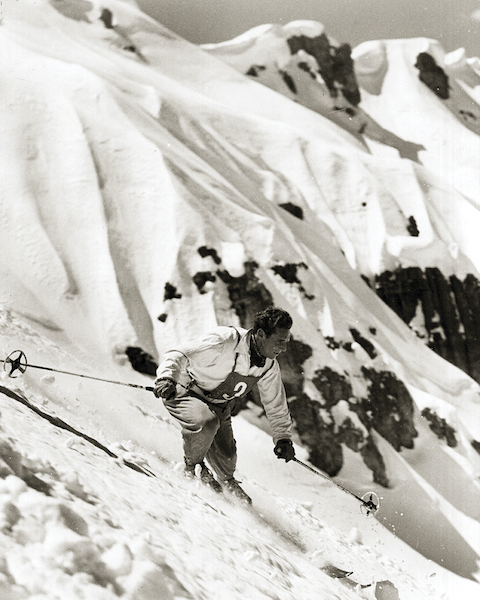
Peter Picard competes in the first Silver Belt giant slalom race at Sugar Bowl in 1940, photo courtesy Sugar Bowl Resort
Test of Mettle
While the terrain park features represent the resort’s commitment to reinvention in the modern era, its resurrection of the Silver Belt event is a nod to both its recent and distant past.
Sugar Bowl put on the first Silver Belt Classic in 1940, just months after opening. While skiers could ride a chairlift to the top of Mount Disney, Silver Belt competitors had to hoof it up to the race start atop Mount Lincoln, where they strapped wooden skis to their feet and ripped through gates set in an ungroomed gully.
“It was outrageous for the time, absolutely outrageous,” Legnavsky says. “If you look back on some of the photographs and imagery of what these people were doing on this equipment, it was really pioneering and way before its time.”
Some of those who hoisted the signature silver-studded belt in victory include a who’s who of ski racers from their time, including Alf Engen, who directed the legendary ski school at Alta, Utah, and pioneered powder skiing; Andrea Mead Lawrence, who became the first American alpine ski racer to win two gold medals at the 1952 Olympics; and Buddy Werner, the first American alpine ski racer to challenge the Europeans by winning races in the 1950s and ’60s.
When the World Cup began in 1967, the Silver Belt limped along for a few years before finally fizzling out in 1975.
Interestingly, while the standardized international competition ended the Silver Belt Classic, the man who would revive the race was a product of the World Cup.
Daron Rahlves, a Tahoe local who made his name on the World Cup circuit, set out to revive the Silver Belt by devising a race that looked nothing like the ones he’d spent his career running.
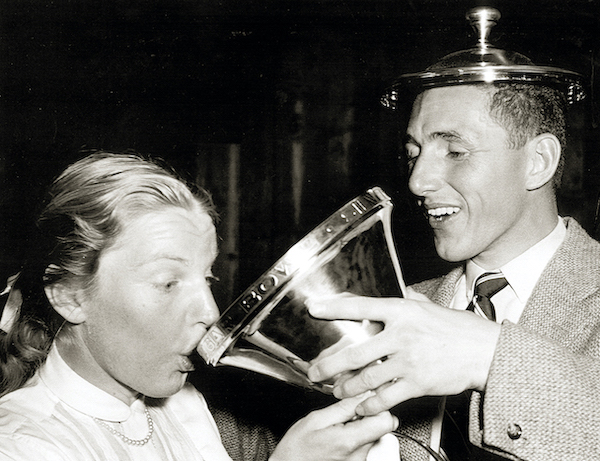
Babette Haueisen and Bill Beck, winners of the Silver Belt Classic in 1955, celebrate their victories with some well-earned bubbly, photo courtesy Sugar Bowl Resort
“I was a ski racer, so I’m chasing gates all the time on groomed runs,” Rahlves says. “But any chance I had, I was freeskiing and just loving the natural terrain we have up in Tahoe. Back in the day, they just [raced the] gully, and I looked at all that terrain, and I was thinking we’ve got to somehow bring this back.”
In 2004, Sugar Bowl unveiled the Silver Belt Banzai, using the same course as the historic giant slalom but with elements of ski cross, where four racers charged out of the starting gate simultaneously.
“It’s like moto on skis,” Rahlves says. “It was a way to hold on to tradition a little bit with a new twist.”
After the Silver Belt Banzai was held again in 2009 and 2010, Rahlves helped expand the event into a multi-stop series called the Rahlves’ Banzai Tour, with races held at other Tahoe resorts before culminating at Sugar Bowl. The Banzai Tour was discontinued in 2016, however.
“When there’s that race component, that’s competition. Little lights go off with all these risk management employees and insurance companies, and they say, ‘Whoa, what do you mean race competition?’” Rahlves says. “It’s harder and harder these days to do fun, cool stuff like you could back in the early 2000s.”
The Latest Silver Belt Twist
However, when Legnavsky came on, part of her mission to retain the central ethos of cool at Sugar Bowl included getting back into hosting events.
“Daron came in, and he did a fantastic job of evolving it into the Banzai, which I think was really cool,” Legnavsky says.
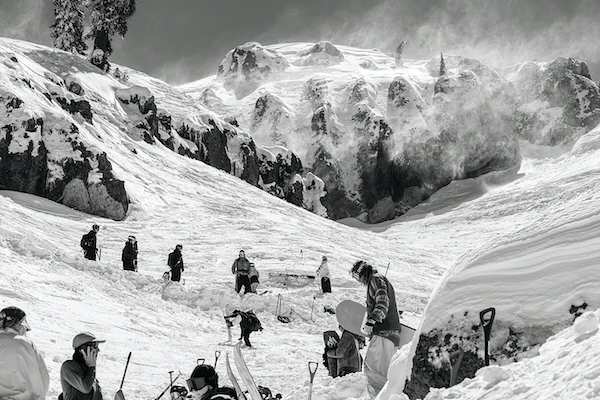
Athletes build features in the Silver Belt Gully before the 2026 Silver Belt Freeride Comp at Sugar Bowl, photo by Jake Burchmore, courtesy Sugar Bowl Resort
The resort’s CEO says she was dead set on resurrecting the Silver Belt, but rather than a simple reboot of the old iterations, she wanted a new tweak of her own.
“Obviously, freeride has come in since then, and park,” she says. “So we decided to run a combo of freeride and park by letting athletes build features in the freeride terrain.”
Legnavsky turned to Guldman and others in Sugar Bowl’s freeride community and asked them what specifically the resort could offer that wasn’t being offered elsewhere.
Guldman says his career as a professional skier, which involves journeys into the backcountry to build jumps, gave him the idea to adapt that for a competition.
“There’s this merging of the park skiing and the freeride world that a lot of people are interested in,” he says. “When you watch ski movies, that’s more or less what’s happening. It’s a lot of building jumps in the backcountry and doing tricks off natural features, but there isn’t really a competitive outlet for people to do that, and especially not at an amateur level.”
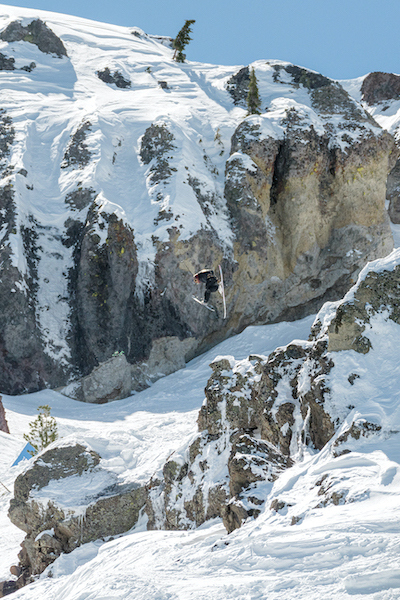
Skier River Brown competes in the Silver Belt Freeride Comp in spring 2026, photo by Jake Burchmore, courtesy Sugar Bowl Resort
So the new Silver Belt Freeride Comp, which debuted in 2024, is a contest made for the YouTube generation, many of whom are more interested in the expressive derring-do world of freeride and park than seeing who can get down the mountain the fastest.
“There are so many different ways to ski it,” Guldman says. “You are still skiing Silver Belt Gully in its true form. If you’ve ever been like, ‘Wow, that was a fun jump, but if it was a little bit bigger, I could do more on it,’ that’s really what the goal was.”
The event is open to both amateurs and professionals and is judged in a fun, forward-thinking manner: Instead of a slate of judges, the competitors decide the outcome.
There is an open qualifier and then a final, which combines qualifying amateurs with invited professionals. Each competitor gets two runs, which are filmed in full and edited for video review that evening. The athletes then gather to watch the runs together.
“It’s like a ski movie premiere,” Guldman says, citing the raucous cheers in the room.
Skiers and snowboarders, men and women, without distinction, all cast votes, and the top three vote-getters hit the podium.
“So often in these competitive spaces, you get to the end of the day, and you really just want to know where you stack up compared to everybody else,” Guldman says. “But as soon as you’re voting on who you think skied the best that day, it instantly transforms that process to being about the community and supporting the people next to you.”
At first there was consternation about whether the event was true to the spirit of the Silver Belt Classic. But after hosting the competition in consecutive years, Guldman noticed a parallel.
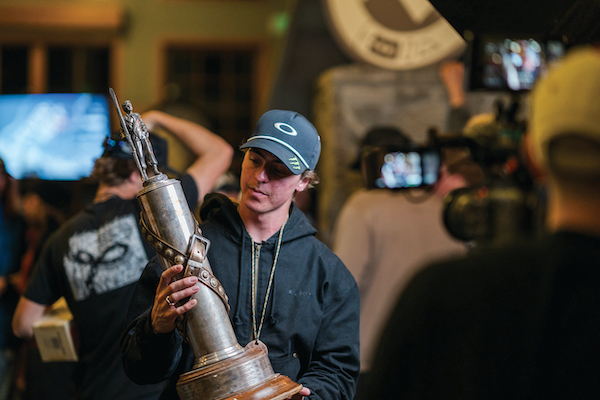
Luca Harrington beholds his impressive trophy after winning the men’s ski division of the 2026 Silver Belt Freeride Comp, photo by Jake Burchmore, courtesy Sugar Bowl Resort
“As we were developing the event, we were like, ‘Wow, what we’re doing is quite different from what it was historically.’ But then we reflected on it after, and we were like, ‘Actually, this is kind of the same thing.’ A really central part of the historic Silver Belt was all the athletes showed up a couple days before and they would boot-pack the entirety of Silver Belt Gully in order to compress the surface and make it something they could set gates in and actually race. That’s the same process we go through now, but instead of trying to pack the snow down, we’re trying to build jumps.”
Rahlves says he is enthusiastic about the new direction for the Silver Belt while maintaining fidelity to the tradition.
“It’s evolved from just a normal GS race to the Banzai,” he says. “Now it’s onto the freeride, basically a big-mountain slopestyle event. And it’s fun to watch. I went there last year and checked out the comp, and it’s really cool. That’s the way the sport evolves, and it’s really unique. And I think it brings a big draw.”
That final aspect is something Legnavsky also believes—that such events allow Sugar Bowl to showcase its wares and stand out from its regional competitors.
“Events are really important to get yourself on the world map, to draw people,” Legnavsky says.
‘Independent in Spirit’
Sugar Bowl is placing big bets on terrain parks, freeride competitions and the future of the sport at a time when the ski industry has bet on a different model.
Kirkwood, Northstar and Heavenly are all owned by Vail Resorts, and Alterra Mountain Company owns Palisades Tahoe, which merged with Alpine Meadows. All these resorts are anchored by mega-passes sold to skiers across the continent and around the world.
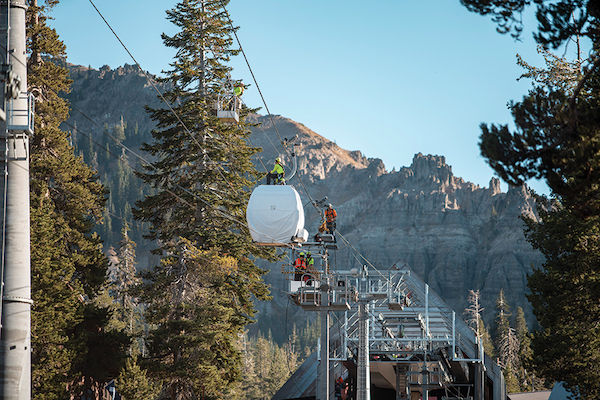
Sugar Bowl’s new eight-passenger Doppelmayr D-Line system under construction in 2026, photo courtesy Sugar Bowl Resort
Sugar Bowl is independent of all that, but even for other independent resorts, the lure of upfront revenue and driving
on-the-mountain spending is strong.
“We can very easily try to join something like Ikon, but it would be too much for us,” Legnavsky says. “We do not want to be crowded.”
Instead, Sugar Bowl is attempting to thread a difficult needle in drawing enough people to provide a return on its investment while not drawing so many that long lift lines and crowded slopes compromise the classic Sugar Bowl experience.
“We want to get busy enough to be successful and thrive and fix our stuff each year,” Legnavsky adds. “But that’s it.”
In the meantime, the bet is that independent approach will be recognized by skiers who are nonconformist in their approach to skiing and everything else.
“In an age of so many corporate conglomerate resorts,” Guldman says, “having a place that’s not only independent by name, but independent in spirit, as well, is truly a rarity.”
Santa Cruz–based journalist Matthew Renda has fond memories of his first time snowboarding at Sugar Bowl, when fresh snow allowed for outrageously fun hot laps on the newly installed Summit Chair. Based on his research for this story, the year must have been 2010.
No Comments