



27 Nov The New Sierra Table
As forward-thinking chefs bring their talents to Tahoe, the region is evolving into a culinary destination with its own distinct identity
At Savoie, it starts with a stone fireplace older than the restaurant itself—a holdover from the historic Pfeifer House, the Tahoe City chalet the Sullivan family couldn’t bear to see disappear, its hearth still stacked with firewood beside sheepskin-covered chairs. It is an immediate invitation into a ritual that had thinned out of lake dining: families around a fire, anchored in the warmth of the mountains.
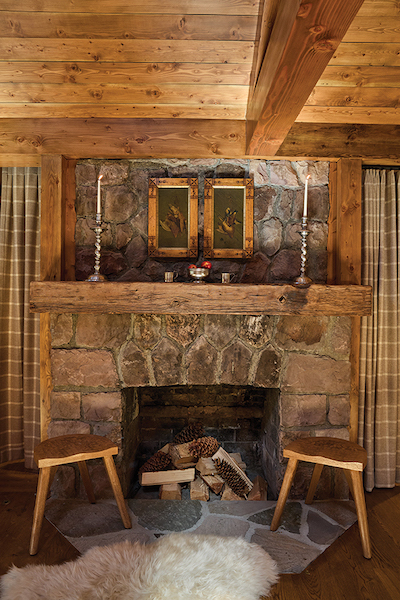
At Savoie in Tahoe City, the restored fireplace anchors the main dining room, alongside stonework and pieces preserved from the building’s days as the Pfeifer House, photo by Jessica Antola
Elsewhere around the lake, fire takes entirely different forms.
At Sylva in Tahoe City, a wood-fired oven chars Spanish octopus until the edges turn gamey and the center stays velvet. At Smoke Door in Kings Beach, the entire premise is built around haiboshi, an ash-drying technique chef Tyler Burges adapted after watching fish cooked between layers of volcanic ash in Japan, with almond wood embers here standing in for Japanese oak. And in Truckee, at Trokay, Mt. Lassen trout gets smoked over Sierra juniper foraged from Martis Peak.
It would be easy to call what is happening around Lake Tahoe a culinary transplant—San Francisco’s tables and tastes, simply replanted at 6,200 feet in the Sierra. The timeline says otherwise.
Culinary Shift
A decade ago, Trokay stood nearly alone in bringing a tasting-menu, wine-driven, service-focused approach to the north side of the lake. What changed isn’t that San Francisco discovered Tahoe. It’s that Trokay’s persistence—more than a decade of proving, one season at a time, that this kind of cooking could survive in the Tahoe-Truckee region—made room for what came next.
Great Gold opened in 2020, followed by Smoke Door, Sylva and Savoie. Different pedigrees sharing one fundamental wager: that the Sierra could support cooking built on fire, patience and a pantry mirroring its place.
Some of the talent never had to travel far. Sylva’s Andrew Shimer grew up in Tahoe City. Savoie’s Mark Sullivan spent childhood summers at the lake. Trokay’s John and Nyna Weatherson chose Truckee over a job at The French Laundry, the acclaimed restaurant in Napa Valley, because they wanted a life in the mountains, not another line on a résumé.
While the techniques came from demanding kitchens like Daniel in New York and Saison and Spruce in San Francisco, the conditions were uniquely Tahoe’s: visitors already paying resort prices, a year-round community large enough to keep a serious dining room alive between powder weekends and, after 2020, cooks and capital that could leave the big cities and still find an audience.
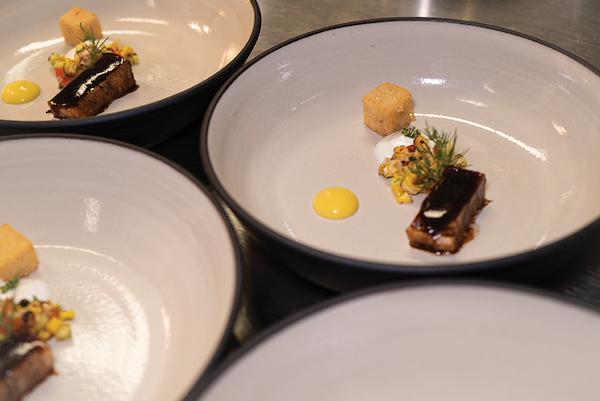
Angus short rib braised in red wine and served with roasted sweet corn at Trokay in downtown Truckee, courtesy photo
The ingredients were here, too, waiting on kitchens willing to build menus around the ranges and farms instead of shipping the city up the hill. What is taking shape isn’t San Francisco relocated. It is talent, technique and terroir becoming its own distinct identity: forage-driven, fire-built and unmistakably of this place—a new Sierra table.
Leading this new wave of fine dining, Trokay remains the kind of table a region gets once in a generation, if lucky. The Weathersons opened a café in downtown Truckee in 2011 and two years later moved into the exposed-stone, reclaimed-wood room they occupy now.
While their first menus owed a debt to the New York kitchens where John trained, what’s on the menu now is built from a pantry that exists nowhere else: fir and juniper from the surrounding mountains, trout from Mt. Lassen Trout Farm and strawberries renowned for their sweetness from Dan and Rachel McClure of Nevada’s Own.
John does not measure the restaurant against outside recognition. Instead, what Trokay has is lineage. He calls what followed—Great Gold, Smoke Door, Tangerine, Sylva, Savoie—a compliment rather than competition. The debt is deeply practical, too: He has passed purveyor contacts to Burges at Smoke Door because a winter supply truck at the lake can fail, and a number to another kitchen can save a night.
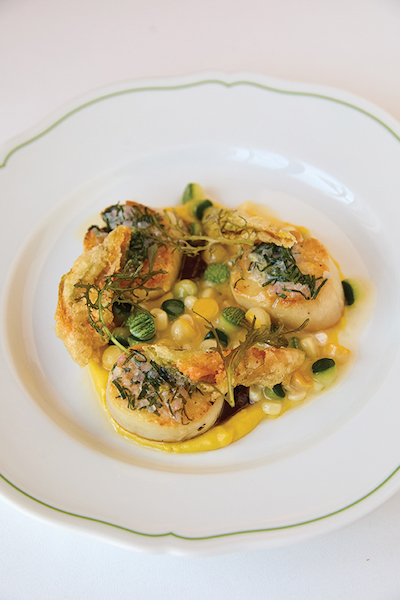
Sylva’s wood-fired, oven-roasted Spanish octopus, photo by Dylan Langille
Sense of Community
In Tahoe City, Sylva proves the pattern reaches beyond a single town. Shimer grew up here, trained in San Francisco and Oakland’s Mezze, then spent more than a decade as executive chef at Christy Hill in his hometown before opening his own place with his wife and partner, Chata Villa.
“We didn’t want to bring a San Francisco big-city restaurant to town,” Shimer says. “We wanted it to relate to our community.”
Tahoe City, Villa admits, had grown quiet enough that locals frequently drove to Truckee to eat—a gap Sylva was built to close.
“Fine casual at its core,” she says, “but the ingredients on the plate are fine dining.”
The wood oven acts as the engine of the kitchen, turning out plates like the Maiale Tonnato—45-day-cured pork lonzino over tuna conserva and cured egg yolk, which took longer to perfect than anything else on the menu. Like Weatherson, Shimer no longer chases the recognition he once did.
“Early on, working in San Francisco, Michelin star and James Beard—that was on my radar,” he reflects. “Now we just really want to give a fun experience to our customers and have people be happy.”
That sense of community is practiced daily at Sylva: basil borrowed from nearby Wolfdale’s, or a guest on a busy Saturday pointed toward someone else’s happy hour down the street, treating the town’s success as shared.
‘Good Things Will Come’
Smoke Door offers another entirely distinct experience. Tucked behind a low, unmarked building straddling the California–Nevada line, it houses an omakase that would not be out of place in San Francisco or Los Angeles.
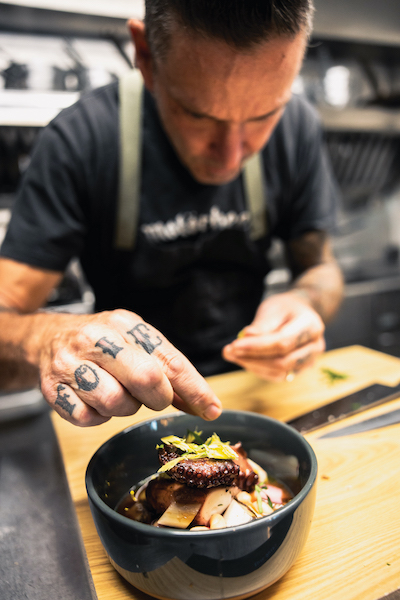
Donabe rice with matsutake mushrooms, pickles and cured egg yolk at Smoke Door, photo by Ingrid Nelson
Burges trained at Saison and built the restaurant’s vocabulary around haiboshi, a technique that, almost nowhere outside major culinary hubs, is attempted with this level of rigor. He chose Tahoe over cities where an audience already existed.
“If you do quality food, if you do good things, then good things will come,” Burges says. “I don’t think you need a big sign in front of the door.”
Before Smoke Door even served its first plate, the team drove to Trokay for the tasting menu. What Burges envisions next is a formal version of the network already thriving between these kitchens: a community of lake chefs who pull for one another.
Yet not every table in this culinary evolution boasts a tasting menu. In 2020, David Steele, the entrepreneur behind
San Francisco’s Flour + Water, co-founded Great Gold with chef Brandon Kirksey to bring a similar sensibility to Truckee: seasonal, artisanal Italian cooking that few restaurants in the region had fully embraced, for a community that could support it. Kirksey doesn’t call the result fine dining.
“I look at us as intentional dining,” he says.
It is classic Italian technique, sourced from Northern California farms and the Tahoe Food Hub, served to locals and second-homeowners alike. Plates feature rigatoni under a long-simmered short rib ragù, hand-thrown pizzas and a tomato bread that could hold its own on Arthur Avenue, the Bronx’s Little Italy.
Great Gold has since expanded to Reno, with a third location coming to Roseville, each chosen for a community that can support the restaurant they want to run. Tangerine, a second project from the same team, extends that pedigree into a French bistro—proof the reach isn’t confined to a single cuisine.
Home Fires
Savoie represents the newest arrival, and perhaps the most personal.
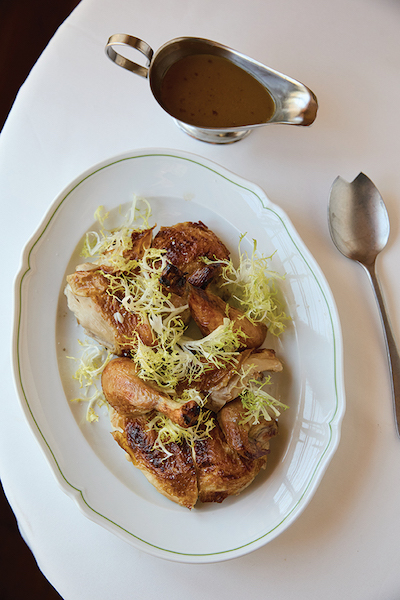
The Rôti du Jour is a daily-rotating roast on the menu at Savoie, photo by Jessica Antola
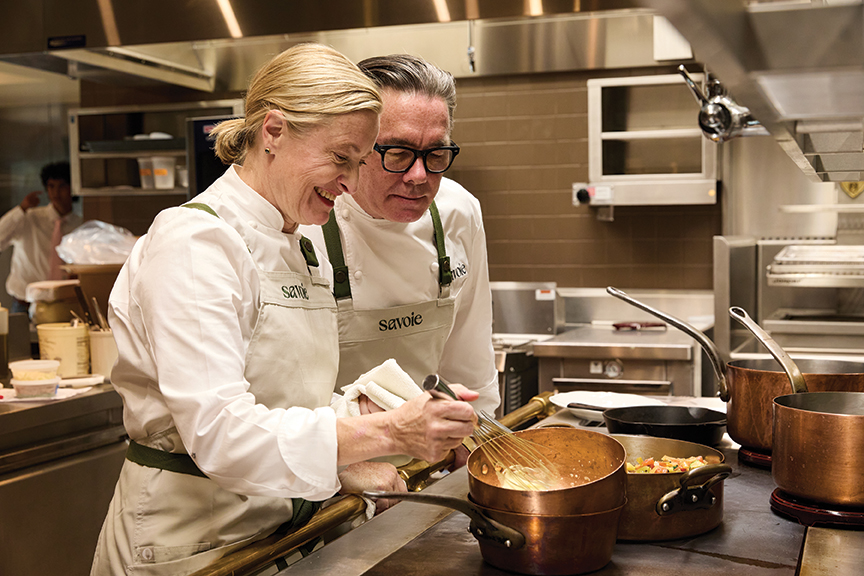
Maureen Sullivan, stepmother to chef Mark Sullivan, bought the Pfeifer House in 2019 upon seeing it for sale, preserving a building her family had gathered in since the 1950s. Mark—whose Michelin-recognized work includes Bay Area restaurants Spruce, The Village Pub and Selby’s—and pastry chef Alison Sullivan drew the menu from memory of the Mont Blanc massif, with France on one side of the ridge and Italy on the other. The kitchen forages its own hillside to flavor the crème caramel, returning a sense of ritual to lake dining that had long been missing.
Dining at the lake used to be an afterthought to skiing and water sports—something people figured out once they arrived. Now, reservations are booked well ahead of a trip. What draws people is no longer just the landscape, but a table capable of holding world-class technique—from the wood-fired hearths of the Alps to the precise omakase of Tokyo—while still tasting unmistakably like these mountains.
Bigger capital has noticed the shift, too. A Nobu is rumored for the Hyatt in Incline Village, and Mastro’s has opened at the Golden Nugget on Tahoe’s South Shore—arrivals that prove Tahoe can support serious money, while highlighting just how differently these independent kitchens built their homes here.
Nothing about them was imported wholesale. They are built on a decade of quiet risk, a farmer’s contact passed between chefs who had never met, basil borrowed from a neighbor and families buying back buildings because letting them go felt like losing something irreplaceable.
Tahoe has long attracted visitors with its natural beauty. Fine dining gives them another reason to come. The kitchens building this new Sierra table speak in firewood and juniper, backed by something much harder to import: a region of small mountain towns resilient enough to sustain them, and chefs willing to treat that community as shared.
David Rodriguez is a Reno-based food and travel writer, creator of WhereRenoEats.com and author of “The Dish” column for Reno News & Review. He also contributes to Edible Reno-Tahoe and Nevada Magazine.
No Comments