




28 Sep Drawn to the Ring
Before rising from poverty to wealth, legendary heavyweight champion Jack Dempsey earned a reputation as a fearsome young fighter in Reno, where he later returned to take advantage of Nevada’s lax divorce laws
In a letter sent to a friend, Jack Dempsey wrote that he was definitely not coming to Reno for a divorce.
Dated April 10, 1931, the note came from the 35-year-old former world heavyweight boxing champion to an unidentified buddy in the Biggest Little City in the World. It immediately leaked to the Associated Press.
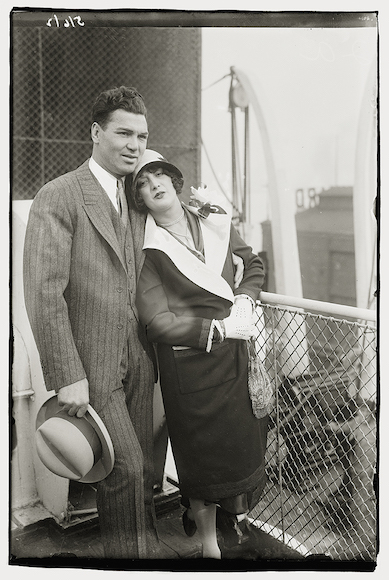
Jack Dempsey and actress Estelle Taylor were married for six years before getting a divorce in Reno in 1931, photo courtesy Library of Congress Prints and Photographs Division
In newspapers across the country, Dempsey’s pre-emptive denial accompanied news announcing his extended visit to Northern Nevada. He’d be there on doctor’s orders to rest in the dry desert air—not to get divorced from his Hollywood starlet wife, Estelle Taylor. Definitely.
A writer found Dempsey in the bar of the historic Riverside Hotel, a swanky inn along the Truckee River on Virginia Street. Owned by George Wingfield, a gambler turned rancher turned Nevada’s richest man, it regularly hosted Depression-era glitterati looking to end their marriages quickly—which, thanks to a new Nevada law, was possible after only six weeks of state residency.
“Our little difficulties may be patched up, and again they may not,” Dempsey told the reporter. “Honestly, I had not thought of a divorce until the newspapers began to hint at it. Women of the films are just as temperamental as pugilists.”
So began a wild three years in the Silver State for Dempsey.
In a non-exhaustive list, 1931–34 would find him in Reno divorcing, remarrying, investing in local and Mexican casinos, befriending suspected murderers, promoting a gold-toothed fighter named “The Basque Woodchopper,” going on hunting trips with the governors of both California and Nevada at the same time, rubbing shoulders with the “politico-gambling” class and generally living a caricature of the Nevada larger-than-life style.
Reporters told the stories of his $40,000 blackjack wins and noted gamblers covered his losses as he sought to find his footing as a fight promoter.
Dempsey’s fast-lane life in Reno strongly contrasted his early days in rural Colorado and Nevada as a teenager clawing out a hardscrabble existence as a miner by day and prizefighter by night. His fame was hard-won.
Humble Beginnings
Born in Manassa, Colorado, in 1895, William (the “Jack” came later) Harrison Dempsey’s upbringing was quite different than his future opponents in one crucial way: He was a Westerner.
His foes in the ring were largely the Irish, Italian and Eastern European sons of Catholic immigrants raised in New York and Boston. Dempsey, conversely, came from mixed ethnic stock in the Mountain West, a family of nominal Latter-Day Saints with 12 siblings.
And while his opponents rose through the youth boxing ranks in YMCA leagues and established gyms, Dempsey sparred with his older brothers Bernie and Johnny on Friday and Saturday nights, when the men of the mining camps would get together for illegal prize fights.
The family led a transient existence for most of Dempsey’s upbringing as his father shuttled between mining jobs in Colorado and Utah, trying to eke out an existence and feed his enormous family.
At 15, Dempsey, along with two older brothers, left home to work in mining camps throughout the region.
By 19, Dempsey first appeared in Reno’s newspapers as Jack, a name he borrowed from a professional nineteenth-century fighter. And, he’d cultivated a reputation.
“Dempsey became well known around Reno’s saloons for walking in and challenging patrons to a fight—for a price,” wrote Guy Clifton in the 2007 book Dempsey in Nevada. He would “enter the saloon and declare, ‘I can lick anyone in this bar.’”
The trick helped Dempsey land fights that were livelier and more lucrative than the sparring partners he was pounding at area gyms.
The big Coloradan—then about 6 feet and 159 pounds and going by the nickname “The Manassa Mauler”—left Reno for Goldfield in Southern Nevada on the promise of mining work and regular camp fights.
In May 1915 he landed a bout against an experienced fighter named Johnny “Big Swede” Sudenberg for $150, win or lose. Sudenberg promised a knockout in a pre-fight interview, but was sorely disappointed.
“For ten rounds last night Jack Dempsey of Pueblo, who looked more like an overgrown schoolboy than a fighter, and who incidentally proved otherwise, met the lunges of his shorter opponent, Johnny Sudenberg, with a straight left which invariably connected with the latter’s visage before Johnny could get inside the Colorado boy’s guard for a slam of his own variety,” wrote the Goldfield Daily Tribune.
The fight ended in a draw. Fans and promoters throughout the region took note of Dempsey’s surprise performance. He barely walked away from the fight, though.
“Dempsey said he collapsed after the fight and was unceremoniously dumped into a wheelbarrow where a good Samaritan wheeled him across town and dumped him onto his bunk in the dirt cave where he was staying because he couldn’t afford a hotel room,” Clifton wrote.
Dempsey would fight Sudenberg to another draw 12 days later in Tonopah, cementing himself as a bona fide contender in Western boxing circles.
A Legend in His Prime
Within a year of the Sudenberg fights, Dempsey would make his East Coast debut, trading bouts in rural Nevada for the Fairmont Athletic Club in the Bronx.
On July 4, 1919, he won the heavyweight championship of the world, defeating Jess Willard in Toledo, Ohio.
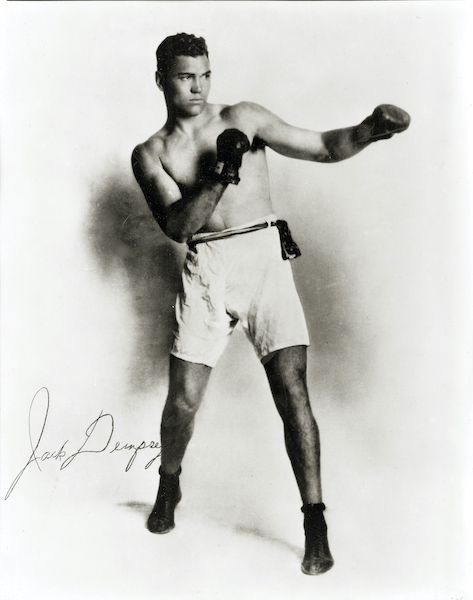
Jack Dempsey was heavyweight champion from 1919–1926, photo courtesy University of Nevada, Reno Special Collections
Willard was the betting favorite, as “The Pottawatomie Giant,” as he was known, stood over 6 feet 6 inches tall and weighed around 245 pounds. Dempsey, by contrast, was listed at 6-1 and 187 pounds.
Despite the size disparity, Dempsey overwhelmed his larger opponent with a flurry of devastating punches, sending Willard, who had never been knocked off his feet previously, to the canvas seven times in the first round. Badly beaten, Willard’s corner threw in the towel after the third round.
“I told you I would knock him out in the first round and to all intent and purpose that is what I did,” Dempsey said after the fight. “He took a lot of punishment in the next two rounds but was so feeble that I hated to have to hit him.”
With his reputation established, Dempsey cut a fearsome figure in the squared circle, going on to stop fighter after fighter with a strong left hook before barraging them with combinations of punches they couldn’t handle.
“What ailed (Dempsey’s opponents) was that they were not hard enough to knock out Dempsey, or even to do him any serious damage,” wrote H.L. Mencken, a famed essayist who covered some of Dempsey’s major fights, in the Baltimore Evening Sun. “Whenever they landed, Dempsey simply shook them off. And, in the intervals between them, he landed dozens and scores of harder ones.”
Dempsey’s stature rose in the roaring twenties. Instead of taking a fight every few weeks in one Western rodeo arena after another, he fought at Manhattan’s Polo Grounds and Madison Square Garden.
He’d go a year or more between title defenses, preferring to rest his body between fights and enjoy the good life. He featured
in the first-ever million-dollar fight, defeating Frenchman Georges Carpentier in 1921.
His fame brought him roles in films, endorsements and even the title of president in an Irish laborer’s league.
In 1925, he married Estelle Taylor, a silent film starlet with raven black hair and a penchant for playing femme fatale–type characters. A 1923 star turn as Miriam in Cecil B. DeMille’s The Ten Commandments brought her national fame and top billing on marquees from coast to coast.
‘Honey, I Forgot to Duck’
The marriage presaged the end of Dempsey’s competitive career.
In 1926, he fought in the first of two spectacular battles against Gene Tunney, an Irish New Yorker who served as the perfect foil in the press.

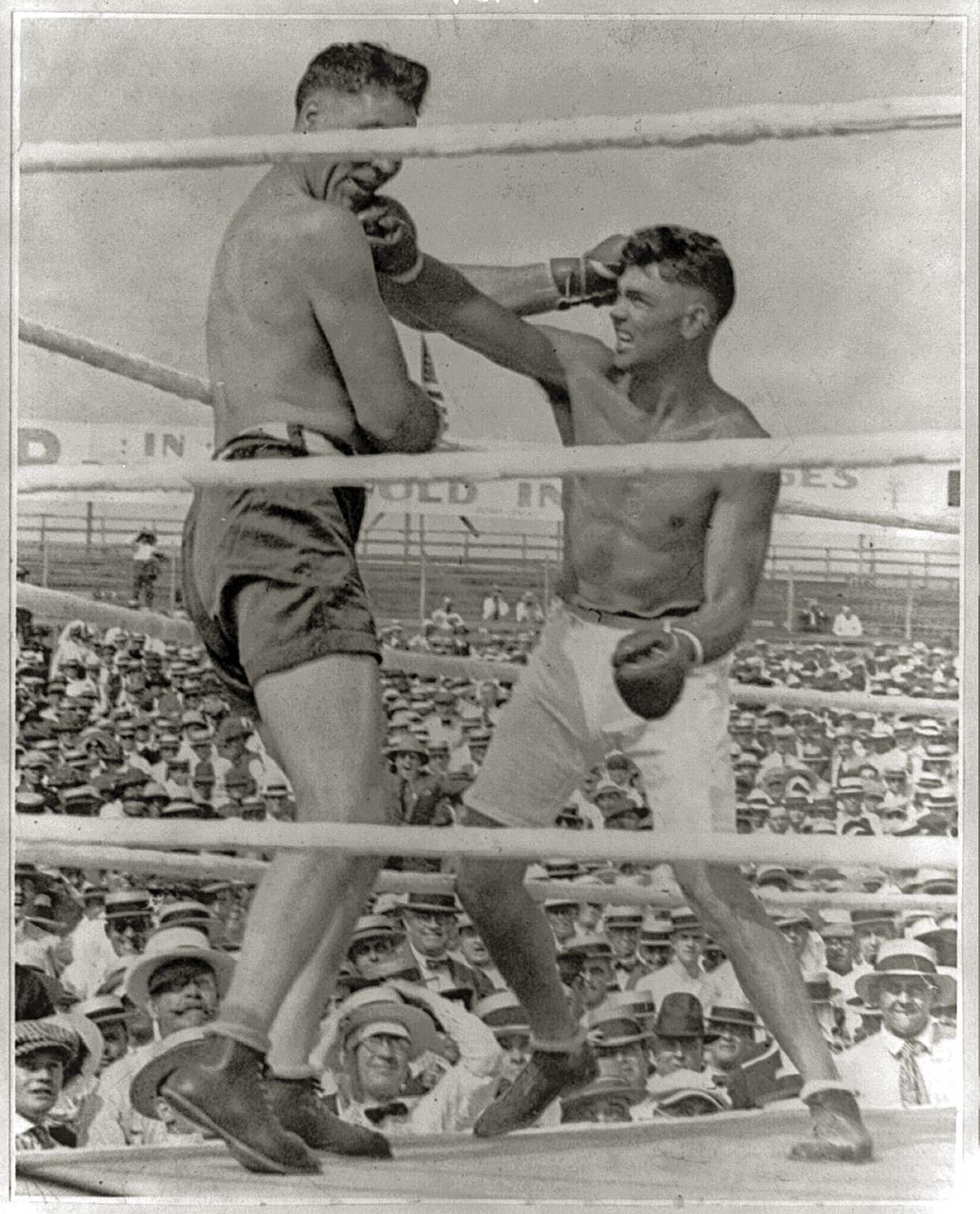
Jack Dempsey at training camp in June 1921, photo courtesy Library of Congress Prints and Photographs Division
Tunney’s Eastern manners and diction contrasted nicely against Dempsey’s rough-hewn, Western-born ways. The former was frequently photographed in New York in tuxedos and spats, the latter in cowboy hats and bolo ties.
In September 1926, they squared off in Philadelphia, with Tunney winning a unanimous decision after 10 rounds. Babe Ruth and Charlie Chaplin attended, and President Calvin Coolidge tuned in to the fight via radio from the White House.
It wasn’t the only presidential connection.
Taylor missed the fight for a film shoot and took a train to meet Dempsey in Philadelphia. When she asked him why he lost, the now-former champ responded with a memorable line.
“Honey, I forgot to duck,” Dempsey said.
Some 57 years later, President Ronald Reagan would make the same quip to his wife Nancy after a 1981 assassination attempt left him hospitalized.
Dempsey tuned up for a rematch with a fight against Jack Sharkey at Yankee Stadium in July 1927. The fight was not without controversy, as Dempsey landed a knockout blow in the seventh round as Sharkey turned to complain to the referee about what he thought was a low blow.
When asked later why he threw the left hook after Sharkey had stopped fighting, Dempsey replied, “What was I going to do—write him a letter?”
Tunney-Dempsey II was scheduled for September 1927 at Chicago’s Soldier Field, which opened three years earlier. Demand for tickets was hot, and ringside seats went for $40 each, which equates to about $770 today. The fight’s gate was $2.6 million, making it the most lucrative live entertainment event to date.
Known today as “The Long Count” fight, it ended, controversially, in another 10-round Tunney win by decision.
With nearly 105,000 in attendance, Dempsey knocked Tunney to the canvas in the seventh round. The New Yorker was wobbly and had a hard time getting to his feet. Previously, the referee would have started a 10-count when Tunney was knocked down. But, under a new rule, Dempsey had to retreat to a neutral corner before the count started.
Dempsey lingered over a prostrate Tunney, ready to pounce as soon as he rose to his feet—the same aggressive tactic he used against Willard in his brutal beatdown eight years earlier. The referee had to push Dempsey toward his corner, costing valuable time, and Tunney eventually stood by “nine” on the delayed count.
Boxing historians argue today over whether Dempsey would have won the fight under the old rules. But it wasn’t to be. Dempsey went on to lose the final two rounds and subsequently the fight, after which he decided to ride off into retirement.
From 1931–34, that ride would include a layover in Nevada, a small state with some big ideas.
Destination Divorces
In spring 1931, Nevada’s lawmakers made an aggressive push to protect and expand a peculiar Silver State industry: divorce.
The state’s governors and assembly had long been far friendlier to the institution than the rest of the country.
“Nevada was always trying to bolster its population. It became a state early and had to constantly maintain its population numbers,” says Dr. Angela Moor, a professor of history at the University of Nevada, Las Vegas, whose dissertation focused on the history of quick marriages and divorces in Nevada. “Because it was trying to maintain those numbers, it had looser requirements to be a bona fide resident.”
In practice, that meant Nevada for much of its early history had a six-month waiting period to establish state residency, at which point residents could petition for divorce. Its marriage laws didn’t require blood tests or waiting periods, and divorcees could remarry immediately.
Compared to other states and territories, Nevada’s laws were lax. California had a three-day waiting period before issuing a marriage license, and in New York couples couldn’t remarry for a year after divorcing. Most states required blood tests to rule out or treat venereal diseases. Nevada’s courts asked for none of the above.
The laws drove a small but notable industry of Americans traveling to Nevada and setting up shop at least temporarily to wait out the six months before suing for divorce.
But by 1931, Nevada’s monopoly on easy hitching and splitting was under siege. Lawmakers in Arkansas, Idaho and Arizona sought to match Nevada’s waiting period.
In response, the state’s legislature passed the drastic reduction to six weeks. It would take effect in May of that year.
“They didn’t want anyone coming for their piece of the divorce pie,” Moor says.
The law became an instant sensation, drawing headlines from Los Angeles to Detroit to New York. It also paid dividends, as Nevada’s divorce total climbed to 5,273 in 1931 from 2,718 the year before, Moor says.
Following the new divorce law like a shadow was its requirement that petitioners actually reside in Nevada. As a result, dude ranches popped up in Reno and around Lake Tahoe’s Nevada side with the express purpose of giving wealthy people something to do while they waited out their six weeks.
“They were basically cosplaying a Western person for six weeks,” Moor says. “Riding horses. Sitting around a campfire. Women could maybe have an affair with a ranch hand.”
Dempsey, who rose to fame with his fists, initially indicated his intention to work as a ranch hand during his stay, according to newspaper reports.
However, he ended up first at the Riverside Hotel, which Moor describes as a “haven” for divorcees, before settling on a $1,000-a-month stay at the Steinmiller House, a stately brick mansion on Court Street.
Champ on the Ropes
Despite good living on a steady diet of gambling, hunting trips and horse races, the champ had seen better days.
Dempsey and Taylor lived in a mansion in Los Angeles’ Los Feliz neighborhood, an upscale hillside community tucked between Hollywood and Echo Park.
One year Dempsey’s senior, Taylor espoused a love for animals, the stage and screen, and a disinterest in domestic life—three marriages would eventually end in divorce, and she never had children.
Dempsey, whose first marriage ended after three years in 1919, was beginning to think about a family, an irreconcilable difference between the two.
Exacerbating all this was financial anxiety caused by the Great Depression.
Starting in 1929 with a stock market crash, the downswing erased much of Dempsey’s fortune, reputed to be north of $3 million. Investments in mining, real estate and stock speculation went belly-up. Fights promoted by Dempsey drew meager crowds. The couple’s house had lost about a fifth of its value, with no prospects of a quick rebound.
With his wealth plummeting, Dempsey turned to the one thing he could always count on to generate income: his fists. He flirted with a comeback and trained diligently at the Reno Boxing Club in the summer of 1931 before a series of exhibition fights.
At the boxing club, a part-time fighter named Imey Garfinkle trained regularly. Garfinkle had a 4-year-old son named Buddy who tagged along and played under tables while his dad sparred.
Imey and one of the press photographers who followed Dempsey around cooked up an idea for a picture that would become an iconic bit of imagery: a staged photo of Buddy squaring off with the champ in the ring.
In the shot, Dempsey towers over the diminutive Garfinkle.
“I didn’t want any part of that picture at first; he was so big,” Garfinkle said in a 2008 interview at his Incline Village home, where a copy of the picture still hung. He was 81 at the time but said he remembered the moment clearly. “But my dad told me to get in the ring, and I did.”
Garfinkle died in 2019, but the picture has lived on in Dempsey lore. It serves as the cover image for Dempsey in Nevada.
Dempsey’s comeback efforts were fruitful if not fully realized. He fought well in 62 exhibition matches throughout the Midwest and West Coast in 1931, earning some $200,000. But he stepped away from the ring for good (almost) in early 1932 to come home to Reno (he fought three more exhibition matches in 1940 in a final comeback attempt).
Single Once More
As Dempsey wended his way through the end of his fighting career, the court battle between he and Taylor heated up.
The petition finally made its way to a Reno court in September 1931, following an acrimonious summer between the boxer and actress.
On the day of the hearing, a morose Dempsey claimed spousal neglect led to the end of the marriage.
“Dempsey took the witness stand for about 20 minutes and related that his wife’s motion picture and stage career had broken up their marriage,” according to an AP report from the Reno courtroom.
He charged that Taylor “would not make a home, and preferred a career to matrimony.”
Legal wrangling ensued. By late December, Taylor would accept the Nevada divorce decree on the condition that Dempsey pay off about $40,000 in mortgage and car loans. The champ was free.
The following year, Dempsey began rallying local businessmen to support the Reno Rodeo, which had gone defunct after a bankruptcy a decade earlier. He was in demand in the Biggest Little City, speaking to rotary clubs and appearing at horse races and casinos.
The press followed the newly single boxer everywhere and reported on his love life.
“In that period of my life, I must have been linked with everyone in a skirt,” Dempsey wrote in his 1977 autobiography. “Sure, I screwed around, but so did everyone else I know.”
He promoted a heavyweight fight before a crowd of 8,000 in Reno on July 4, 1932, between Max Baer and King Levinsky. Set in “Dempsey’s Bowl,” the match drew Hollywood celebrities and Fred Balzar, Nevada’s governor.
The crowd, however, was paltry by Dempsey’s standards and he began to take acting jobs elsewhere to meet the needs of his wallet and ego.
“It had been demonstrated to him that Reno held no rosy future for an ex-champion or a versatile fight promoter who hoped to cash in on his reputation and ability,” wrote Joe McDonald in a Detroit Free Press feature in December 1932.
Marriage, Take Three
Dempsey wasn’t quite done with Nevada. Home in the early ’30s was still on Joaquin Miller Avenue in Reno, and close friends like Wingfield and Balzar comprised his social circle.

Jack Dempsey and actress Hannah Williams after their wedding in Elko in 1933, courtesy photo
In spring 1933, tabloids began reporting on Dempsey and a “cheerful little earful” from the Broadway stage, actress Hannah Williams. A rumored Reno wedding was in the offing.
On July 18, however, Dempsey, 38, and Williams, 22, snuck into a courtroom in Elko, Nevada, for a quickie marriage.
The couple “motored across the desert from Salt Lake City and during the night and registered at a local hotel as ‘Mike Costello’ and ‘Jane Gray,’” read an AP report. “Dempsey and his bride left by automobile for Reno, where their romance began last March.”
That romance began, in a very Nevada quirk of fate, while Williams was waiting out her six weeks in Nevada to divorce Roger Wolfe Kahn, a bandleader and son of a wealthy New York financier named Otto Kahn.
They left Nevada for New York in 1934 and went on to have two daughters. In 1943, history would repeat itself yet again—although this time in a much unfriendlier New York courtroom—and the couple would divorce.
The champ, it seems, was at his best in the ring rather than wearing one.
Kyle Magin is a writer based in Durham, North Carolina.
No Comments