



28 Sep Wheels for the Journey
Exploring the most capable and comfortable rigs for off-road adventures
We’ve all heard the popular refrain: “It’s about the journey, not the destination.” For folks living in the Lake Tahoe region, that journey can often be found right out the back door, without ever having to drive anywhere. But for people living in urban areas far from the backcountry, or for those looking to venture well off the beaten path, a capable vehicle for the journey is a must.
Drive around Tahoe any given weekend, and you may see more adventure vehicles per square mile than anywhere else in the country. Sprinter vans, pickup trucks with pop-up campers, SUVs with rooftop tents, and even minivans with lift kits and all-terrain tires are common sights at virtually every trailhead, campground and grocery store in the region.
In summer, most have mountain bikes or paddleboards attached, and in winter, skis and snowboards. Whether we like it or not, vehicles are a necessity in this modern world of leisure, and if set up properly, they can be quite comfortable while enabling bigger adventures.
The key is narrowing down your interests and where you want to go—and, most importantly, deciding what you can afford.
‘Less is More’
Carson City resident Harry Wagner has worked as a freelance journalist covering the 4×4 and off-road world for the past 25 years and has a YouTube channel called Harry Situations, where he helps educate people about off-road vehicles.
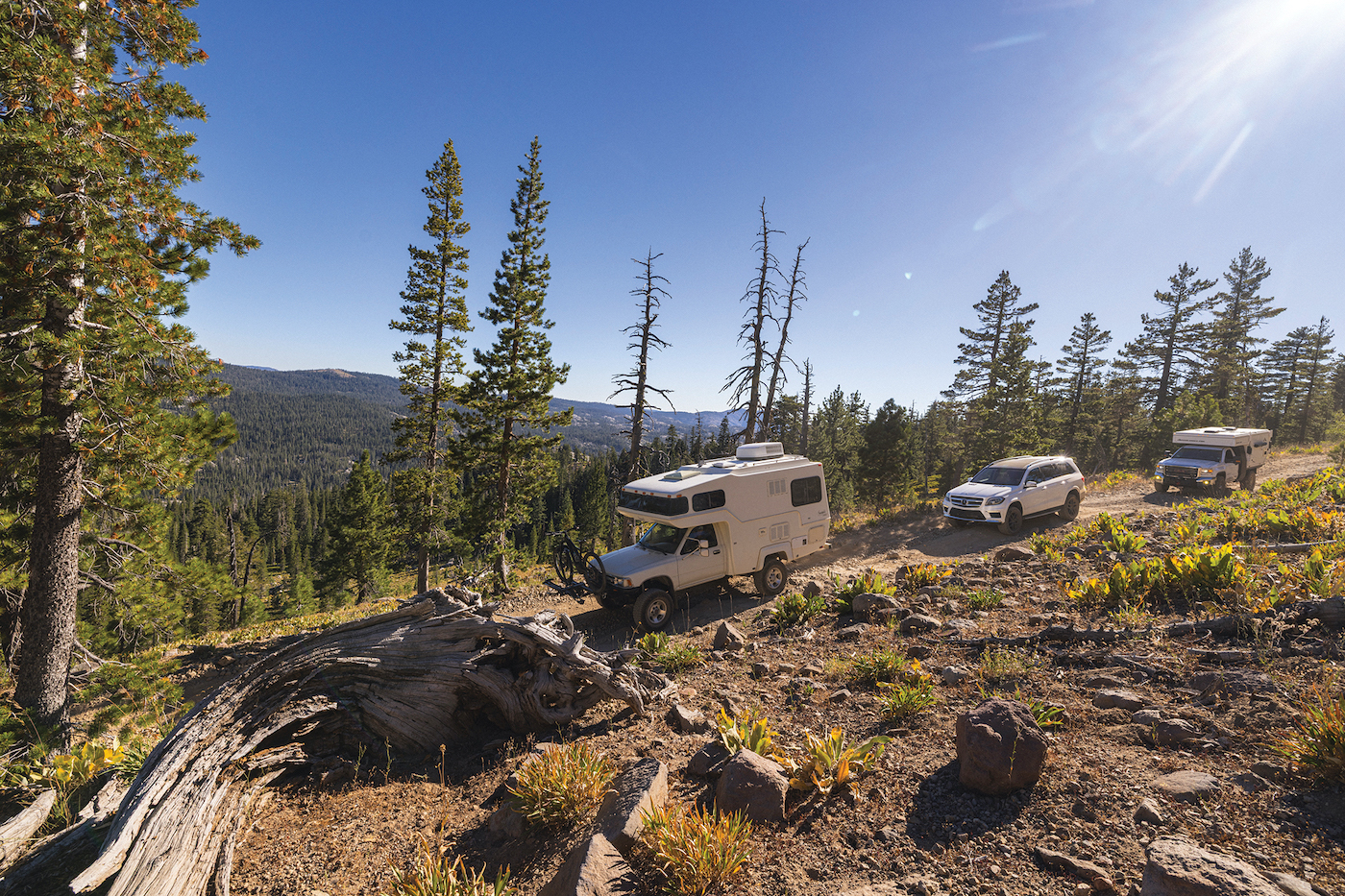
Author Kurt Gensheimer’s customized Toyota Sunrader flexes out its suspension en route to White Rock Lake, photo by Ryan Salm
When recommending vehicles to friends, Wagner likes to use his own Venn diagram with two overlapping circles. One side of the circle represents “capability off-road” and the other side “comfort on-road.” The overlap is “comfort in camp.” He says finding a balance between on-road comfort and off-road capability is important for a good adventure vehicle.
But there is a point of diminishing returns, especially when adding weight to your vehicle.
“With adventure vehicles, less is more,” Wagner says while camping at White Rock Lake north of Truckee for Episode 93 of Mind the Track Podcast. “Every modification you make to your vehicle potentially makes it worse. You really have to question whether or not you need that modification. Toyotas are popular, and in stock form they aren’t bad, but if you add any weight, they quickly become overloaded.”
Wagner got his start in the off-road world at a young age, hanging out as a kid at his dad’s 4×4 repair shop in Yuba City. On weekends, his family would make trips up to the rugged Rubicon and Fordyce Creek trails, while seeking out remote mountain lakes where the fish bit hard and often.
He has owned dozens of vehicles over the years, from Toyotas and Jeeps to Dodges and Fords and even Suzukis. Wagner has also traveled the world in 4x4s, rock crawled them up granite slabs, raced them across deserts and seen pretty much every build under the sun from mild to wild.
Since the pandemic, Wagner has witnessed an explosion in “overlanding” vehicles, a trendy term for rigs built to drive far down bumpy dirt roads to reach remote camping spots. They’re easy to spot, as they typically feature fancy aftermarket bumpers with winches, traction boards and gas cans strapped somewhere on the pristine, polished body, often accompanied by a rooftop tent.
These vehicles look more suited for the Sahara than the local commute, with the main difference being that most of the accessories strapped to the trucks around Tahoe have never been used.
“I think a lot of folks during the pandemic got into needing all this gear to go camping,” says Wagner. “When my wife was pregnant with our son, I came home from Target with bags of stuff. She’d ask, ‘What is all this?’ And I said, ‘I don’t know, they said we need it, so I bought it.’ It was an epiphany for me, because I grew up in the outdoors. I know what I need and don’t need. These folks buying all this gear for the outdoors, they don’t know.”
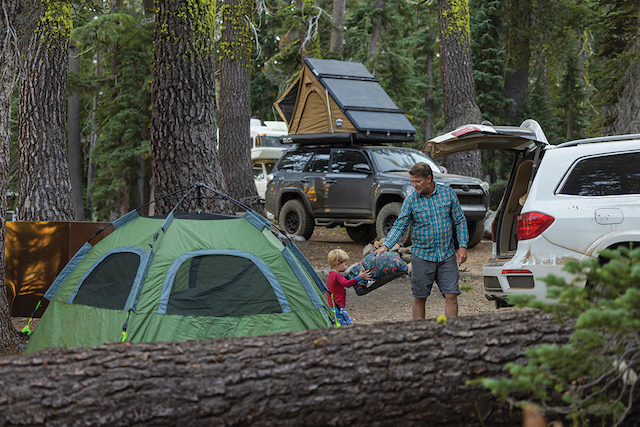
Harry Wagner shares the same camping experiences with his son that his dad shared with him, including setting up a good old-fashioned tent, photo by Ryan Salm
Now that Wagner is a father, he’s been sharing with his son the same off-road camping adventures that his dad shared with him. For such a seasoned off-road expert, you’d think Wagner would have the ultimate 4×4 setup, but he recently sold his Ram pickup with a pop-up Four Wheel Camper to put cash down on a new house.
His current adventure vehicle?
“It’s a completely stock 2015 Mercedes-Benz GL550 that I bought for $10,000,” says Wagner. “I’ve never owned a Mercedes before, and it’s the first vehicle I have no idea how to work on, but the price was right, and it fits the family.”
Wagner likes the Mercedes because of its luxurious ride and balanced on-road and off-road capabilities, featuring an advanced air suspension system that raises the body 3 inches for better clearance, then drops back down for optimal performance on pavement.
Because he doesn’t know how to work on such an advanced vehicle, Wagner admits he’s a little concerned about the cost of repairing the suspension if it fails. But, because he bought it for a bargain price, he won’t be out too much money if the repair bill approaches five figures.
He also doesn’t have a fancy rooftop tent on his Mercedes, just a regular old tent that pitches on the ground. Sleeping on the ground in a tent seems like a huge step backward for Wagner, but what he’s learned over the years is that the more you adventure, the less you need. Besides, Wagner is not a fan of rooftop tents, and he explains why in detail on his YouTube channel (search “rooftop tents Harry Situations”).
“They’ve become more of a look than a functional piece of camping equipment,” says Wagner. “Even cheap ones are still expensive and cumbersome. But if being off the ground makes someone feel safer and gets them outdoors, more power to them.”
Knowledge is Power
While Wagner is content roughing it on the ground like a Pacific Crest Trail through-hiker, most 4×4 enthusiasts prefer a level of comfort and convenience considerably higher.
That’s where K.P. Pawley and his Reno-based company Zero Declination come in.
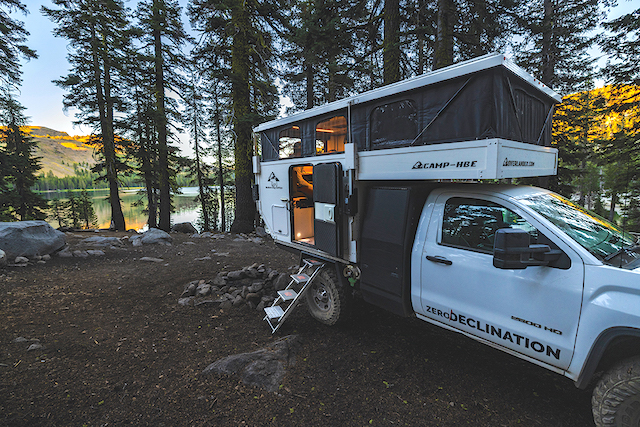
K.P. Pawley’s Zero Declination GMC Sierra at White Rock Lake, photo by Ryan Salm
Pawley grew up on a farm and was always surrounded by working farm trucks—mostly Chevrolet pickups—that were always overloaded with weight but did a great job carrying it. So when Pawley was 18, he used all his money to buy a 2006 Chevy Silverado 2500 4×4 with a regular cab and a long bed. In 2016, he put a pop-up Four Wheel Camper in the back of his then 180,000-mile Silverado and took off on a three-year journey along the Pan-American Highway.
In those three years, the Silverado proved its reliability, suffering only one breakdown on the trip: a worn-out wheel bearing in Ecuador. Although the part cost him $600 to import, Pawley had the know-how to work on his own truck and was able to diagnose the issue, gauge its severity and repair it himself.
Asked about the number one piece of gear that saved him on his three-year journey, Pawley says it wasn’t so much the gear: It was his knowledge.
“Having mechanical knowledge from the farm and working on trucks as a kid is what made the trip go smoothly for me,” he says. “If you have an old truck, you have to know how to work on it. If you know nothing about mechanics, you will end up paying a lot of money relying on others.”
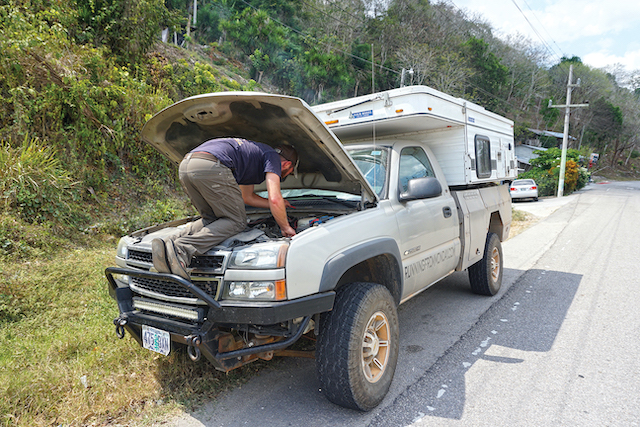
K.P. Pawley under the hood of his Chevy Silverado during a three-year Pan American Highway adventure, courtesy photo
This mechanical knowledge while on a journey hearkens back to the days of the Grateful Dead and the army of Volkswagen Microbuses following every show. The only reason Deadheads could continually follow Jerry and friends was their mechanical knowledge and the utter simplicity of a VW. It was not uncommon to see an air-cooled VW engine in a stadium parking lot with a handful of hippies lifting it into the engine bay.
Pawley’s Pan-American adventure changed his life trajectory, and when he returned home, the last thing he wanted to do was get a normal job. Because he had completely rewired his Four Wheel Camper before driving to Argentina, he began rewiring other people’s campers for income. That opportunity grew into his current business.
Zero Declination
Named for the convergence of magnetic north and true north, Zero Declination is geared toward customers aiming for the dead center of Wagner’s Venn diagram: “comfort in camp.”
Pawley’s builds are all based on full-size, three-quarter or one-ton truck platforms, because based on his Pan-American journey and childhood observations, he believes these trucks are best suited to carry weight and drive off-road.
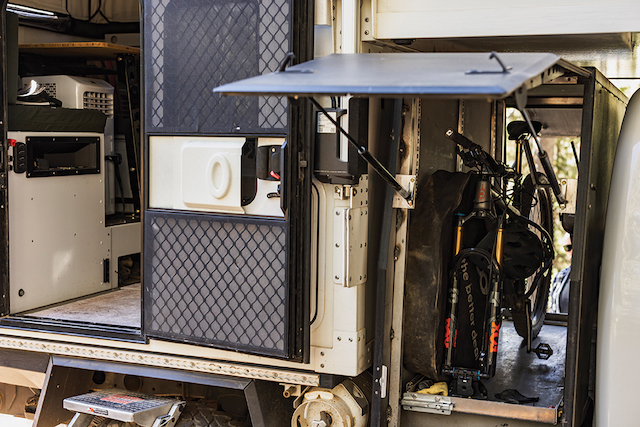
K.P. Pawley’s OEV pop-up camper is filled with creature comforts, including cooking and dining accessories and a slick Gear Garage that he innovated, photo by Ryan Salm
Zero Declination sells aluminum flatbeds and pop-up campers from Canadian company Overland Explorer Vehicles (OEV), known for top-notch build quality and four-season insulation.
And because Pawley is an avid mountain biker, skier and watersport enthusiast, he created what he calls the Gear Garage, a storage cabinet sandwiched between the truck cab and the camper body, large enough to fit skis and boards or two bikes. It’s an innovative, tucked-in storage cabinet with a slide-out tray that’s hardly noticeable.
Zero Declination isn’t just a camper retailer—it’s also an install shop for everything from solar panels, inverters and wiring to flatbeds and toolboxes.
Pawley is a no-nonsense guy and walks the talk, as he lives full time in his OEV-equipped 2016 GMC Sierra when not at his shop. He does not hold back his opinions about adventure vehicle builds and will even turn down a sale if he doesn’t think it will properly serve a customer’s needs.
Like Wagner, Pawley believes the biggest mistake people make when building an adventure vehicle is adding too much weight.
“Everything you do to your truck makes it worse,” he says. “It might make it better in some ways, but it’s going to make it worse in other ways. I’m not saying don’t modify your vehicle, but be thoughtful before making modifications. People like to say, ‘Well, you never know.’ Yes, yes you do know. People have camped in the woods before. On the whole, the adventure vehicle industry sells fear in order to sell more stuff, and that can be a barrier for people.”
Adventure on the ‘Cheap’
Another barrier for people is the astronomical cost of new vehicles. According to Kelley Blue Book, a new vehicle averages $49,855, with full-size trucks running north of $60,000.
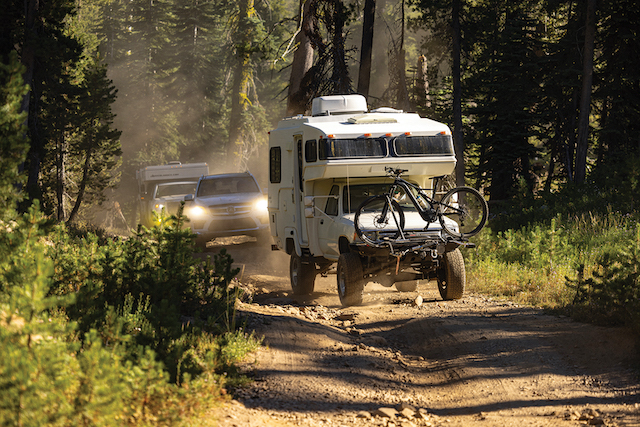
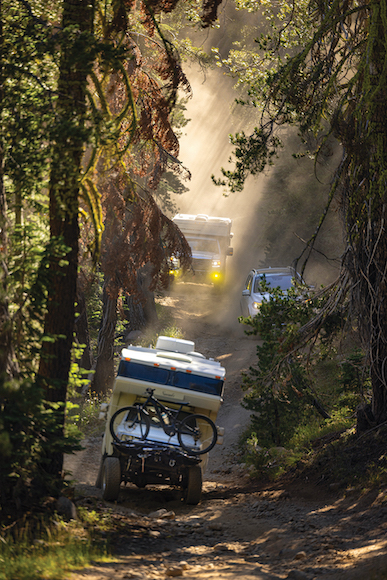
Author Kurt Gensheimer leads the way to White Rock Lake in his customized 1990 Toyota Sunrader 4×4, photo by Ryan Salm
Long gone are the days of inexpensive 4×4 trucks with basic equipment known as the “poverty package.” Most new trucks are highly equipped with luxury interiors and a host of advanced electronic features. For many adventurers who prioritize playing outside over making money, a new vehicle is pretty much out of the question.
So, what used vehicles make good adventure rigs?
Because of Pawley’s experience with Chevy trucks, he recommends the 1999–2007-era Chevy Silverado and GMC Sierra platforms, as well as the Tahoe and Yukon SUVs and the Express van. They can often be purchased in good condition for under $10,000 and feature powerful V8 engines with outstanding reliability. Parts are also cheap, widely available and can be installed by anyone with basic mechanical skills.
Wagner is a fan of the first-generation Toyota Tundra made from 2000 through 2006, known for its supreme reliability and
off-road comfort.
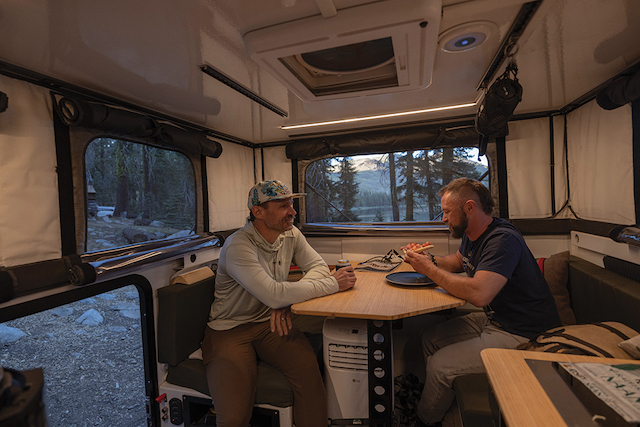
K.P. Pawley enjoys a meal with author Kurt Gensheimer in his OEV pop-up camper, photo by Ryan Salm
He also recommends an often overlooked option, a Suzuki Grand Vitara, a compact SUV along the same lines as a Toyota RAV4 or Honda CRV.
Chevy Astro vans are another popular option for budget-conscious ski bums, featuring factory all-wheel drive and a reliable V6 engine.
Pawley and Wagner both warn that owners of older vehicles should know how to work on them if planning a long journey off the beaten path. Both also advise against buying exotic right-hand-drive imports like Toyota Land Cruisers, Land Rovers or Mitsubishi Delica vans. Most mechanics in the U.S. won’t work on them, and parts can be difficult to source.
As for personal comfort in camp, Pawley says whatever vehicle you have, make sure it offers a warm and dry space to get out of inclement weather. Rooftop tents won’t cut it in a storm.
Off-Road Capabilities
When it comes to off-roading, a winch is tricky because 99 percent of the time you don’t need it, says Pawley. But that 1 percent of the time, you really need it.
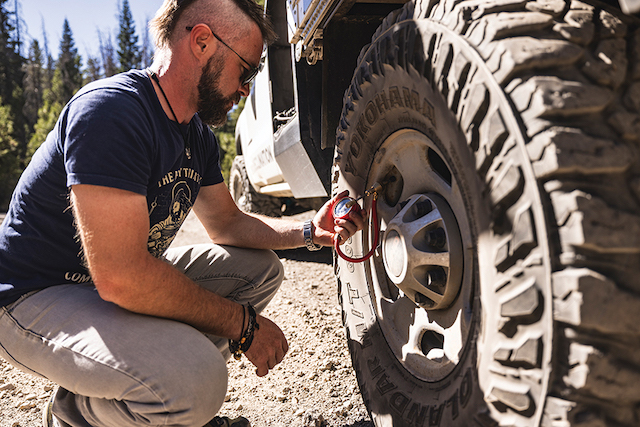
Before heading off-road, K.P. Pawley airs down to 50 percent of street tire pressure for improved comfort and traction, photo by Ryan Salm
Winches can also be deadly if they are not properly used. Before investing in a winch, Pawley recommends buying tow straps and a good shovel, especially for spring skiers in the Eastern Sierra, or anyone who likes to venture out in the snow.
Both Wagner and Pawley recommend traction boards, which work well in sand and snow, are lightweight and are far less dangerous than a winch. They also advise against spending thousands of dollars on LED lights, which are often too powerful to use effectively and are rarely needed.
More important than fancy accessories are a good set of all-terrain tires. Those who frequently drive in snow will want to find a tire with a three-peak mountain snowflake logo embossed on it, indicating an advanced rating for snow and ice.
Wagner is sponsored by Nitto Tire and likes the company’s Recon Grapplers and Trail Grapplers. Pawley currently runs 37-inch Yokohama Geolandar tires on his GMC Sierra, but he has also run all-terrain Toyo Tires and was impressed with how many miles they lasted.
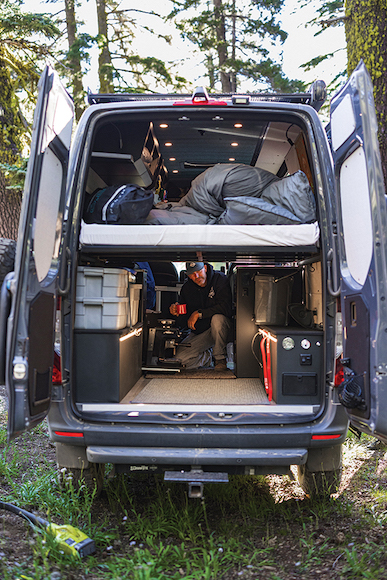
Tom Beckering shows off why Mercedes-Benz Sprinter vans are so popular, as his features ample gear storage and even an espresso machine, photo by Ryan Salm
Before heading off-road, airing down at the trailhead is recommended to maximize off-road comfort and capability, especially in sand and snow.
As a starting point, Pawley recommends removing 50 percent of whatever street tire pressure users run. So if a vehicle’s street pressure is 40 pounds per square inch (psi), air down to 20 psi. Not only will this make the ride more comfortable, but it puts less wear and tear on suspension components while providing considerable traction improvement.
When returning to pavement, airing up is a must, which means either purchasing an air compressor or finding a nearby service station.
Of course, no feature about adventure vehicles would be complete without Mercedes-Benz Sprinter vans.
For Pawley, vans are great for a specific type of buyer, but he is adamant that a full-size truck with a body-on-frame platform and a 4×4 with a transfer case is much better in rugged off-road situations than a unibody van with an all-wheel-drive system. If off-road capability is not as important, a van is a viable option, especially for folks with gear-intensive hobbies.
At the end of the day, both Pawley and Wagner agree that avoiding unnecessary weight and keeping modifications simple are the most important things with adventure vehicles. Consider the gear you think you might need and note what you’re missing each time out.
And remember, everything you do to your vehicle can potentially make it worse, not better.
A self-described gearhead, @trail_whisperer converted his 2WD Toyota Sunrader to a 4×4 in 2019, along with an engine swap. Seven years and 30,000 miles later, it’s still going strong. Listen to his adventures on the @mindthetrack podcast.
No Comments