




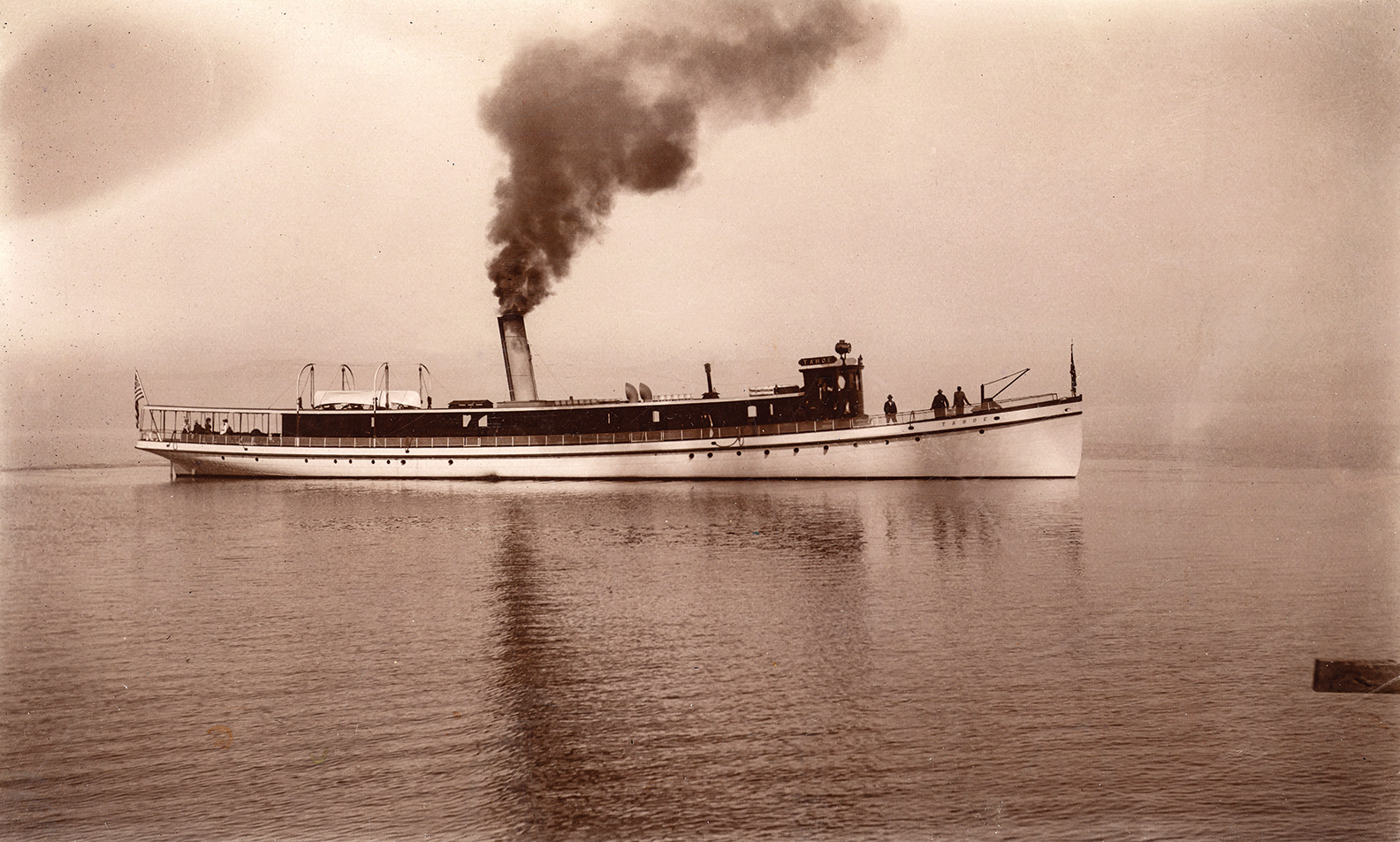
28 Sep Ghost Ships of Lake Tahoe
Beneath the surface of North America’s largest alpine lake, a lost world of sunken vessels hearkens back to an erstwhile era rich with maritime culture
Lake Tahoe has always inspired people to look across its brilliant blue surface. But some of its most intriguing stories lie beneath it.
For more than a century and a half, Tahoe has supported a remarkably active maritime world—from the hard-working boats of the first commercial fisheries to magnificent trans-Tahoe steamers, elegant private yachts, speedy Chamber’s Landing race boats, mail boats, logging boats, launches and countless lesser craft that once stitched the communities around the lake together.
Inevitably, some never made it home. They slipped beneath the azure surface and into Tahoe’s cold, inky depths, leaving behind wrecks, mysteries, rumors—and legends.
These are Tahoe’s ghost ships: vessels such as the great S.S. Tahoe, the extraordinary Thunderbird yacht, the mail boat Marian B, Shanghai and others whose stories illuminate an almost forgotten life on the lake. Some were famous in their day; others were ordinary working boats whose names have nearly vanished from memory.
Together, they reveal a Lake Tahoe that was once far more dependent on its waterways than the lake we know today.
Eternal Rest for the Queen
Of all the vessels claimed by Lake Tahoe, none has acquired a more enduring legend than the S.S. Tahoe.
Launched in 1896, the great steamer was once the queen of the lake, carrying mail, freight and wealthy visitors between Tahoe’s scattered resorts and communities.
By the 1930s, however, highways and automobiles had made the grand steamers obsolete, and in 1940 the S.S. Tahoe was deliberately scuttled off Glenbrook in what was intended as a dignified final resting place.
But the old ship did not settle where expected; instead, she slid down the steep underwater slope of Glenbrook Bay and came to rest hundreds of feet below the surface. There she has remained for decades, intact but unreachable to ordinary divers.
Her discovery and later exploration only deepened the mystique: the once-bustling steamer that had carried generations across the lake now rests in perpetual darkness, one of Tahoe’s most evocative links to its vanished maritime age.
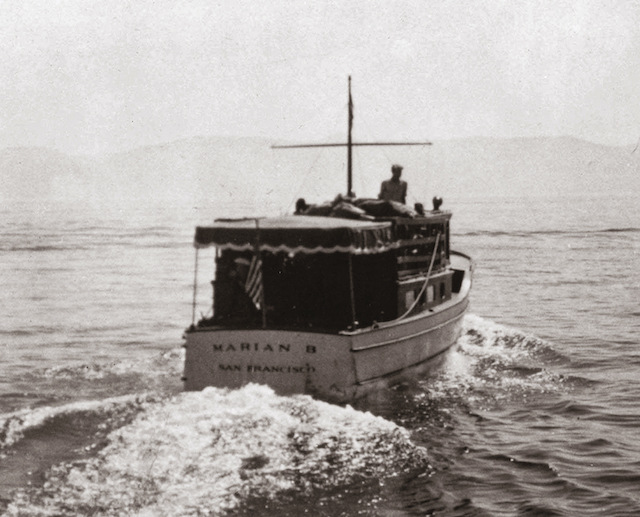
The Marian B. was a 42-foot-long, twin-engine cruiser that delivered mail on Lake Tahoe
Final Delivery
On May 18, 1941, Lake Tahoe swallowed the last U.S. Mail boat to ply its waters.
The 42-foot Marian B., a fast twin-engine cruiser that had carried mail around the lake for seven years, ventured onto Tahoe with three souls aboard: her pilot, the mail clerk and the pilot’s 10-year-old son. A violent storm swept across the lake, and somewhere off Tahoe’s East Shore—near George Whittell’s Thunderbird Lodge—the Marian B. vanished.
What happened in those final moments remains uncertain, but the evidence was grim. Charred debris later found on the lake suggested that the vessel may have exploded or caught fire before breaking apart. All three aboard died; bodies and wreckage came ashore in the aftermath, although the pilot himself was never recovered.
The Marian B.—her hull, engines and final resting place—was never conclusively located intact, leaving the little mail boat lost somewhere in Tahoe’s immense depths, where it remains one of the lake’s most significant and haunting ghost ships.
The disaster also brought one of Tahoe’s most extraordinary vessels into the story.
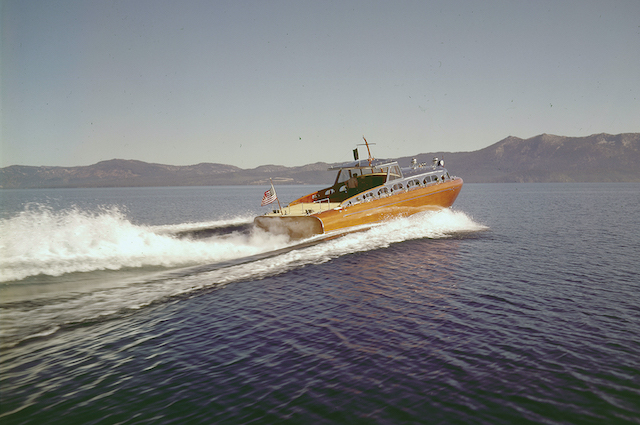
The iconic Thunderbird yacht pictured in 1965
Only the previous summer, millionaire George Whittell Jr. had launched his spectacular new Thunderbird, the sleek mahogany motor yacht he kept at his secluded East Shore estate. When word spread that the Marian B. was missing, virtually in Whittell’s front yard, the U.S. Coast Guard—which dispatched a search plane from the San Francisco Bay Area—asked Whittell to join the search aboard Thunderbird.
Local newspapers reported that Whittell personally mounted a search in the yacht, whose speed and powerful equipment made her uniquely suited to comb the water near the lodge.
Contemporary Tahoe lore adds the unforgettable image of Thunderbird working through the darkness, her searchlights sweeping across the waves and granite shoreline for some sign of the missing boat and its passengers.
It is an eerie convergence of two Tahoe legends: one magnificent vessel, barely a year old and very much alive, searching the black night for another that had simply disappeared. Thunderbird eventually returned to her boathouse. The Marian B. never did.
Living Ghost
Not every one of Tahoe’s ghost ships lies on the bottom. For years, the sleek and powerful Thunderbird was arguably the lake’s most famous living ghost ship—a vessel more often whispered about than seen.
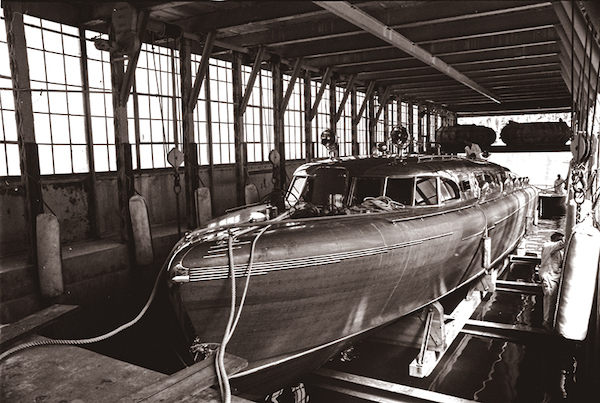
First launched on Lake Tahoe in 1940, Thunderbird has spent much of her life hidden away in George Whittell’s boathouse at Thunderbird Lodge
A 1960 Nevada State Journal article began by conjuring the image of “a nautical ghost rising from the depths of Lake Tahoe,” only to reveal that the real apparition was Thunderbird herself, hidden away in Whittell’s massive boathouse at Thunderbird Lodge.
The paper described the 55-foot yacht as a mahogany-planked, copper-sheathed speedster capable of extraordinary performance, yet noted that she had spent most of her life kept out of public view. The reporter even observed that, as far as anyone could determine, Thunderbird remained sealed inside her steel-and-rock boathouse, inaccessible to all but invited guests.
For a boat capable of commanding everyone’s attention, her greatest talent may have been disappearing.
Unlike the wrecks resting in Tahoe’s deep water, Thunderbird became a ghost ship by vanishing in plain sight—a fabulous, almost mythical yacht rumored to possess tremendous speed and power, sleeping behind closed doors for years at a time, emerging only when her famously private owner chose to let Tahoe catch another glimpse of her.
In the Shallows
Most of Lake Tahoe keeps its ghost ships well hidden. With depths plunging beyond 1,600 feet, much of the lake bottom belongs to the imagination. Emerald Bay offers something different.
Sheltered and comparatively shallow, the bay provides a rare window into the sort of maritime debris that may lie unseen elsewhere around Tahoe. Here, instead of merely imagining the little boats that once crowded the lake, divers can actually swim among them.
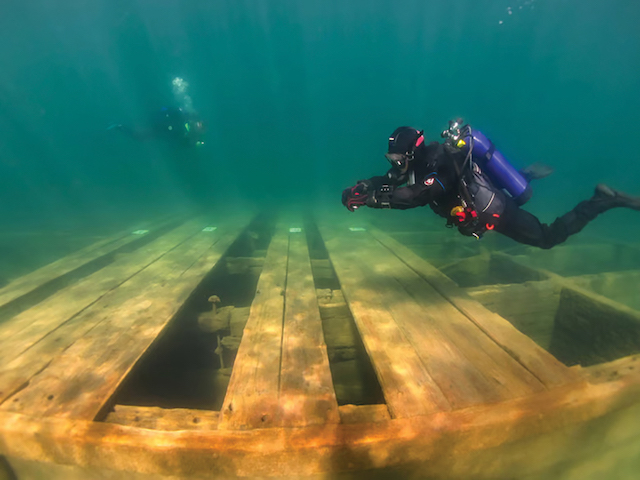
Beneath the surface of Emerald Bay lies sunken fishing boats, rowboats, motorboats and other small craft that once worked on the waters of Lake Tahoe
Beneath Emerald Bay lies what amounts to a miniature lost fleet. Near the old Emerald Bay Resort are fishing boats, rowboats, motorboats and other small craft, many apparently sunk at their moorings after their useful lives were over.
Among the most evocative is the Florence M., a 27-foot passenger launch built by Stephens Brothers in Stockton in 1915 and brought to Tahoe in 1926 to carry resort guests on excursions.
Nearby rest two wooden fishing boats, including one fitted with a live-bait well, and a hard-chine skiff.
Farther along the bay lie two immense wooden barges, once used to haul cordwood and, during the summer season, automobiles across the lake.
California State Parks linked several of these wreck sites in 2018 as the Emerald Bay Maritime Heritage Trail—the first trail of its kind in California. Its interpreted wrecks lie in roughly 10 to 60 feet of water, unusually accessible by Tahoe standards.
The lake’s cold water has helped preserve the century-old hulls, frames and timbers, leaving behind an extraordinary cross-section of the ordinary craft that once served Tahoe’s resorts, fishermen and visitors.
Perhaps that is what makes Emerald Bay especially intriguing in a story about Tahoe’s ghost ships: The bay may not be exceptional because boats sank there; it may be exceptional because its shallow bottom allows us to find them.
If this small corner of Tahoe holds fishing boats, launches, barges and the remnants of a resort fleet, what rests beyond sight in the deeper lake? Emerald Bay offers a tantalizing glimpse of a submerged maritime landscape that may extend far beyond this famous bay.
The Lost Fleet
Long before Tahoe’s sleek mahogany runabouts and great excursion steamers became the lake’s maritime icons, another fleet worked its waters with a less glamorous purpose: catching fish by the ton.
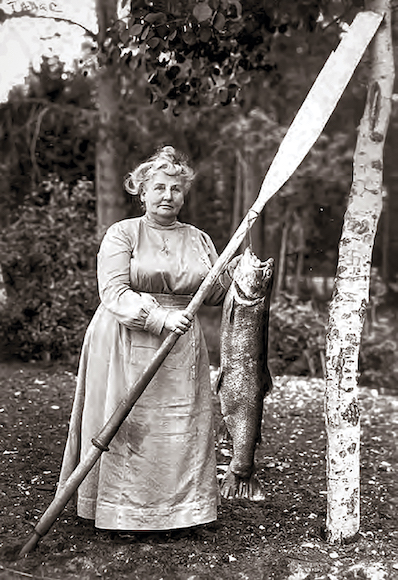
This image of a woman with a Lahontan cutthroat trout in the late nineteenth century was often used by resorts to promote Lake Tahoe’s commercial fishery
Commercial fishing took off with the Comstock boom after 1859, when Carson City and hungry mining camps like Virginia City created a ready market for Tahoe’s astonishingly abundant Lahontan cutthroat trout. Fishermen scattered around the lake worked from sturdy small boats, concentrating especially near the mouths of spawning streams, where trout could be intercepted in staggering numbers.
Surviving records do not appear to give us a reliable census of the fishing fleet, but this was no handful of gentlemen anglers: It was a sustained commercial industry supplying hotels, resorts, towns and entire cities. In 1880 alone, California officials recorded roughly 70,000 pounds of native Tahoe trout taken commercially—a harvest requiring countless boat trips hauling thousands upon thousands of fish ashore.
Few operations better capture the almost industrial ferocity of the fishery than Friday Burke’s Burke & Company, established near Burke Creek on Tahoe’s East Shore.
Burke’s fishermen reportedly deployed seine nets 600 yards long—six football fields of netting—across waters used by spawning cutthroat and could take as much as 1,000 pounds of trout in a single night. Elsewhere in the Tahoe-Truckee watershed, contemporary observers described catches measured not in individual fish but in hundreds of pounds per fisherman per day.
It is easy to picture the scene now largely vanished from Tahoe’s collective memory: fishing boats slipping away from shore in the evening, men paying out immense nets into the dark water, then returning low in the stern under heaps of silver-sided trout destined for mountain kitchens and mining camps.
Those anonymous working craft deserve a place among Tahoe’s ghost ships as surely as any famous steamer. Most left no names, photographs or celebrated wreck sites—only traces in old fishery reports and the ecological aftermath of an industry so prodigious that it helped transform the lake it depended upon.
By the 1930s, Tahoe’s native Lahontan cutthroat had disappeared from the lake.
Lost and Found Again
Not all of Tahoe’s ghost ships remain ghosts. For decades, the little vessel known as Shanghai lay quietly on the bottom off the lake’s West Shore, preserved by the cold, clear water and largely forgotten by the world above.
Her early history is tantalizingly incomplete: She is believed to have begun life as an excursion boat before being relegated to more utilitarian duty as a workboat. At some point, fire overtook her and sent her to the bottom.
Beneath the surface of Emerald Bay lies sunken fishing boats, rowboats, motorboats and other small craft that once worked on the waters of Lake Tahoe
There she remained until 2000, when Shanghai was raised from the lake, her hull remarkably intact but still bearing the unmistakable scars of the blaze that ended her working life.
The following year, Edna and Sarah Obexer donated the recovered vessel to Tahoe’s maritime heritage community. Today she hangs suspended above visitors in the Thunderbird Lake Tahoe Discovery Center Museum in Incline Village—a ghost ship literally returned from the depths.
There is something particularly fitting about ending a story of Tahoe’s ghost ships with Shanghai. The S.S. Tahoe still sleeps in the darkness off Glenbrook; other lost launches and working boats survive only in photographs, newspaper accounts and family stories.
But Shanghai crossed the boundary in the opposite direction. After years beneath the lake, she was hauled once again through Tahoe’s surface, carrying with her the physical evidence of another maritime age—weathered timbers, fire scars and all.
Most ghost ships can only be imagined. Shanghai came back—a reminder that beneath Tahoe’s famously clear surface, other chapters of its maritime past may still be waiting to come home.
Bill Watson is the curator of Thunderbird Lake Tahoe.
No Comments