



28 Sep Mountains and Memories
In his nearly 90 years on earth, Dick Dorworth has lived a storied life filled with adventure, speed and good fortune
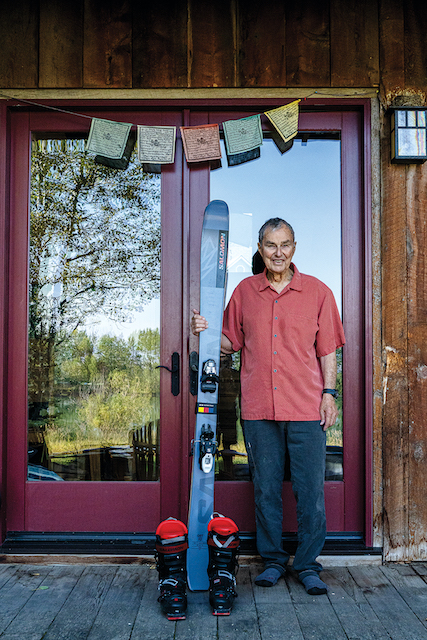
Dick Dorworth at his Bozeman home in August 2026, set for another ski season, photo by Jason Thompson
The man who skied 106.8 miles per hour down the steep slopes of Portillo, Chile, in 1963 is still skiing today, though the slopes aren’t steep and he’s certainly not thinking about breaking any world records.
The numbers that excite him most when ski season comes to Bridger Bowl near Bozeman, Montana, where he lives with longtime partner and fellow ski legend Jeannie Wall, are the price of a season pass—$15 for “Super Seniors”—and the average cost per visit. With 60 trips last year, that breaks down to 25 cents per ski day.
It’s a fair price for one of our most storied icons, who wanted only two things in life, skiing and writing, and found considerable success in both.
Dick Dorworth turns 88 in October. He’s comfortable admitting Bozeman will be the final stop in a lifelong itinerary that includes distinguished tenures across the Mountain West, Europe and South America. But that doesn’t mean he’s done skiing.
“My doctor says she’s never seen anyone my age in this good of shape,” Dorworth says. “I intend to ski, and at this point I don’t see why I won’t.”
After two separate hourlong conversations with Dorworth, I wouldn’t guess he needs a second opinion. If I hadn’t already known, I might have said he was 60. His memories are detailed and lucid, his voice is robust and his wit is as keen as when he was writing ski stories for national magazines. Of course, he doesn’t need me to expound further on his graceful aging, which is likely a journalistic affect to focus on anything other than the fact that the 87-year-old on the other end of the line, 50 years my senior, is cooler than I am.
Many never see their dreams come true. Many who do remain trapped in an old dream. A rare few realize life itself is the dream, and they remain alert to its subtle and unexpected gifts. Even in loss. Even in aging. Even in death. Dorworth is one of those few.
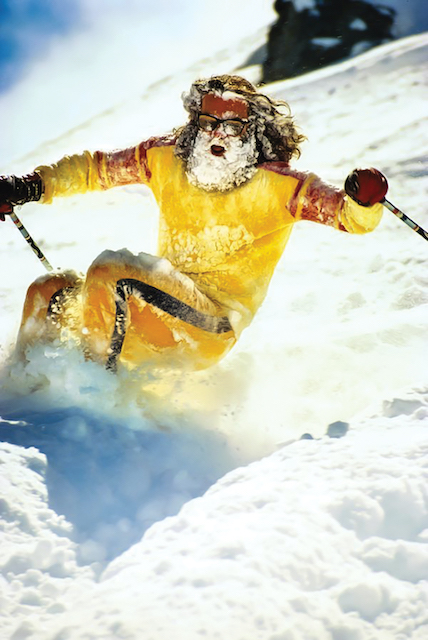
Dick Dorworth skis deep powder in Verbier, Switzerland, during a Warren Miller film shoot in 1975, photo by Tom Lippert
“He found a way to be very present and compassionate,” says Wall, who befriended him more than 30 years ago when he was guiding clients out of a tent in the Tetons. “He has a joyfulness to him, a really beautiful, positive energy and a genuine compassion for people around him.”
Dorworth credits his Buddhist faith, which steered him through the national hangover of the 1970s, and which sustains him today at his local dharma in Bozeman. Every Sunday is Zen night, and he doesn’t like to miss it.
“As soon as we’re born, we’re going to die,” he says. “My Buddhist practice is to let go. One thing you let go of is attachment to body.”
Dorworth is no ascetic, though he did give up LSD, psilocybin, peyote, cocaine, cannabis, alcohol, tobacco and all other substances in the syllabus of the counterculture. He still drinks coffee. He still enjoys his body, which he cares for with devoted attention, even as he accepts its impermanence.
How do you continue to enjoy the very thing you’re losing? Dorworth has figured it out. An hour of yoga every day. Weightlifting to strengthen core, back and legs. A spin on the stationary bike while reading nonfiction, Buddhist teachings or literature. An hour of meditation, as the local dharma opens weekdays to practitioners of all traditions. Coffee with friends, many of whom are in their 90s and still skiing. And, of course, when the snow blankets Bridger Bowl, up to six days per week of skiing.
Loving and letting go, simultaneously: an almost impossible act for anyone raised in America in the last few hundred years. Then again, Dorworth isn’t just anyone.
Early Years
An exceptional life often begins under exceptional circumstances.
When the United States entered World War II, Dorworth’s father deployed to Guam, where he ran a warehouse and fueled up the Enola Gay on its way to drop the atomic bomb on Hiroshima. His mother moved with two of her sisters to an apartment on the shore of Lake Merritt in Oakland to work full time.
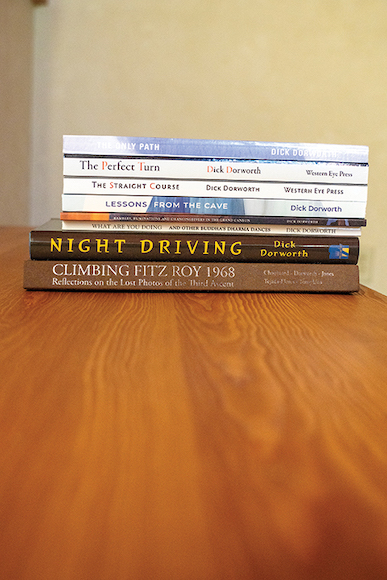
A stack of Dorworth classics, photo by Jason Thompson
That left little Dorworth, like a fledgling protagonist in a Dickens novel, to become the ward of a series of boardinghouses throughout the Bay Area.
That was not uncommon during the war, Dorworth says. Fathers were deployed but not earning enough to sustain the family back home. Mothers had to work. Children were raised communally—although “raised” implies a deliberate execution of utopian philosophy instead of the reality, which was that the children were sheltered and fed.
In Dorworth’s case, they were fed well. Because his father was serving in the Pacific, he received a ration of food every week. It went straight to the boardinghouse and was shared equally among the tenants. Every other weekend, his mother picked him up for a few hours, often in the company of a new male friend, and they saw a film together.
Apart from those infrequent visits, Dorworth spent the next four years as his own parent—what his partner Wall affectionately refers to as “a feral childhood.” He loved it.
“It taught me to make decisions for myself,” Dorworth says. “There was never anyone around saying, ‘You should dress or act this way.’ I learned to trust my instincts and think for myself. That was a great gift.”
When the war ended, Dorworth and his parents made an uneasy family unit. Both parents drank heavily and felt constrained by their marriage. All were ready for a new chapter.
It came in the form of Uncle Harvey, who’d found a literal cash cow by illegally flouting wartime beef sanctions. With his money, he was building Harvey’s Wagon Wheel Saloon and Gaming Hall on Tahoe’s South Shore, what would later become Harveys Lake Tahoe. It was as good a reason as any to leave the Bay Area and start over in the Sierra Nevada.
For Dorworth, descending into the Tahoe Basin from Echo Summit was like entering the promised land.
“It was a springtime blue sky day with snow on the ground and freedom in the hills,” he wrote in a story exploring his childhood. “Whether I lived in a palace with a loving family or a rooming house with strangers, my home would always be in the mountains.”
Discovering Home
In Tahoe, moving between a series of cabins, Dorworth experienced a childhood defined by what he calls “benign neglect.” During the summer, his parents worked double shifts in casino and restaurant jobs. During the winter, they drew unemployment and worked under the table for cash. Once again, he was his own parent.
Which is not to say they didn’t provide for him.
In second grade, a friend took Dorworth skiing on a gentle slope at what is now South Shore Boulevard, and his parents bought him skis. They moved to a little cabin in Zephyr Cove with a ski jump and a slalom hill in the backyard and a one-room schoolhouse less than a mile away, which he skied to in the winter. His mother fed him a steady diet of literary classics, despite her own obsession with pulp paperbacks.
“I read and I skied,” Dorworth says. “When I was 12, I told my father I was going to be a writer and a skier.”
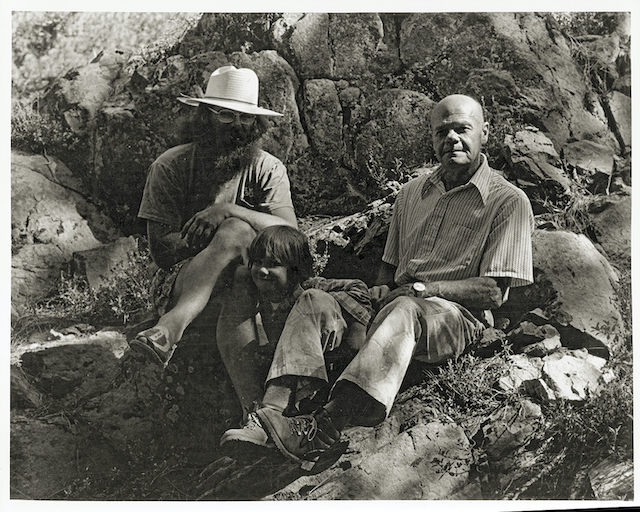
Dick Dorworth with his son Jason and father Al by the Truckee River in the mid-1970s, courtesy photo
His father spent a week’s wages to buy him a Royal typewriter, which he used for the next six decades, writing seven books and dozens of articles for nearly every major outdoor magazine.
A major disruption to his Tahoe idyll came in eighth grade when he was sent to the Christian Brothers School in Sacramento. Dorworth says his parents needed the space to figure out how to salvage their failing marriage.
“Overnight, I went from living in Lake Tahoe with total freedom,” he says. “I lasted less than six weeks.”
Dorworth remembers collecting loose change in a sock until he had about $20 saved. He ran away from school and found a payphone downtown, which he used to call a nearby cousin to come rescue him. The next call was to his father, informing him that he would not be returning to school.
“He said he’d take me right back,” Dorworth recalls. He told his father, “OK, but I’ll run away again and next time I won’t phone you.”
He was back home in Tahoe the next day.
With the full support of his parents, who had resolved to stay married as friends, if not exactly husband and wife, he dove headlong into skiing. He recalls the investments and the sacrifices both parents made, including equipping him with the best gear available and taking him to a local rope tow near Meyers and the short-lived White Hills Ski Area at Spooner Summit.
But he remained his own source of inspiration, what he refers to as a “self-taught skier”—maintaining by hand the slalom course in the backyard of the Zephyr Cove home, cutting, stripping and sharpening willow branches for ski poles, and practicing his craft with a singular devotion. Independent since he could remember, being alone outdoors fueled Dorworth. It also healed him.
“My coveted outdoor experiences as a child were far removed—if only for a few hours—from the confusion and periodic waves of alcoholic sorrow that washed across my family,” he once wrote. His mother, he says, “was carrying a lot of baggage” from an early childhood defined by traumatic abuse. His parents’ commitment to him despite their problems is how he chooses to remember them.
“I gained a lot of respect for my parents,” he says. “Even though their marriage was a mess, they both loved me. They gave me everything.”
In 1950, the investment paid off. Though he’d only been ski racing for a year, Dorworth signed up for the Far West Ski Association Four Event competition, which judged competitors across downhill, slalom, ski jumping and cross-country.
“I was the champion for my age group, and I never looked back,” he says.
Need for Speed
For the next 15 years, Dorworth competed at the highest level, racing on the All-American Ski Team and the first U.S. National Ski Training Team. Races took him around the world, but each time he came home he felt increasingly at odds with the sport’s conservative leadership and organization, which he says prioritized single, impressionable, clean-shaven men.
Bearded, divorced, hard-partying and cynical about U.S. politics, Dorworth was none of those things. The mere mention of Bob Beattie, head coach of the U.S. Ski Team from 1961 to 1969, who often seeded Dorworth last in races, is liable to elicit a few swear words.
“I had a hard time with American ski racing,” Dorworth summarizes, after recounting a blow-up he and Beattie had at the starting gate of the Harriman Cup slalom course. The two reconciled after, but U.S. competition was beginning to lose its luster, even as Dorworth remained one of the fastest skiers alive.
In 1963, he completed the 2.6-mile Diamond Sun Race in Sun Valley, Idaho, widely considered one of the fastest standard races in the world, in 2 minutes and 21 seconds. Sixty-three years later, that record still stands.
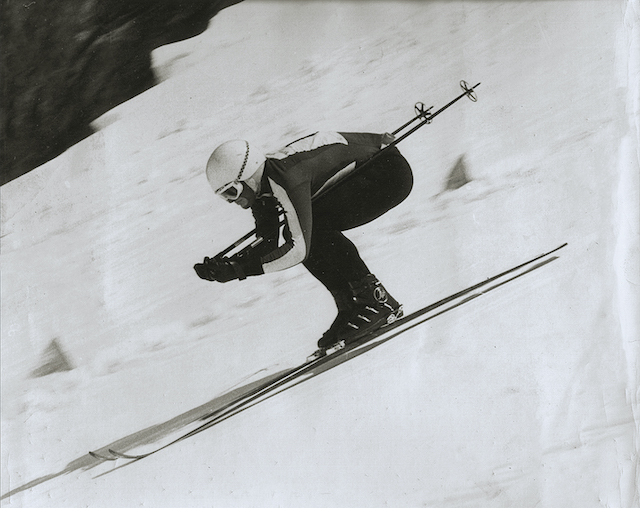
Dick Dorworth competes in the 1964 Kilometro Lanciato speed skiing event in Cervinia, Italy, courtesy photo
Emboldened by his success, and bitter with the national team, Dorworth flew south to set more records.
“I was so pissed off at American skiing that I wrangled a job, plus room and board and transport to Chile, to teach skiing that summer,” he says. In his agreement with the Chileans, he added the caveat that he would need time off to ski at Portillo, a global destination for speed records.
Grainy, handheld footage from the era shows Dorworth, a small dot in a white helmet, plummeting down the Andean slope. He narrates the action in voiceover.
“The main thing to do is to keep your body very low and keep very far forward, like an egg. You must maintain balance at all costs. When you start at Portillo,” his voiceover continues, the camera panning out, “it’s a commitment that there’s no retreat from.”
Though his new world record wouldn’t last for more than a year—the current time, shockingly, is 158 miles per hour—it brought him enough fame to launch his next chapter.
“That changed my life in a lot of ways,” he says. “All of a sudden, I was well known in the ski world.”
Working construction in the offseason the following summer, Dorworth received an invitation to go to Italy and defend his world record speed title. When asked what it would take to get him out there, he requested a plane ticket, room and board, and “more money than I thought they’d give me.”
They gave it to him.
“I thought I would stay a month,” he says. “I sold my return ticket and stayed a year and a half.”
In 1964, Dorworth was splitting his time between France, Germany and Austria, ski racing in competitions around Europe and working on his speed, until a crash at 101 miles per hour left him with a broken leg and a lingering back injury. Deep down he knew he was done with ski racing, but his pride wouldn’t let him quit on a fall. The next year, he returned to try again, only to watch a good friend drop in before him and die in a terrible high-speed wipeout.
“That was the end of competition for me,” he says. “I came back to the states and started coaching.”
Opportunity Abounds
The first stop was Tahoe’s Heavenly Valley by invitation from the Killebrew family, who owned the resort at the time and wanted Dorworth to run the youth ski program. The terms of the contract included a percentage of the program’s earnings.
“All of a sudden, I had 200 to 300 kids in the program and the profits were unreal,” he says.
Unreal and short-lived. Let go soon after—Dorworth says the family was bitter about how much money they watched him pocket—the retired ski racer and unemployed coach suddenly had nothing to do.
When a friend at the University of Nevada, Reno, offered Dorworth a position teaching English, he accepted.
“My original plan was to stay there and get my master’s and PhD,” he says. With what felt like the best of his life behind him, Dorworth figured a career of letters was better than nothing. Become an academic, read and write in a little cubby, share his love of literature with the next generation. There are worse things.
The illusion didn’t last long.
“After one year there, I realized I could not spend my life in an office,” he says. “I ran back to the mountains to teach, ski and make money.”
Not included in that list, though a defining part of the few years he spent bumming around Tahoe and Truckee, were the drinking, partying and—his words— “women chasing.” Who had time for an office job in Tahoe in the late ’60s?
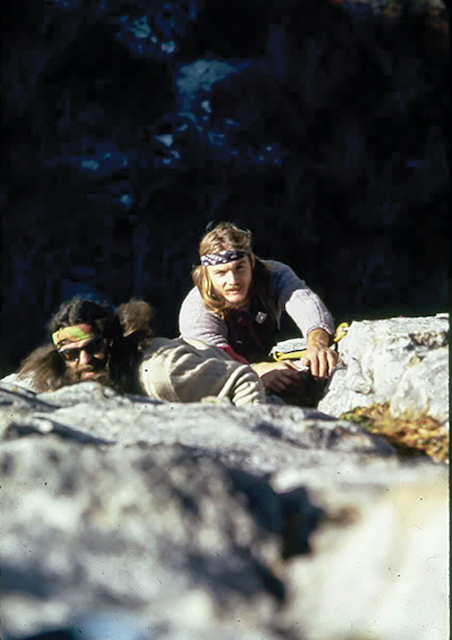
Dick Dorworth, left, and Steve McKinney climb at Lover’s Leap, circa 1974-75, courtesy photo
People who overindulge tend to lose opportunities, not gain them. Networking in the twenty-first century owes more to lines of code than lines of coke. Maybe it was the era, or maybe it was just Dorworth himself, but every stop on the party circuit widened a social circle defined by boundary-pushing, hard-charging, career-making radicals. Movie stars, elite athletes, future business moguls—they were all there.
Perhaps the most consequential was Jim Bridwell, an accomplished rock climber and Dorworth’s brother-in-arms on the party scene. He’d taken a few ski lessons from Dorworth and wanted to repay the favor on the rock walls in Yosemite, something Dorworth had no interest in. However, a climbing session near Truckee with famed alpinist Dougal Haston changed his mind.
“The first hour that I climbed with Dougal, I realized that was what I had been missing since I quit ski racing,” he says.
When Bridwell left for Yosemite later that year, Dorworth joined him in Camp 4. They climbed every day for a month.
“I didn’t realize it at the time,” he says, “but I was learning from the greatest climbers in history.”
Among those were Doug Tompkins and Yvon Chouinard, climbers who would go on to be two of the most successful outdoor businessmen in American history. At the time, they were still honing their craft in the mountains and dreaming up what would eventually become billion-dollar businesses with The North Face and Patagonia—early footage from the era shows a young Chouinard hammering pitons in sandals and denim shorts.
Dorworth had skied with Tompkins over the years and become good friends. When he learned of an expedition to summit Fitz Roy, the iconic peak in Argentina, the novice climber talked his way into the used Ford van headed south to surf, ski and summit.
“[Tompkins] wanted me along because he knew I was a good skier,” Dorworth recalls. “I convinced Yvon that I was a climber. I told him, ‘Anything you can lead, I can jumar.’”
That’s exactly what happened. In Mountain of Storms, an adventure film that set the template for decades of copycat productions to come, Dorworth can be seen, sunburned and alone, shimmying his way up one of the most famous peaks in the world, carrying load for some of the most famous expedition leaders in the world.
“I got to climb Fitz Roy as a novice climber,” he says. “That changed my life.”
Living the Trifecta
Dorworth left Yosemite a tagalong and returned a hero.
“That next spring I was a mini celebrity,” he says. “I got to climb with the best climbers in Yosemite.”
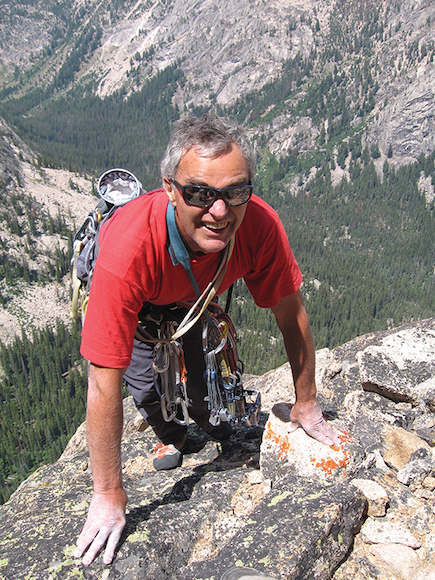
Dorworth climbs at the Elephant’s Perch in Idaho around 2005, courtesy photo
In his early childhood, someone gave Dorworth a piece of advice that stuck with him. He can’t remember who said it, but he never forgot the message: “Specialize in what you are most interested in.”
He knew at an early age that his life would consist of skiing and writing. When he added climbing, the trifecta was complete.
“Those are the only three things I’ve ever really learned,” he says.
For the next several decades, they were the only three things he really wanted to do, with the exception of practicing Buddhism, which he discovered at the Sonoma Mountain Zen Center during a 10-day retreat from his job as director of the Aspen Mountain Ski School.
The blessings of a charmed life continued and multiplied. Warren Miller, a boyhood hero whose films would tour through Tahoe in the ’50s when Dorworth was still a budding skier, reached out and invited the bearded hippie to join him in Europe for a season of skiing and filming.
“I really liked him and admired him, but he was a very conservative man,” Dorworth says. “I said, ‘I’d love to go but you have to know I have a beard down to my belly button and hair down my back and I don’t want to shave.’ I didn’t hear from him for about three weeks.”
Dorworth, then in his 40s, started training just in case. When Miller called back, he had good news.
“Well, Dick,” he said, “I’ve always maintained it’s what’s in a man’s head, not what’s on it. Let’s go to Europe.”
The trip, Dorworth says, “was wonderful fun. I was skiing for money in the best places in the world.”
When he came back, he resumed his itinerant life of skiing, teaching, climbing, writing and practicing Buddhism, the latter of which guided him through the difficult realities of an aging athlete’s body.
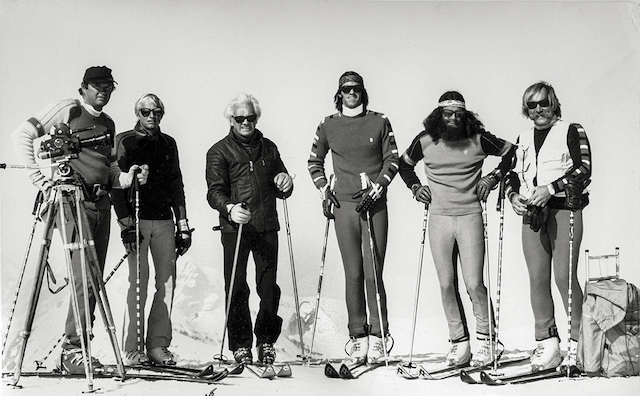
From left, Warren Miller, Pat Bauman, Émile Allais, Jon Reveal, Dick Dorworth and photographer Tom Lippert at Flaine in the French Alps in 1973, photo by Tom Lippert
A misdiagnosed case of tuberculosis in the 1940s—a doctor told the young Dorworth he had tonsillitis, and even removed his tonsils—came to light after a mysterious pain in his back turned out to be Pott’s Disease: tuberculosis of the spine. After a year of antibiotics, the disease was treated, and a lifelong mystery solved.
“I’ve had compromised lungs my entire life,” Dorworth says. “When I was a competitor, I’d win the first three events and, no matter how hard I trained, wind up 10th in the last one. I just thought I couldn’t train hard enough.
“I’ve never been any good at endurance or altitude,” Dorworth adds, in what is surely an exaggeration for the man who jumared up 11,000-foot Fitz Roy and skied down some of the steepest slopes on earth.
Despite advances in medical science since his early misdiagnosis in the ’40s, there were some discoveries that couldn’t be fixed. A worsening case of Dupuytren’s contracture, a condition that causes fingers to curl inward, forced Dorworth to retire from rock climbing. Though climbing was a later love, the loss was still immense. He remained positive.
“Everything in the universe changes constantly,” he says. “One thing you let go of is attachment to body. When you die, your body is gone, but something remains—your spirit, your soul, your karma, whatever you want to call it. All things are spiritual, and all things are sacred.”
Wall has observed the changes up close, and admires his equanimity.
“He is able to let go of things when the time is up,” she says. “When he was done ski racing, he knew. When he stopped climbing, he let it go.”
Golden Years
In 2012, the U.S. Ski and Snowboard Hall of Fame inducted Dorworth into their rarefied ranks.
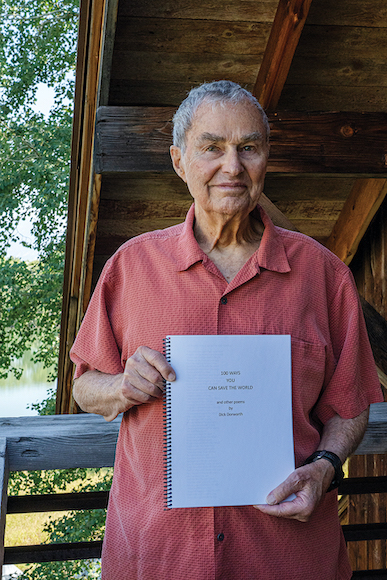
Dorworth with his soon-to-be-published book of poetry, which will mark his 10th published book, photo by Jason Thompson
“There are precious few individuals who have been able to assemble so many different talents along with a high level of passion for his sport into one body,” the organization wrote in its tribute. “He has inspired generations of skiers worldwide through his example as a leader and his ability to translate his passion for skiing into words.”
Indeed, The Perfect Turn, a collection of Dorworth’s writing published in 2010, was awarded the Ski History Association prize for the best new ski book of the year, and is considered by many mountain athletes to be a canonical text.
Dorworth admits he’s in “a little slump” with writing, but that isn’t preventing him from putting out a book of poetry. Called 100 Ways You Can Save the World and Other Poems by Dick Dorworth, the collection published by Valmont Press compiles a lifetime of poetry into one book, and will be available this year.
No doubt the writing slump will end soon. No doubt the snows will fall soon, too, and Dorworth will again be enjoying the two pursuits he was put on this earth to do.
“For an old guy, I’m skiing quite well,” he says. “My hands won’t hang on to rock, but they’ll grip a ski pole just fine.”
The day will come when even that may prove impossible. Until then, Dorworth will continue to carve a gentle path down the groomers at Bridger Bowl, to type the words borne of a lifetime of experience and to sit in quiet meditation in the twilight of a dream not yet done.
Michael Rohm is a writer and musician based in Portland, Oregon. His conversations with Dick provided a valuable reminder that adventure isn’t limited by age or location.
No Comments