




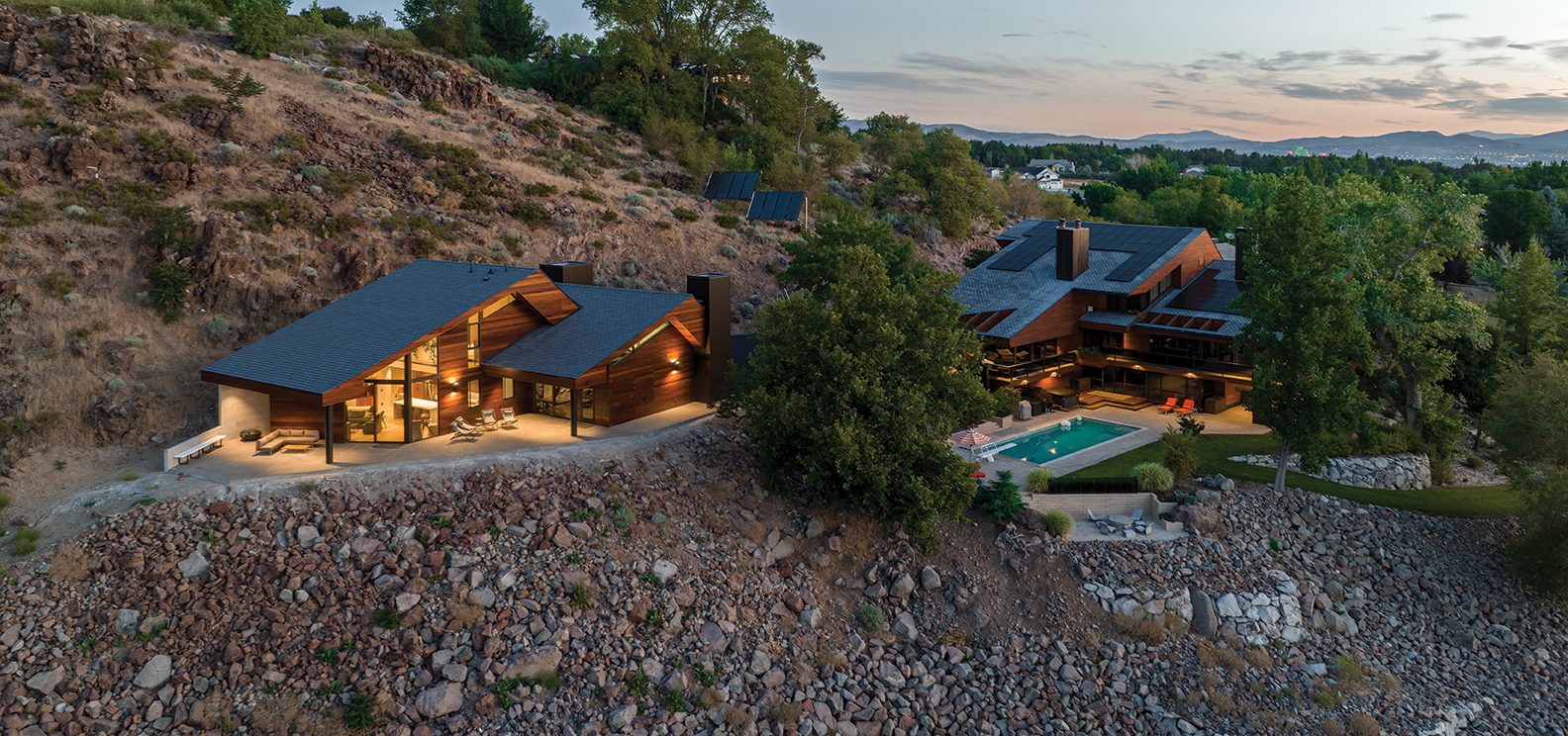
01 Mar Homage to a Classic
A Reno guesthouse channels the 1970s in all the best ways
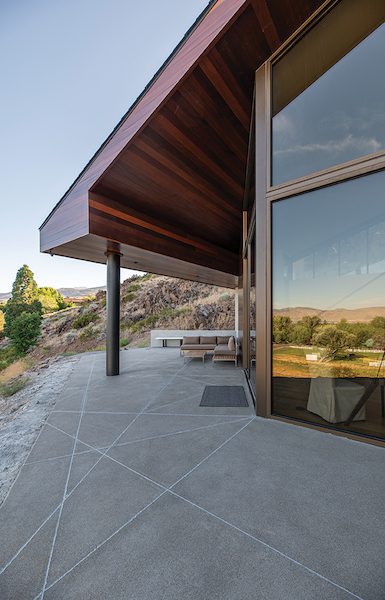
As in the main home, funky angles contribute to the 1970s aesthetic of the guesthouse
In April 2017, Michael and Pam Hillman fell in love—with a southwest Reno home designed in 1978 by acclaimed Swiss architect Eduard Dreier.
“They just don’t construct homes like this anymore,” Michael says.
As part of their bid, the couple vowed to restore the home, a promise they made good on over the course of four and a half years. The house today is a mid-century modern gem, with funky angles, cashmere carpets, Philippine mahogany, wallpapered doors, a curved sliding door and vintage furnishings. Every room has a story, and the original hand-drawn plans, colored in ’70s-era yellow, red and browns, hang framed on a wall.
“The original home was cutting-edge for the time and was directly responding to the milieu and architectural moment in which the home was created,” architect Gordon Magnin says.
The one thing the home was missing was enough garage space, a necessity for Michael’s collection of Porsches. As the Hillmans explored options, they knew they wanted the new project to have the same feel and personality as the main home.
To that end, the Hillmans interviewed six architects, touring the main house with each and watching their responses.
“Gordon geeked out on the house itself and the efforts Pam and I were making to ‘contemporize’ everything for the next 40 years living here,” Michael says. “His initial ideas and suggestions resonated with both of us immediately.”
In their first design meeting, the discussion of building a standalone structure in the vein of Dreier’s style morphed from a simple garage to a larger scale. After all, they were going through the time and expense, and the initial results from civil engineering work were positive.
“Expanding the footprint and creating an efficient living space went from possible to desirable,” Michael says.
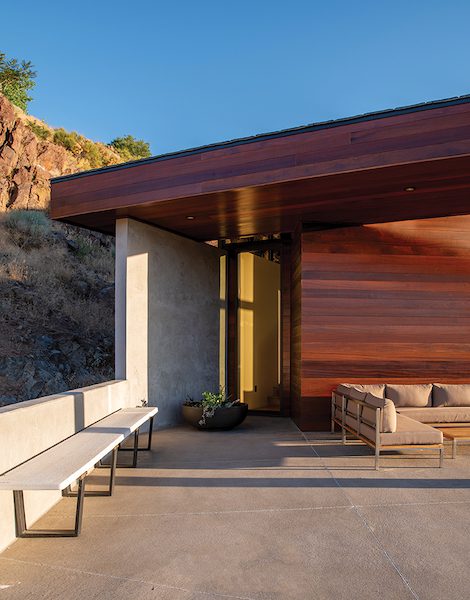
A large retaining wall protects the house and property from the rocky hillside
While Magnin’s style leans contemporary, he says he finds inspiration in past movements and mid-century architects.
“I think that each architectural project has its own essence or DNA, and it was a really fun and unique process to study the existing house and existing house plans to extract the formal and detailing strategies that made the original house so unique, but then to apply those same strategies in a contemporary way to the new home.”
Referring often to Dreier’s original blueprints, Magnin designed an accessory dwelling unit, or ADU, composed of a 1,320-square-foot guesthouse with a 1,050-square-foot garage.
The Hillmans tapped Dan Angelesco of Reno’s DA Builders to lead construction.
Like Magnin, Michael says, DA Builders “understood the what, why and how of our vision and the discrete details for the new construction. There were no surprises, literally, and all change orders were thoroughly researched, justified and executed without drama.”
That said, the home was not without its challenges. Site work began in late 2021. The project was nestled into a craggy hillside—also home to a parliament of great horned owls—and the team began by scaling the hill to dislodge and break up big boulders.
“Once this was complete, we raised the building grade from the lower pasture level up to the grade it sits at today, which is roughly the same as the existing home,” Angelesco says, adding that they raised it about 25 feet in total.
They left a swath of space around the house for water diversion and as a landing spot for any more falling rocks and created a temporary road down the backside of the build that provided better access than the narrow, windy driveway. The road also provided a pathway to the well water and septic on the almost 8-acre property.
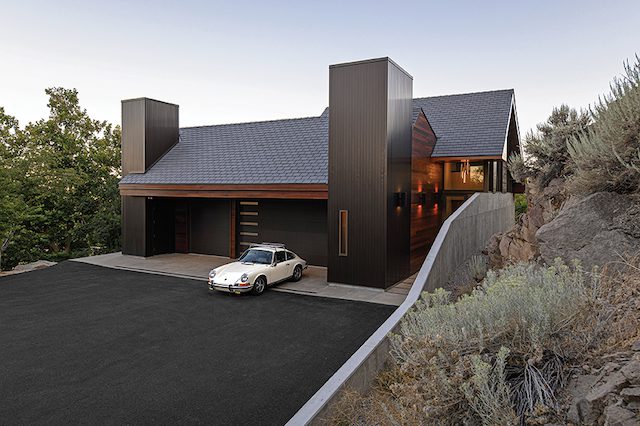
Originally intended to be a garage only, the design evolved to include living space
Then, the DA Builders team added a massive cast-in-place concrete retaining wall and took rocks from the hillside to protect against erosion below the building and for pathways, repurposing some 2,780 metric tons of excavated rock.
Angelesco says that throughout the build, he, Magnin and various tradespeople would walk through the main house with Pam and Michael to work out details. “It was a bit on the fly and a very fun process to be a part of,” he says. “In my 20-year career, this was the most atypical project that I have been on.”
The garage includes three lifts, one for maintenance and two for Porsche storage; each lift can stack two cars, allowing a unique and efficient method to house and showcase the vehicles.
On the first floor is a sizable kitchen with quarter-sawn, grain-matched sapele cabinetry, with a waterfall Caesarstone island that Michael describes as “a terrazzo design created for mid-century modern designs.” The connected living area is adorned with mid-century furnishings like the Florence Knoll mohair settee sofa and chair and Ege Axminster area rug. Storage and a built-in bar are set into the staircase, which leads to the second-floor lofted bedroom.
The goal was to make the ADU look like it had been built at the same time as the original home, almost 50 years earlier.
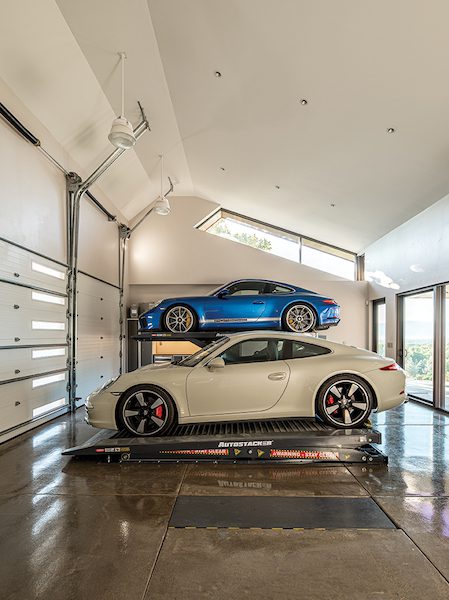
The garage stores the homeowner’s collection of Porsches
“The challenge here was that some of the products and materials used on the main house were no longer available or feasible,” Angelesco says. For example, the siding on the original home is mahogany, but sourcing was difficult and the cost was astronomical, Angelesco says. He credits Michael for finding a product called sapele (also referred to as African mahogany) that looks and performs like the original siding.
Some materials required a deep dive. While redoing granite tile in the main home, Pam researched the source quarry. “She discovered our ‘almond mauve granite’ is still quarried near the Changle region in the Fujian Province of southern China, and was the likely source,” Michael says.
Pam sourced samples from three different locations within the quarry to match the exact tint as the existing granite; Marble Warehouse was able to purchase granite from the same quarry in the same location to match.
For the ADU bathroom, Magnin took inspiration from a guest bathroom in the main house, using the granite tile and incorporating similar cabinetry, mirror, fixtures and lighting details, and mimicking that bathroom’s frameless shower enclosure.
It’s one of many well-thought-out and obsessively researched elements.
“Inside the house, we used very similar materials to the main house,” says Angelesco. “But the more interesting thing is that we also matched details.”
He lists the wood ceiling in the new kitchen, which is modeled after the ceiling in Pam’s office, a floating planter box, copper-faced bar, the wood railing and cap of the stairs, and the drywall and door detailing with reglets.
On the exterior, the roofline echoes that of the main house.
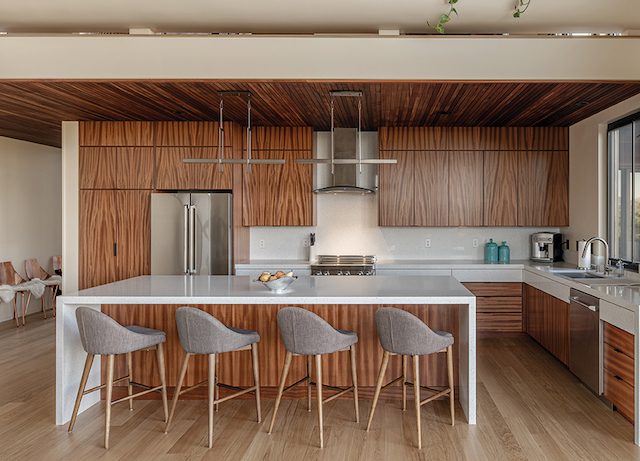
The kitchen features a Caesarstone island and sapele, also known as African mahogany, cabinetry
“I really like how the two homes are sited in relationship to one another,” Magnin says. “It looks like they were always meant to be that way.”
Like most projects at the time, the pandemic took its toll on construction.
“One item in particular was the glazing system,” Angelesco says. “The new build was designed to mimic the original house onsite and that included the glazing system, which was a Kawneer custom bronze frame. When we started the job, we were told a
six- to eight-week lead time for those aluminum frames. We ended up releasing this 14 weeks ahead of when we needed it to play it safe. In the end, Kawneer took 26 weeks to get these frames to us.”
The project won an AIA (American Institute of Architects) Nevada award for excellence in sustainable design in 2024. It’s designed with renewable energy systems and can achieve net zero energy year-round by utilizing closed- and open-loop geothermal systems, efficient heat pumps, solar thermal panels and solar photovoltaic panels, all with commercial-grade control systems.
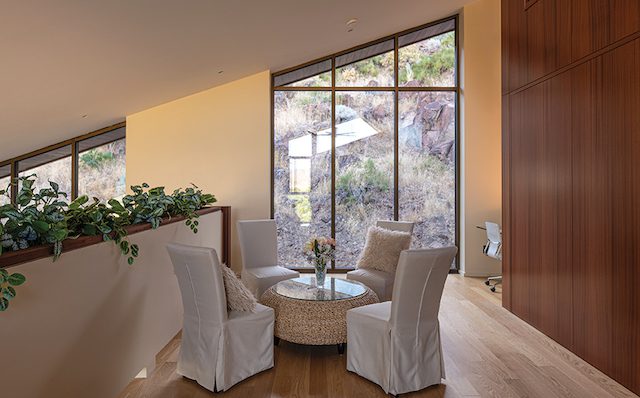
A sitting area in the upstairs bedroom
“Michael worked very closely with the systems and renewable energy systems engineers on the home, which is his area of expertise,” Magnin says. “When we won a sustainable award from the AIA last year, I told him that I couldn’t really even take credit for it since he pushed for and really designed and coordinated those systems.”
Michael is a biomedical engineer who worked in product design at Apple for 16 years and Pam is the CEO of Tribexa, an operating platform for the alternative asset industry. Michael says while they work in different disciplines, they have the same desire to fully comprehend any issue and then “get it right the first time” with every decision.
And indeed, in this labor of love, they certainly seem to have gotten it right.
Award: Vintage Revival
Building Design: Magnin Architecture
Builder: DA Builders
Interior Design: Magnin Architecture; homeowners
Landscape Design: NA
Square Feet: 1,320
No Comments