




01 Mar Striking Balance
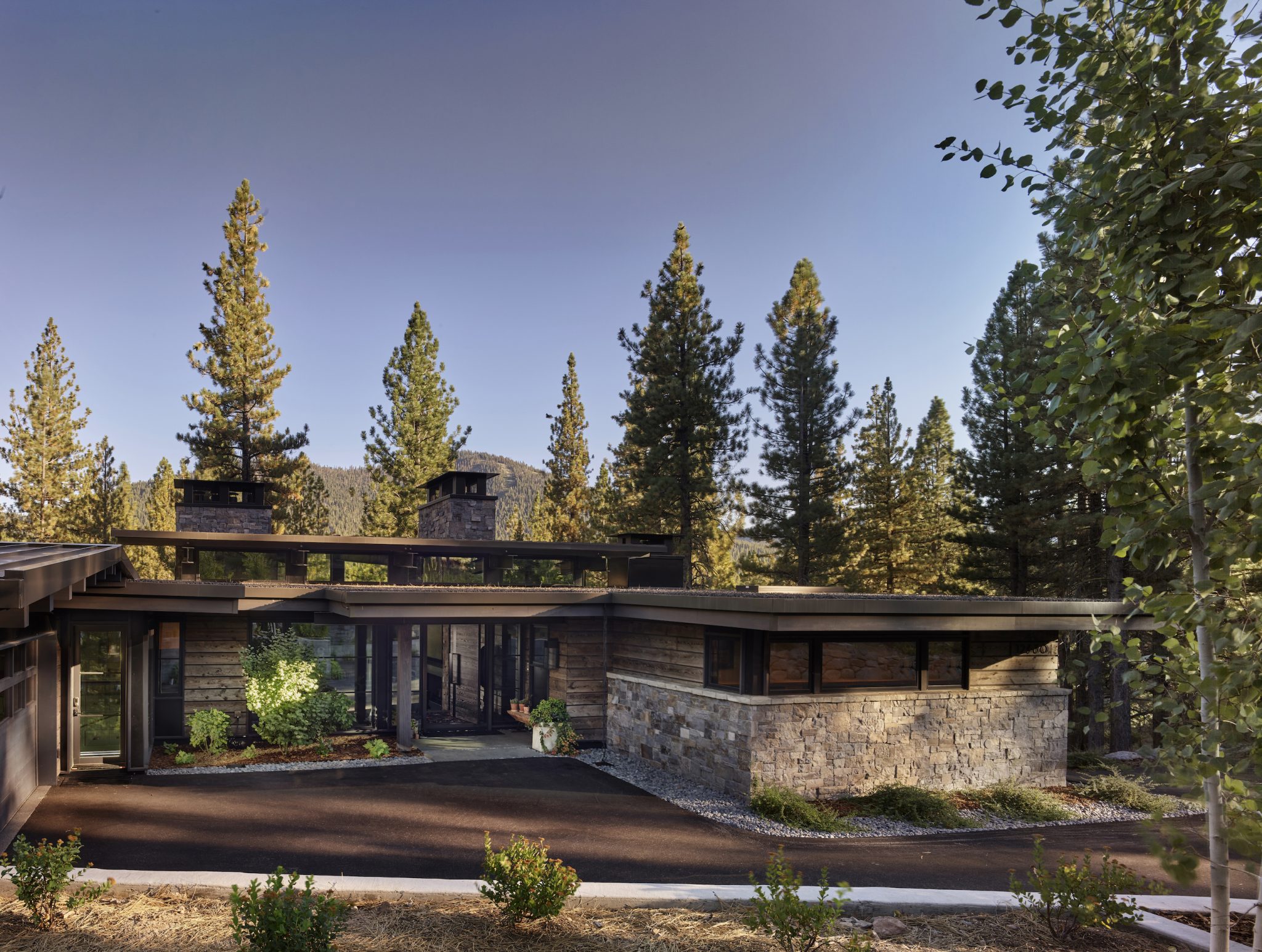
A Lahontan home masterfully blends rustic and modern styles to create a harmonious aesthetic
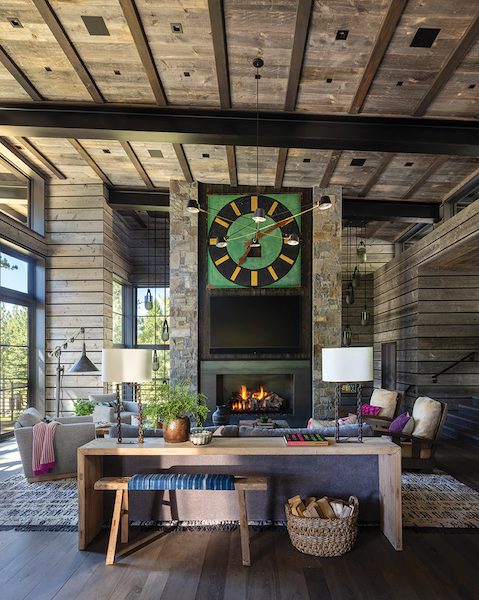
Antique pieces selected by the homeowners and their longtime interior designer, Caroline Tyler DeCesare, adorn the interiors, such as an old French clock face above a fireplace in the living room
A collaborative friendship spanning 20 years and more than a dozen projects provided a solid foundation to approach a unique situation. It featured a property that was both private yet exposed, and architecture that would be modern in form yet traditional in its lived expression.
For the principals—homeowners Dana and Miesje Corbo, their longtime interior designer Caroline Tyler DeCesare of DeCesare Design Group, Clare Walton of Walton Architecture and Mark Tanner of Mark Tanner Construction—the project’s constraints were also its strengths. They enforced a discipline that helped the resulting home achieve the perfect balance of rustic and modern while unabashedly celebrating its site.
The Corbos had a 25-year history at Lahontan Golf Club, the private community just north of Lake Tahoe, and had owned a home there previously, so they understood just how active their neighbors are, and the extent to which they make use of the club’s facilities. It was understandable, then, that they would approach this project with caution, because the site stood in full public view right next to the main lodge.
While the Corbos’ previous Lahontan home had been significantly larger, its traditional Tahoe design and voluminous spaces made it feel more expansive than the couple preferred, while its heavy wood and smaller windows meant it didn’t feel open to the outdoors. Thanks to a strategic design by Walton and DeCesare, the new home—more compact, but significantly more transparent and open to nature—lives larger yet feels wholly part of the landscape.
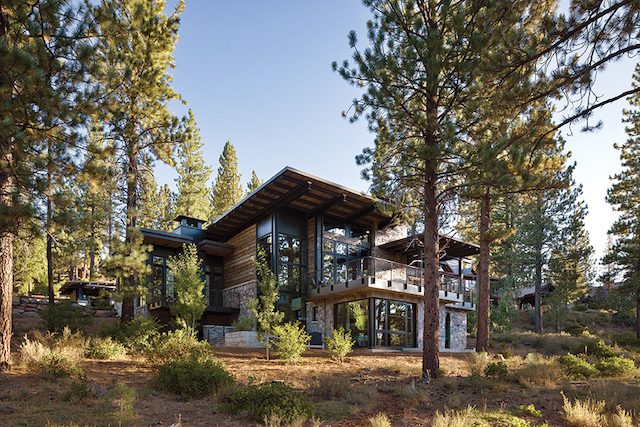
The home’s rugged materials help it blend in with its forested site
The property is accessed by a long private driveway through the forest, lending an aura of seclusion despite its location near the center of the club’s action. Upon arrival, the auto court is defined by the separate casita, a charming 570-square-foot guesthouse that integrates into the terrain on the uphill side, cleverly serving a dual purpose as it mitigates the need for a significant retaining wall. The main house, all stone, wood, glass and steel rendered in clean horizontal lines, is aligned with the hillside in a U-shape, the trees rising above it on three sides, the garage and stone-clad primary suite bathroom on either side defining the parking area.
As with all good architecture, the site dictated the design.
“With the downward sloping lot, we had an opportunity to step the home down with the grade to minimize the apparent scale and integrate with the landscape,” says Walton. “Rather than approaching the design with stacked floor levels and a deck, the topography allowed us to position the lower level so the roof could serve as the main-level outdoor living space. This allows the home to look nestled into the site.
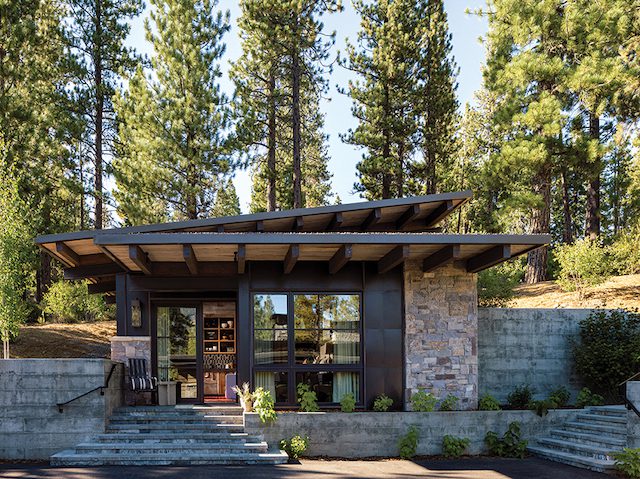
A 570-square-foot casita reflects the architectural style of the main home
“Given the sensitivity of the location, and the desire for the home to feel grand on the inside but also look understated and quiet from the exterior, this approach was a good solution.”
Upon entering a compressed-volume space defined by reclaimed wood on the walls and ceilings (the house has almost no drywall), visitors descend four steps into the double-height open volume of the main living area.
That section of the house is defined by two projecting shed roofs, the lower one over the kitchen and outdoor dining area. They extend toward the view of trees and sky, with glimpses of Northstar’s slopes and intermittent open meadows beyond the forest. The great room, which has doors that open wide to the deck underneath clerestory windows, is anchored by two fireplaces with steel surrounds and chimneys set within stacked stone walls.
“This is the first home we have ever built with two fireplaces in the main room,” says Tanner. “The placement of the fireplaces and use of space make for a great experience of warmth to complement all the glass.”
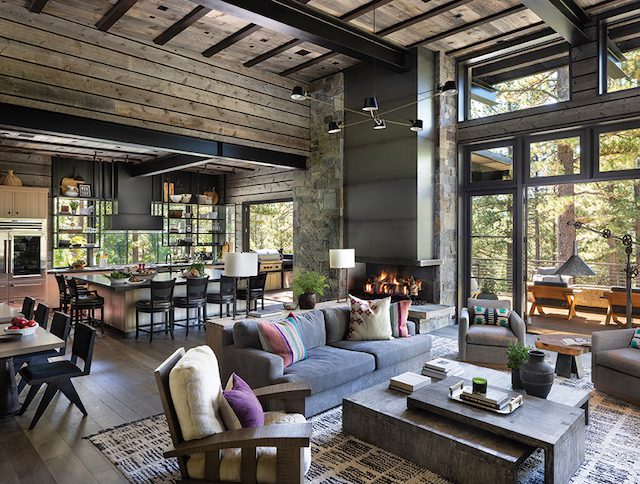
The great room features two fireplaces with steel surrounds set within stone walls, one of which is flanked by clerestory windows and a large glass door that opens to the elevated back deck
The airy chef’s kitchen is dominated by an oversized island with seating on two sides. A steel hood and open shelves hanging in front of the windows help camouflage the view of the nearby lodge. The room opens to the deck outside, where mature pines rise all around. The sensation is of floating in a treehouse.
One of Dana Corbo’s favorite architectural “moments” is the two-story glazing at the staircase that connects the main floor to the lower level, which houses guest bedrooms, a bunk room and an entertainment space with outdoor access. This was a feature of Walton’s original concept for the house, recalls Dana.
“When Clare drew up her first iteration, she [designed a] big, tall corner window in the stairwell. I said, ‘That is so cool and so creative.’” The effect is mesmerizing and changes from season to season, he adds. “It looks out onto the meadow, so when you’re coming down the stairs, you’re looking out over this gorgeous meadow with all these trees. And it’s especially great in the summer, when all the aspens green up.”
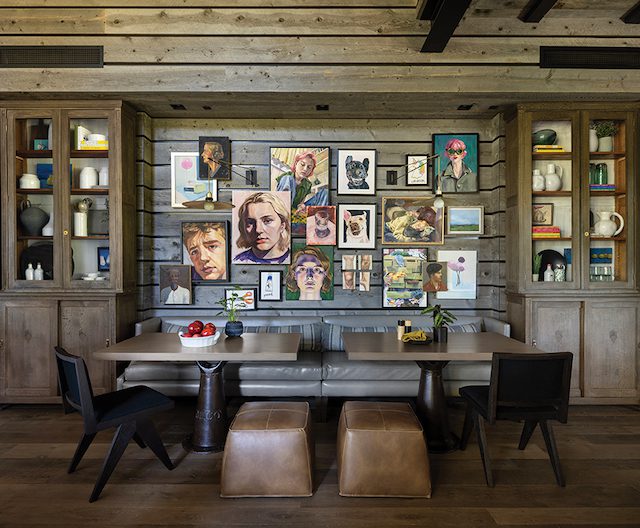
A multifunctional dining space serves as a work station, breakfast nook and game table. It features a leather banquette flanked by antique French display cabinets and a layered gallery mixing found pieces with paintings by the homeowners’ artist daughter
DeCesare, with project lead Kathryn Brower, helped select the project team and create the overall design; they also collaborated with the Corbos on every design decision. Bespoke details include custom steel fireplace surrounds and sculptural lighting fixtures. Textural additions like patterned rugs and sheepskin-upholstered Mimi London chairs and one-of-a-kind reclaimed finds—such as a vintage clock face in place of art above the flat screen in the living room—and the limestone horse trough used for the outdoor fire feature make the home unique and personal, the spaces cozy and welcoming. Meaningful personal touches include original oil paintings by the owners’ artist daughter.
“Anytime we do a Corbo house, there are going to be a lot of layers,” says DeCesare. “We went to antique fairs like Round Top to find the two big hutches in the dining room. We found old doors and modified vintage pieces to become vanities. So while the architectural form is modern, the interiors are a mix of reclaimed and new materials. Miesje has always loved colors like magenta, pinks and greens, but with cool undertones. She likes a pop of color and something unexpected. We love the layers and the Corbos are always there for it, the ceiling beams, the chinking inside in the great room—we love all of that.
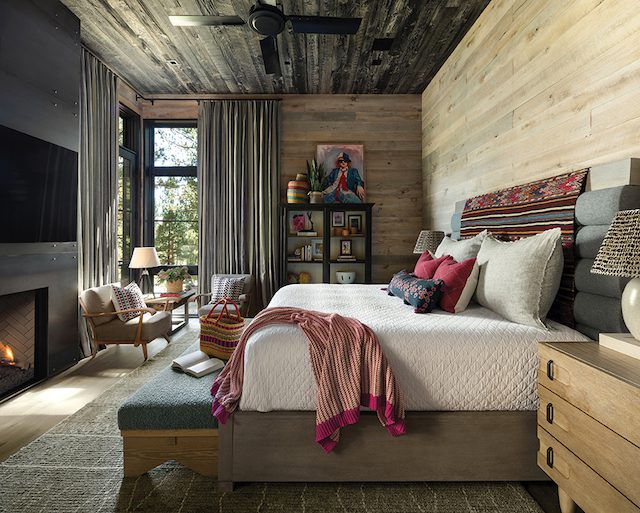
Grounded in natural materials and texture, the primary bedroom feels both refined and fun, thanks to bold pink accents, cheeky art and meaningful personal pieces
“Even the rough textures are done in clean lines and clean forms but with authentic materials where you see the thickness of the wood, the stone edges, the planking. So it’s not too contemporary, because you have handmade tiles and finishes where you can see the hand of the craftsman.”
After doing so many projects together, Dana says, “Caroline knows us so well. She knows what to present and what direction to go in with the palette. Ninety-nine times out of 100, she’ll bring us something and we’ll say, ‘Yes, we trust your judgment.’ There have been times I wasn’t so sure, but we did it anyway and it turned out great. She knew where she wanted to go with this project, and she just hit it out of the park.”
For her part, DeCesare finds the close collaboration stimulating; it also pushes the whole team to strive together for the best outcome.
“Dana is involved in every detail,” DeCesare says. “He wants to make sure the spaces are as functional as they are beautiful. He’s very interested in the particulars and really enjoys the process. It’s great fun for us as designers to work with someone who is really excited and so involved.”
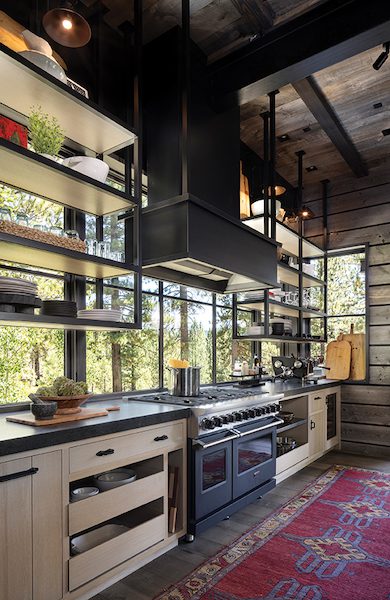
In the kitchen, a steel hood and open shelves in front of the windows help provide privacy from the nearby lodge
Dana also lauds the team at Mark Tanner Construction—including project manager Casey Eberhardt and interior finish superintendents Dave Ariza and Stephen Reitter—for their meticulous work and attention to detail and Walton’s team for siting and consideration of flow.
“This was a challenging homesite,” Dana says, “because it’s not real big—the shape of the envelope is a bit odd—and it’s sloped north to south. What the team was able to put in that tiny envelope was perfect. The house has generous rooms and ceilings and the perfect amount of square footage. Since it’s close to the spa building, we were a little concerned about privacy, but Clare did such an amazing job of orienting the home, we don’t feel impacted whatsoever.”
Now, he adds, “We’re looking out at this great meadow all the time from all the rooms, and we couldn’t be happier.”
Award: Rustic Modern
Building Design: Walton Architecture
Builder: Mark Tanner Construction
Interior Design: DeCesare Design Group
Landscape Design: NA
Square Feet: 4,301
No Comments