




01 Mar Mid-Century Marvelous
A team unites under heartbreaking circumstances to build an unforgettable Reno home
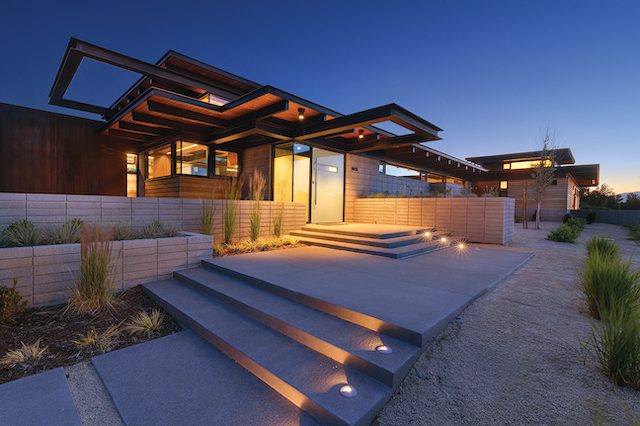
The exposed superstructure, obvious upon first entry, is both functional and decorative
This home could have been a disaster.
The beloved general contractor was diagnosed with ALS and had to leave the job midway through, passing a few months later. The ensuing transition shut down the project for three to four months. Winter weather caused further delays, and the pandemic created supply chain issues. All the while, two of the homeowners’ three adult children were dealing with severe health issues.
“Looking back, it was kind of a miracle we got through it at all; we take nothing for granted,” the wife says.
Architect Jack Hawkins agrees.
“We were in a bad situation that could have been a nightmare. It sucks the oxygen out of it.”
But perseverance, respect, talent and, as the wife puts it, “a brilliant team of humans” didn’t simply save this project; it elevated it into a home defined by stunning architecture and intricate craftsmanship.
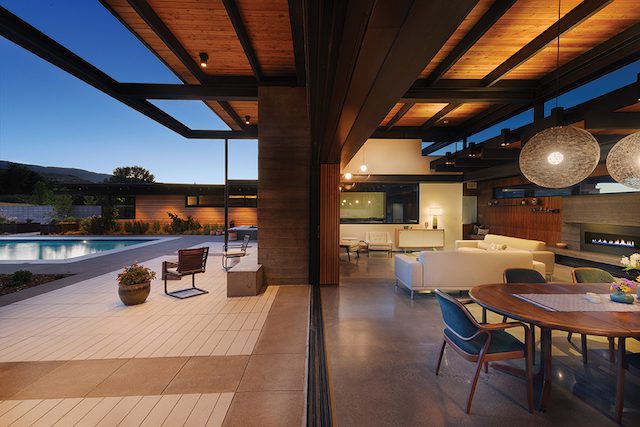
Slider doors seamlessly blend indoors and out
The owners originally contacted Hawkins when they’d planned to build in South Lake Tahoe. They found him through Dwell magazine and appreciated his style, which was similar to their Joseph Eichler–designed Palo Alto home.
But the couple soon realized that the Tahoe property did not provide the kind of conveniences they sought as they aged. In addition, the wife explains, “South Lake was not a viable location for other family members to move to, which came into the calculation not long after we acquired the lot.”
Hawkins convinced them to take a look at Reno.
“We had not visited Reno in a long time, and we were so taken with the variety of lovely neighborhoods, friendly people, convenient amenities, open space; it just felt right,” the wife says.
The couple wanted a design that would accommodate large weekly gatherings and their three visiting adult children but was also comfortably sized for two.
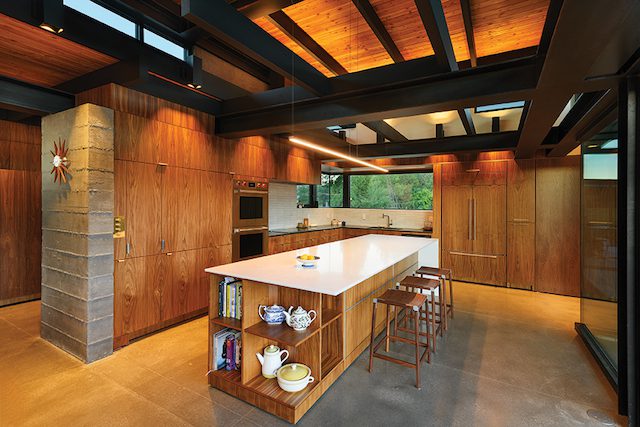
Walnut cabinetry by Welcome Homes Construction is streamlined and minimal
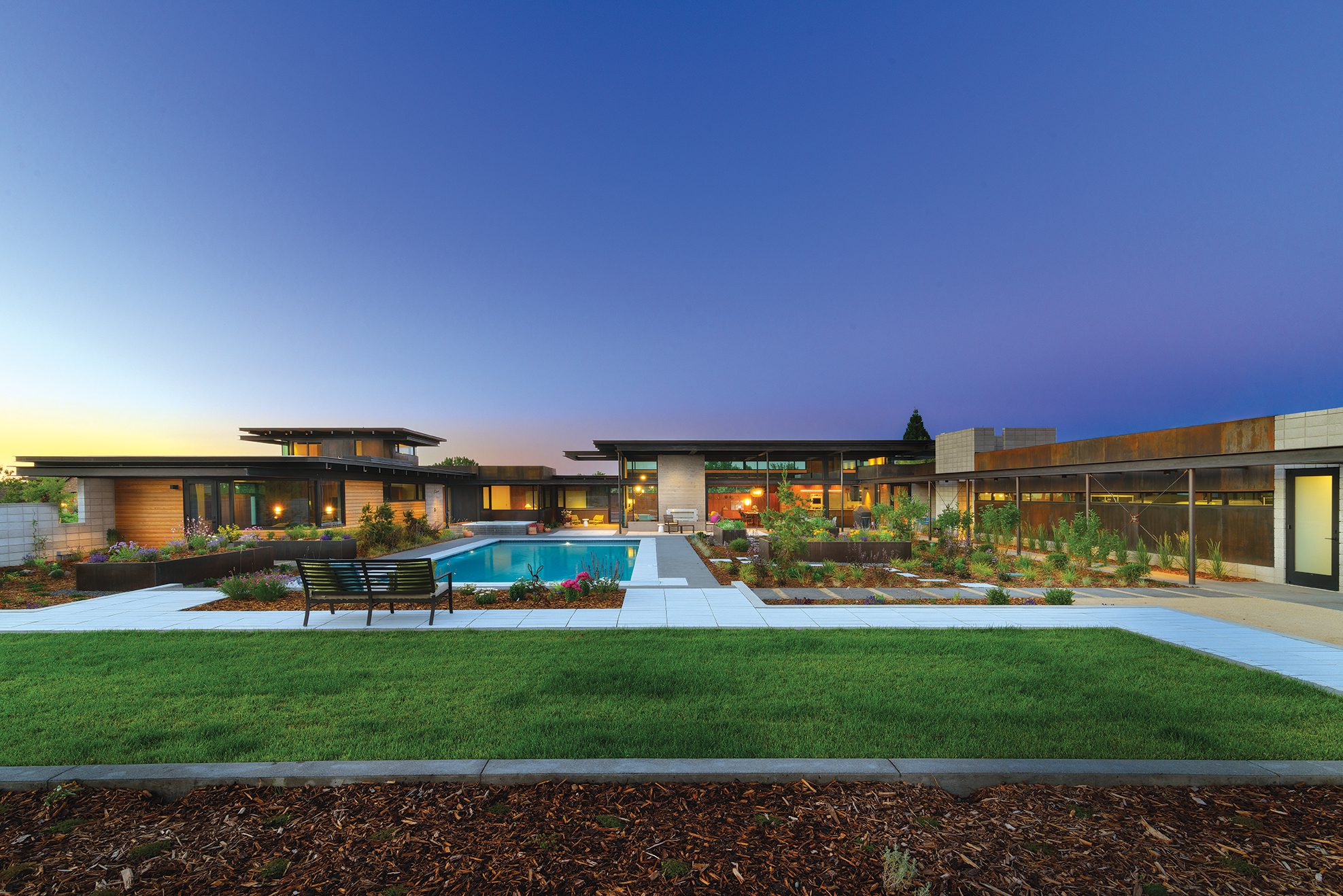
Hawkins created a modest, modern, four-bedroom home in a U-shape configuration that accommodates a courtyard, incorporating the principles of mid-century architecture that the owners desired.
The couple had hired contractor Mike Doherty.
“We had an immediate trust and appreciation for his depth of experience,” the wife says. “He also came with a talented crew of subcontractors who had worked with him for over 20 years—they were like family, and that sealed the deal.”
About a year and a half after breaking ground, with the exterior framing almost complete, Doherty had to step down due to his ALS diagnosis.
“He worked up until he couldn’t,” Hawkins says. “Mike was a great GC and a great human.”
His departure was emotionally traumatic, draining the build’s momentum.
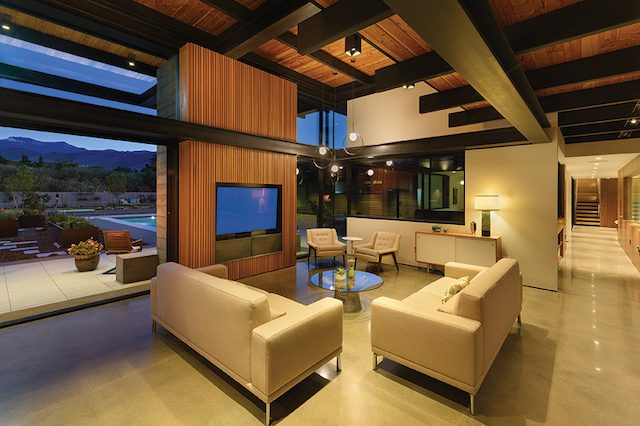
The homeowner sourced many of the vintage furnishings, including the leather ottoman chairs and wood buffet
Hawkins recommended contractor Ryan Shmyr, whom he describes as one of the best general contractors in Reno, to step in, assisted by superintendent Dave Berman.
“The subcontractors all committed themselves to finishing the project in Mike’s honor,” Hawkins says. “That type of loyalty is rare in this industry in these times.”
“It’s a challenge to take over a project that’s already in progress,” Shmyr admits, “but I was excited for the opportunity. The homeowners are very nice people, and we found a way to make an unordinary situation work out for the best.”
While he was put in a tough spot, Shmyr ended up being exactly right for the job.
“Ryan turned out to be a wonderful fit for us,” the husband says. “I have been tremendously impressed how deeply he cares about getting things right. He has often stepped in personally to fix things regardless of whether a problem happened on his watch.”
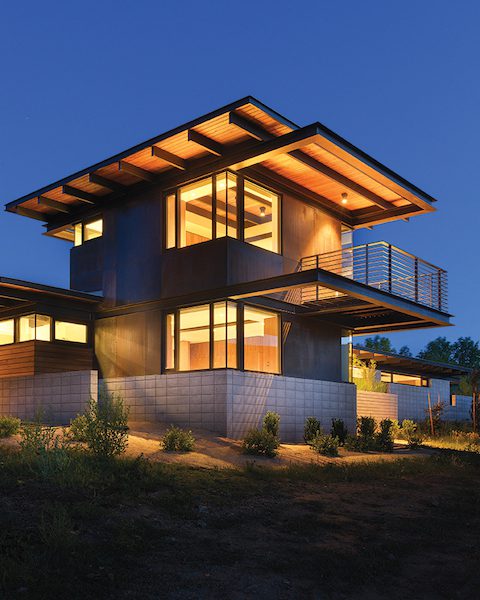
An upper guest room provides privacy when the owners’ adult children visit
The home is in a 100-year floodplain, so it was built 6 feet above the natural grade. The structural elements are exposed, so the steel was constructed upside down, then, with sections of it weighing some 20,000 pounds, flipped into position.
“Mid-century architecture typically expressed the structure,” Hawkins says. “The structure becomes the ornament and rhythm of the home. There is nothing fake about the home. Steel is steel, wood is wood, concrete is concrete.”
The front door opens into the entry and the main living spaces. The kitchen’s walnut cabinetry, by Welcome Homes Construction, panels the refrigerator and conceals a hidden pantry. Countertops are a honed black granite, which plays against the white Heath tile of the backsplash, as well as the polished concrete floors and the structural steel overhead. The walnut kitchen island stools were made by the Sparks-based company Fyrn.
In the main living space, a board-formed fireplace, topped with clerestory windows and incorporating built-in concrete seating, is set against the back wall. Seating is clustered around the TV cabinet and incorporates vintage finds like the 1970s Knoll leather-and-chrome ottomans.
The wife sourced many of the furnishings, some of which belonged to her father and grandmother.
The dining area’s 1960s walnut table and Knoll bentwood chairs came from an estate sale in New York City. “That table has lived through some stories, and I am grateful someone took such great care of it to pass it on to the next generation,” the wife says.
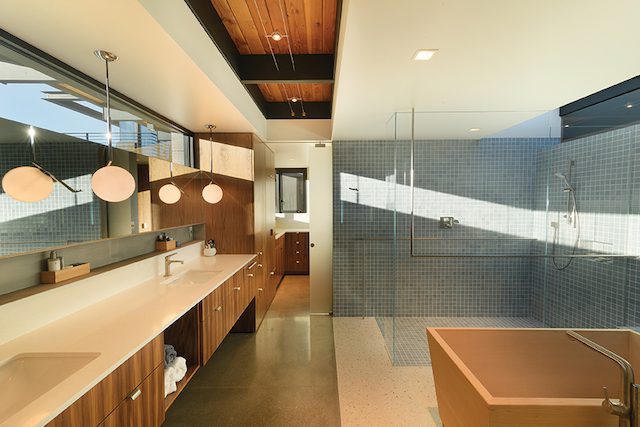
Clerestory windows and a skylight provide abundant natural light in the primary bath
Interior design was a collaboration between Hawkins, who did all the initial interior work, the wife and Hawkins & Associates’ project architect Larisa Sexton.
“Jack’s design really anchored the mid-century aesthetic with the exposed structure, built-in furniture and forethought for wood paneling and cabinetry throughout,” Sexton says. “In refining the finishes, we didn’t want to lean too far into mid-century modern clichés or anything too ‘on the nose,’ but rather a nod to the era with our color palette, natural walnut and geometric patterns.”
From the main living area, a long hallway leads past the library and husband’s office to the guest wing, which includes an upstairs suite. While Hawkins positioned the house on axis with Mount Rose proper, he included views wherever possible, including one of Peavine Mountain seen from a guest room shower.
As the husband is deaf, these long sightlines and ample use of glass were important. His office includes a long wraparound corner window; the wife can get his attention from different parts of the house, while he can work without feeling cut off from events in the common area.
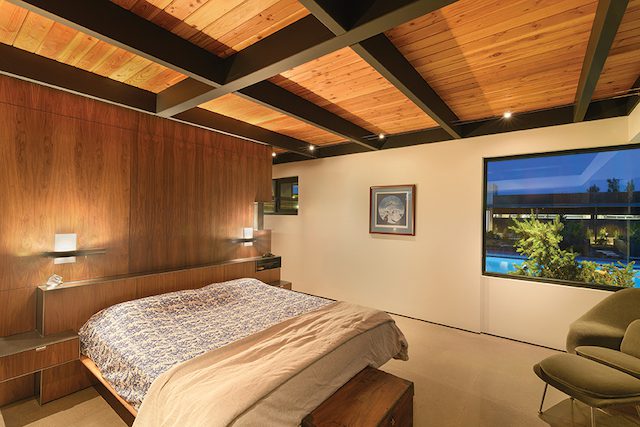
The walnut paneling in the primary bedroom includes a built-in headboard and end tables
“I’m pretty happy with my office,” the husband says, noting that it was moved from earlier drafts to avoid constant sun. “From my desk, I can see what’s going on in the main hall, the library/game room, most of the living room, most of the kitchen, most of the courtyard, all of the pool and Mount Rose rising beyond the courtyard.”
The primary suite forms one wing of the U-shape, along the west side of the courtyard. Designed with the same walnut paneling and long hallways, the bedroom is set at the end of the form. Behind it, the bathroom features a Hinoki wood tub overset by a skylight.
“I have to give [the husband] credit,” Hawkins says. “He insisted on a skylight over the bathroom area, and it is magical.”
The bathroom continues into the walk-in closet and laundry area back to the main hallway. Walnut is used extensively.
“The wood cabinetry is really an elegant blanket that drapes over much of the interior: storage, cabinets, paneling,” the wife says. “It gives it a warmth and depth of character we wanted to balance with the steel and concrete.”
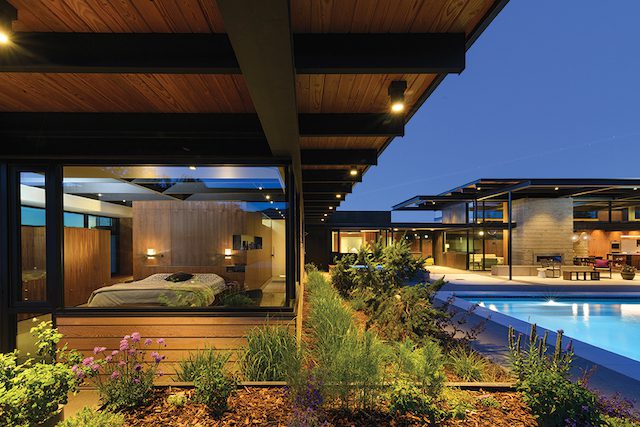
Five doors located throughout the home allow circulation between the house and the courtyard
Shmyr notes that the owners make a good team: “She is focused on the design and finishes; he is focused on the function and utility of the project. They complement each other well in focusing on different aspects of the build.
While the wife focused on interiors, the husband focused on performance. He says the steel and low-E glass means the home functions almost as a Faraday cage, stopping radio waves from penetrating.
“With that in mind, I asked for low-voltage conduits to be installed in every room and have them routed into head ends in either mech room, so I can pull Ethernet, fiber or coax cables to places and devices that need access.”
As a software engineer, he also fought against most home automation.
“We constantly had to push back against efforts by subs to implement various things via wireless or ‘smart’ devices, or even worse, systems that would silently insist on Internet access,” he says, noting that he was “painfully aware” of how many things could go wrong with automation.
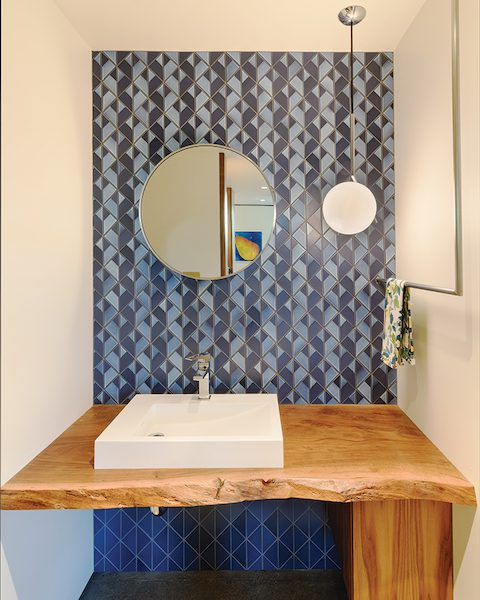
Innovative tile and a live-edge wood counter adorn a powder room
The east wing of the home extends from the kitchen to the mudroom and the 1,700-square-foot garage, which is topped with a solar voltaic system. Eight geothermal wells provide radiant heating and cooling. Meanwhile, the home’s southern orientation takes advantage of passive solar, allowing warm sunlight to enter the main spaces in the winter while large overhangs provide shade in the summer.
“One of my goals, certainly, was for anything we built to be as ‘green’ as possible,” says the husband.
A perch on top of the garage works as a lookout, where the husband photographs Mount Rose as well as the ever-changing Nevada skies. It overlooks the serene and protected courtyard.
“When you are in the courtyard, it feels like you are on 400 acres, but you are in a fairly developed part of Reno, 10 minutes from the airport,” Hawkins says.
A heavy masonry wall keeps the courtyard contained, so the couple’s dogs can run free, while also shielding against South Reno’s strong winds. Hawkins conceptualized the courtyard, which includes ample covered patio areas, a fireplace, pool, hot tub, bocce ball court and a complex garden designed by Patrick McEnany of High West Landscape Architects. Legends Landscaping, along with Shmyr, did the heavy lifting of finishing off the courtyard landscaping, with the owners’ input as well. “A true collaboration,” Hawkins says.
The theme that runs inside and out of the project is the quality.
“[The owners] really appreciated craftsmanship,” Shmyr says. “They allowed us to do things the right way as opposed to the quickest, cheapest or easiest way.”
He says that starts at the framing; using engineered lumber as opposed to conventional lumber results in straighter and flatter walls, which allows the drywallers, tile setters and finish carpenters to have a better base to create a better finished product.
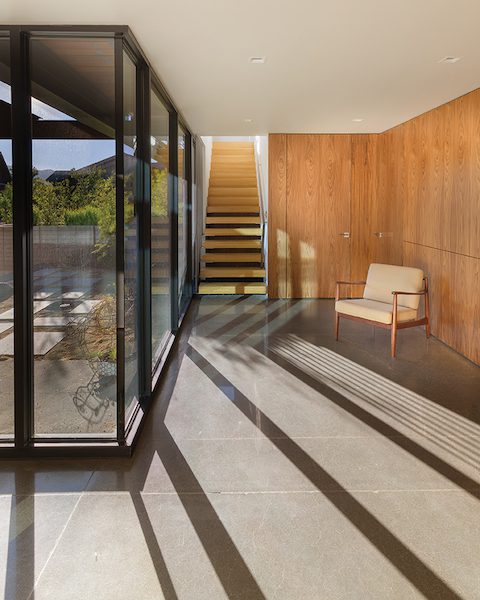
Long sight lines and abundant glass allow the homeowner, who is deaf, to feel connected throughout the home
“The concrete guy helps the framer, who helps the drywaller, who helps the finish carpenter,” Shmyr says. “Each subcontractor works to set up the following subcontractor for success. When we all collaborate, we end up with these great projects because the guy before you and the guy after you care about the success of the project as a whole.”
Sexton agrees: “Every trade really put their all into this project, and it is evident from the detailing and quality throughout the home.”
The house, ultimately, is a piece of art, and a final tribute to Doherty.
“The subcontractors, especially, pulled together to finish the build with Ryan in honor of Mike, whom they loved like family,” the wife says. “Mike was not alive for half of this build, but his influence permeated far and wide, and Ryan showed a lot of respect for that.”
With the various interruptions and challenges, construction took four and a half years, finishing in December 2024.
“It was a testament to everyone involved,” the wife says. “We reminded ourselves how much of a privilege it was to be doing this, and it’ll all be fine in the end.”
Award: Outstanding
Building Design: Hawkins & Associates
Builder: S&H Builders; Michael Doherty Construction
Interior Design: Hawkins & Associates; homeowners
Landscape Design: High West Landscape Architects
Square Feet: 3,827
No Comments