



27 Nov The Misadventures of Mark Twain
During his ‘several years of variegated vagabondizing’ in the Wild West, the witty wordsmith ruffled feathers as a newspaperman with a penchant for twisting the truth
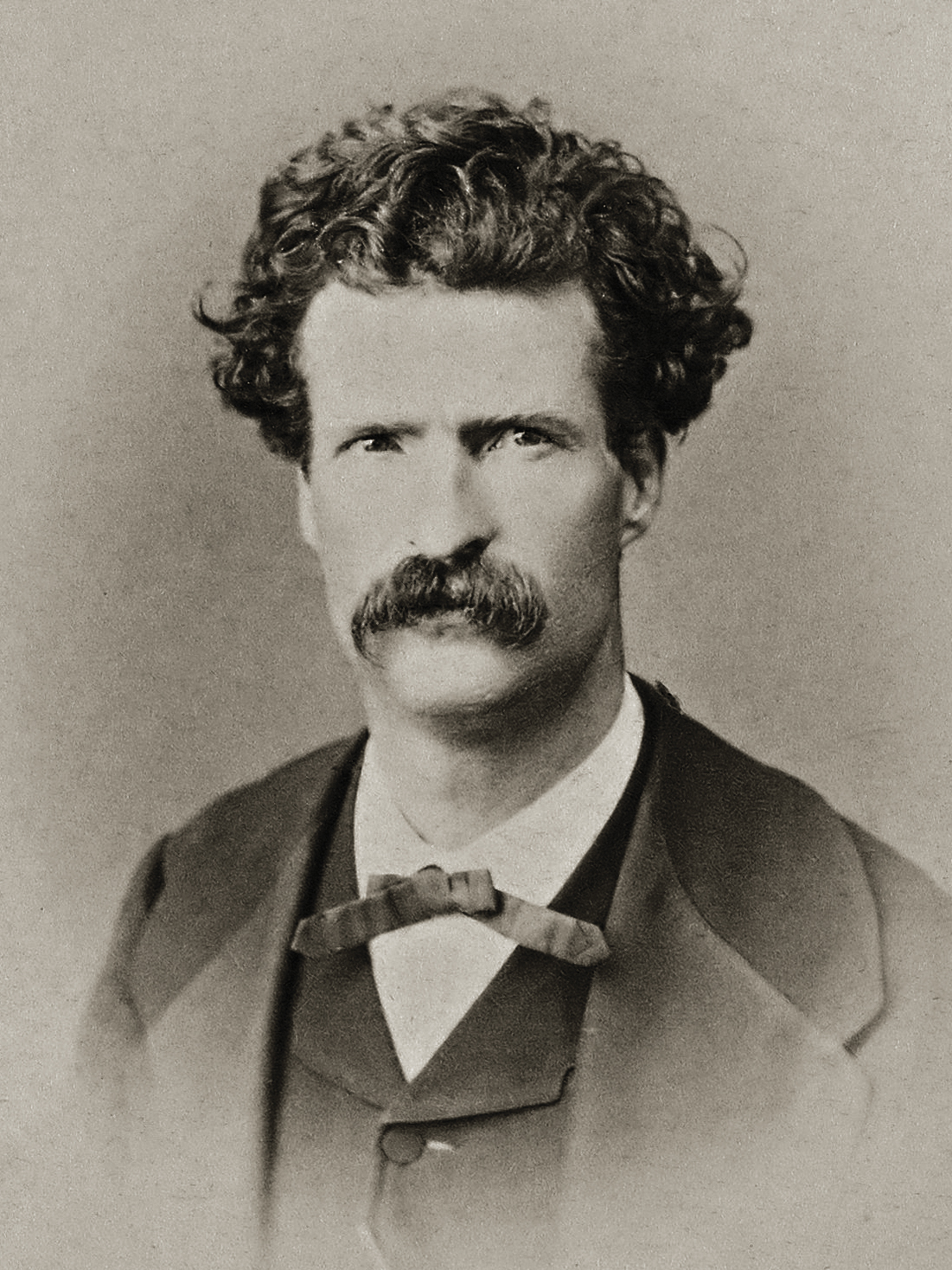
Samuel Langhorne Clemens first used the pen name Mark Twain in 1863, writing for the Territorial Enterprise newspaper in Virginia City. He reached Nevada Territory in 1861, beginning what historian Ron Powers called “the wildest, most irresponsible and dangerous period of his life.”
Twain’s career began in 1848 at age 12 when he went to work for his brother, Orion Clemens, at the Hannibal Journal in their Missouri hometown. A typesetter by age 15, young Twain also wrote his first articles, already exhibiting his penchant for writing outrageous satire and sending it to press when the boss (his brother) was out of town. After Orion sold the paper in 1853, Twain drifted to other newspaper jobs, then returned to Missouri to pursue his dream: to become a riverboat pilot. Though he achieved his goal, when the Civil War began in 1861, Twain was out of work because the war restricted steamboat traffic on the Mississippi.
Meanwhile, Orion, a supporter of Abraham Lincoln, was appointed secretary of Nevada Territory. As the legend goes, Orion could not start collecting his $1,800-a-year salary until he actually reached Nevada, and he was broke. So Twain, who made good money as a riverboat pilot, agreed to cover the $150 stagecoach fare in exchange for work as Orion’s private secretary—and, most of all, a chance at adventure in the Wild West.
Rough Start
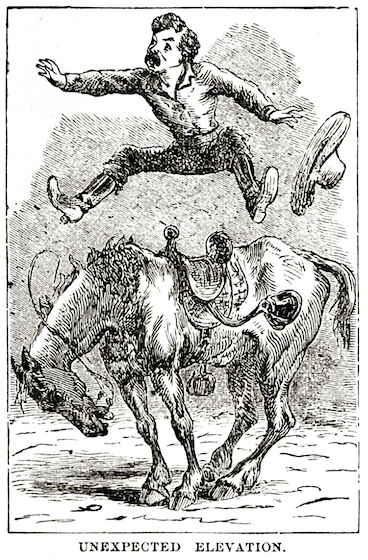
“Unexpected Elevation” depicts Twain’s failed attempt at horse ownership in Virginia City, illustration from Roughing It, American Publishing Company, 1872
Twain recounted his 1861 journey in the quasi-autobiography Roughing It, his “record of several years of variegated vagabondizing.” Once the Clemens brothers reached the territorial capital, Carson City, Twain grew bored. “I had nothing to do and no salary,” he explained. He soon caught “silver fever” and shifted his bunk to Virginia City. He bought “feet” (shares) in mining properties and personally worked the diggings—all with little success.
At one point, he headed to Lake Tahoe for three months of camping. Describing the area, he said, “The air up there in the clouds is very pure and fine, bracing and delicious. And why shouldn’t it be?—it is the same the angels breathe.” The air soon became less heavenly after he accidentally started a forest fire. He stumbled back to civilization.
There, Twain rhapsodized about the variety of people around him. Among those he admired were the highly skilled vaqueros, whom he described as follows: “I had never seen such wild, free, magnificent horsemanship outside of a circus as these picturesquely-clad Mexicans, Californians and Mexicanized Americans displayed in Carson streets every day. How they rode! Leaning just gently forward out of the perpendicular, easy and nonchalant, with broad slouch-hat brim blown square up in front, and long riata swinging above the head, they swept through the town like the wind!”
His admiration led to his next mishap: Twain bought a horse. By his own admission, he was no horseman, and didn’t realize his bargain purchase was a notoriously mean bronc with “as many humps and corners on him as a dromedary.” The pairing did not last long after the horse sent Twain skyrocketing. Failing to resell the beast, he finally gave the animal away “to a passing Arkansas emigrant whom fortune delivered into my hand.”
Mark Twain Is Born
Twain turned to journalism in September 1862. In the year following his arrival, he’d sent several satirical tales to the Territorial Enterprise, signed with the pseudonym “Josh.” The editor, Joseph Goodman, liking his irreverent style and humor, offered him a job for $25 a week (about $860 today).
Writing under pseudonyms was common in those days, and as Sam Clemens quickly developed a reputation for his willingness to poke fun at anyone and everyone, a nom de plume became a necessity.
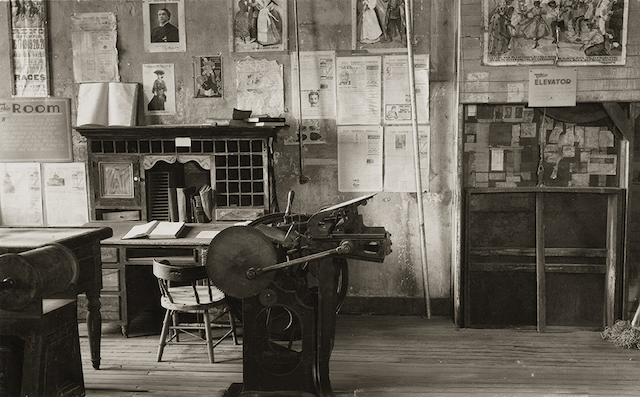
The desk used by Mark Twain and other journalists at the Territorial Enterprise in the 1860s, photo courtesy UNR Special Collections Department
He first used his new pen name in a letter published February 3, 1863. Reporting on the hijinks of the territorial legislature in Carson City, his story, in the form of a “letter” to the Enterprise, complained of a lavish party that allegedly kept him awake for 48 hours. He signed it, “yours dreamily, MARK TWAIN.” Though he claimed the name was inspired by a riverboat pilot, historian Gregory Couch uncovered a more convincing tale—that the two fathoms of water the phrase originally defined translated into Comstock slang for two “blasts” of whiskey at the Old Corner Saloon.
Twain soon was dubbed “the reigning loudmouth of Washoe” for his tendency to conflate fact and fiction.
One example was a fake story about the discovery of a petrified man, allegedly preserved in a position thumbing his nose. He escalated with a story later called the “Empire City Massacre Hoax” in which he described a gruesome murder that never happened, containing elements that only locals would understand as satirical. Other papers reprinted the story as true, and when it was revealed as a hoax, his boss, Goodman, was bombarded with demands that Twain be fired. Still, Goodman stuck by Twain.
One reason was because Twain delighted his boss by masterfully poking fun at the Enterprise’s rival paper, the Virginia Daily Union. Goodman was so at odds with the Union’s editor, Thomas Fitch, that they fought a pistol duel in 1863, which ended when Goodman shot Fitch in the leg.
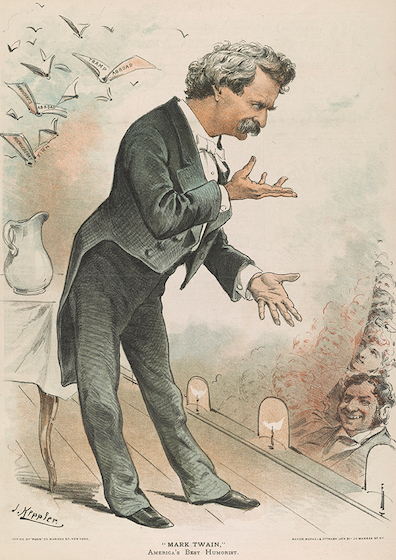
Mark Twain, whose career as a public speaker began with his 1866 tour, became popular on the lecture circuit, illustration from Puck magazine, December 16, 1885
But in May 1864, Twain crossed the line. Prominent society ladies of Carson City, including Orion Clemens’ wife, Mollie, were organizing a fundraiser for the Sanitary Commission, a Union relief charity. They fell into a dispute about which local chapters in the East should receive the proceeds, and Twain dove headfirst into the sensitivities of the era (it was a year before the surrender at Appomattox) by claiming he heard a rumor that the money would go to an organization that promoted miscegenation.
The “joke” blew up in his face. He claimed he wrote the piece while drunk, and that the typesetter printed it by accident because Goodman was out of town. No one bought his excuse. As the Daily Union and the furious husband of one of the society ladies lambasted him with harsh insults, he responded by challenging them to pistol duels—even though, by his own admission, he couldn’t shoot straight.
The authorities noticed the invective was getting out of hand, and notified Twain that dueling was illegal in Nevada. Wisely, Twain left town, accompanied by his friend, Steve Gillis, a short but fierce barroom brawler who had been prepared to act as his second. In his autobiography, Twain explained, “I left Nevada in 1864 to avoid a term in the penitentiary.”
Quickly landing a job in San Francisco, he continued writing semi-fictional lampoons and soon was in trouble with newspapers in the Bay Area. He was, as historian James Edward Caron stated, “a newspaper reporter who seemed completely indifferent to telling the truth.”
Deciding to lie low for a while, Twain took Gillis up on an invitation to visit Gillis’ brothers, Jim and Bill. He spent the winter of 1864-65 in their cabin on Jackass Hill in Tuolumne County. There, he picked up any number of colorful miners’ tales, including one at a bar in nearby Angel’s Camp about a frog named Dan’l Webster. Inspired, he immortalized the world of the California mining camps with his first successful short story, “The Celebrated Jumping Frog of Calaveras County,” published in 1865. Realizing his satirical style fit fiction better than journalism, he shifted genres and changed American literature forever.
The Holdup
His star rising, Twain returned in triumph to Nevada in 1866 on his first speaking tour. In those days, successful writers boosted their income by appearing on stage. While some simply read their work, the best—and Twain quickly became one of them—gave humorous talks with elements similar to modern stand-up comedy.
Having previously offended more than a few people in the region, he worried about his reception, but his first three talks went well. Still, old acquaintances decided he needed to be taken down a peg. Following his performance in Gold Hill on November 10, Twain became the butt of an over-the-top practical joke.
He and his agent, Dennis McCarthy (a former co-owner of the Enterprise), were returning to Virginia City after the show. Out of the darkness, six masked men emerged. The leader held a loaded pistol to Twain’s head while calling upon accomplices with names like “Beauregard,” “Stonewall Jackson” and “Phil Sheridan” to empty his pockets of everything from pencils to $125 in cash and his treasured $300 gold watch.
The next morning, the incident was revealed as a prank, led by none other than Gillis, who returned everything. Twain later claimed, “They did not really frighten me bad enough to make their enjoyment worth the trouble they had taken.” But he was angry. He fired McCarthy, who had been in on the stunt, and left on the next stage.
In 1861, Twain originally intended to spend only three months in Nevada, but, captivated by the Wild West, he didn’t return to live in the East until 1867. His years of mishaps, misadventures and self-inflicted mistakes led to what the historian Powers called “… the most important gestative period of his writing life. Sam discovered the true essence of his craft.” American fiction is the richer for it.
Brenda Wahler, a lifelong Montanan, unearths the complex realities behind the myths of the American West. Her recent books, Marcus Daly’s Road to Montana and Marcus Daly’s Montana Empires, examine the Copper King’s complex legacy. She lives in Helena, Montana.
No Comments