




01 Mar A Contemporary Sanctuary
Fairway Lodge pairs classic and modern design choices to create a refined home fit for the present-day
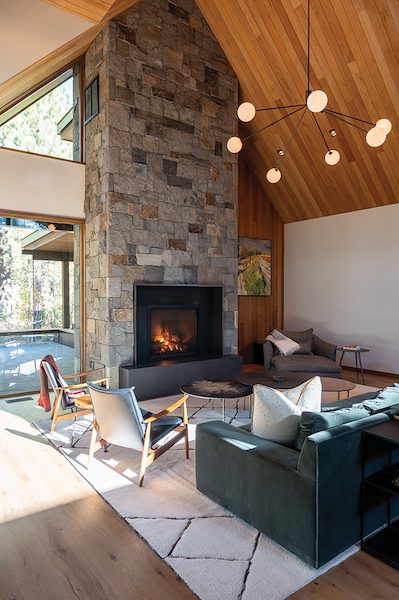
One of the few asymmetrical installations in the home, the fireplace is situated between a window featuring the adjacent fairway and a hemlock wood wall, which ties in the grand hemlock gabled ceiling
“‘Contemporary,’ I find, has become a little bit of a loaded word in architecture and design circles.”
Brendan Riley, owner and principal architect of designSense, is talking about designing a home that represents “the moment,” but not in an expected way. The idea is to blend current ideas with timeless criteria like proportion, scale and texture. In other words, the design has obvious roots, but roots that are neither overly traditional nor obviously modern.
“It is clearly a Tahoe home,” Riley says of the design he feels achieved that delicate balance, dubbed Fairway Lodge. “It has that vernacular of the mountains and its location, embodying these qualities in shape and substance. It then plants these traditions decidedly into the present—into the now, today’s mountain house.”
Interestingly, the current owners of the Lahontan achievement were not Riley’s original clients for the project. He had worked his way through an estimated 80 percent of the design phase with a different client, who ultimately decided they didn’t want to part with the home they were already in and sold the property along with access to Riley’s design. The architect admits that the new owners could have said they loved the property, but they didn’t like the design. Happily, that wasn’t the case. Instead, they finalized the sale, hired Riley and made “very few substantive changes to what was done.”
“For the most part, today’s homes are fitting into some sort of context,” Riley says, referring to this project’s location on one of Lahontan’s fairways. “It had a neighbor to the left, a neighbor to the right. It was an infill situation. We could respond to a known context.”
While there is something to be said for breaking new ground and designing the first home on a street, there is also a pleasant challenge in creating a home that fits into its setting while also feeling fresh and private. Riley knew he wanted to capture views of the fairway, the light and the sun, but he didn’t want the home to focus on or be negatively impacted by nearby residences.
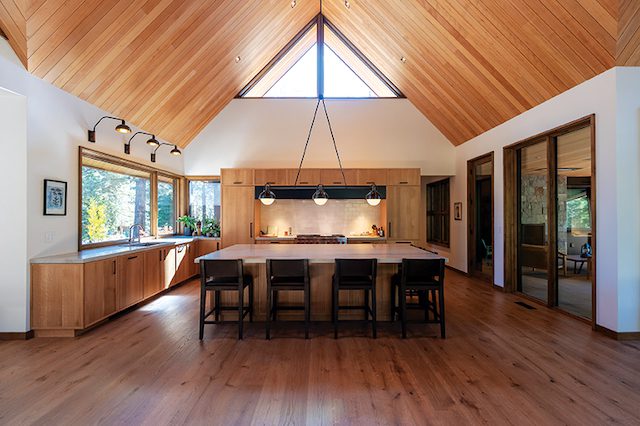
Settled at the end of the gabled great room, the kitchen features a monolithic micro-shaker cabinet structure centered under clerestory windows, along with Heath ceramic backsplash tile and lighting by Allied Maker
To solve this issue, he rotated the plan about 15 degrees so the windows look out onto an expanse of green in the summer and white in the winter—instead of into someone else’s life.
“The rotation changes that field of view in such a way that this home feels really private,” he says. “It doesn’t feel like the neighbors are adjacent to it. You wouldn’t even know there are neighbors.”
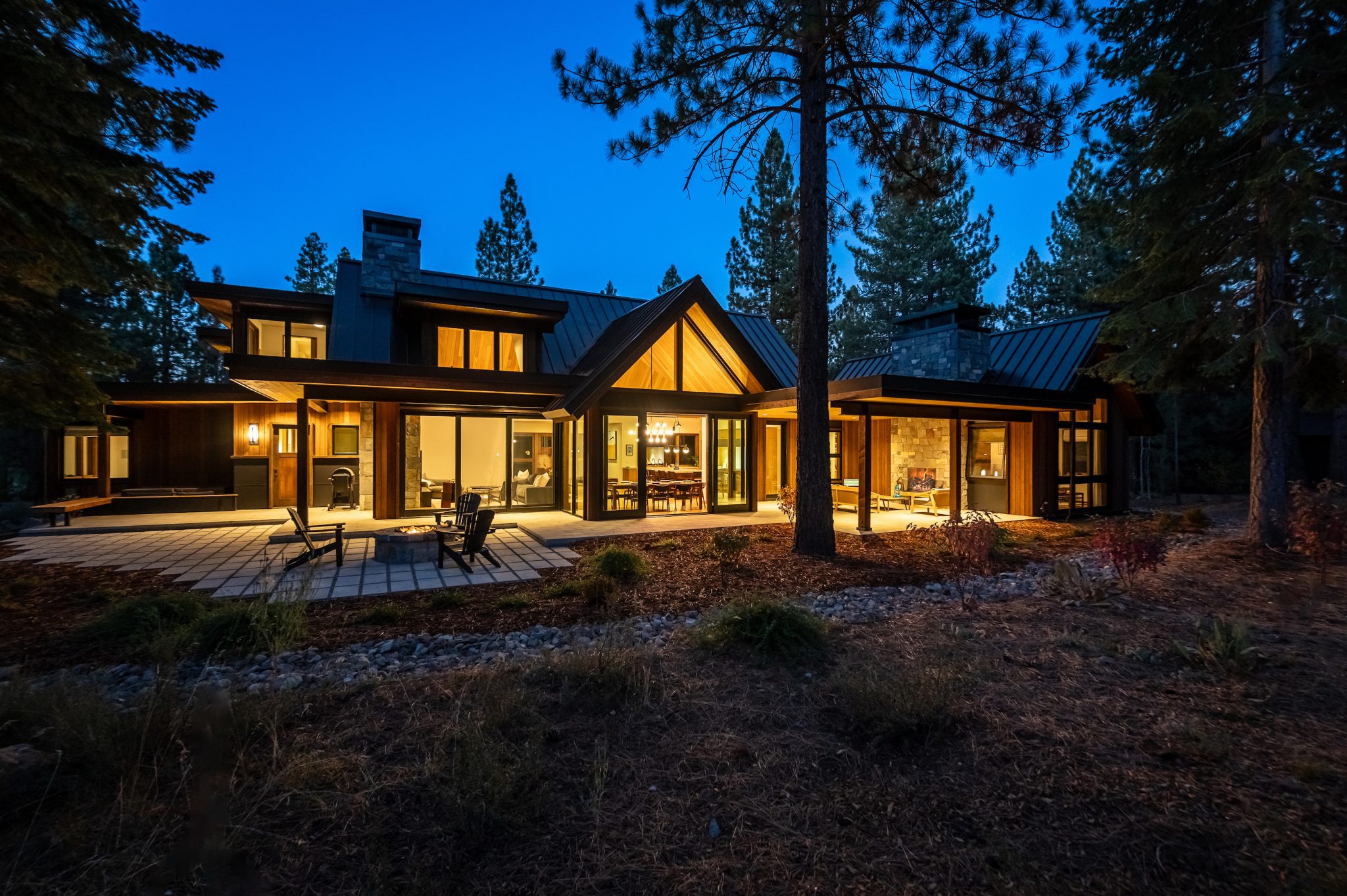
With that directional tweak made, he set to work on the design itself, driven by the iconography of mountain architecture in the Tahoe area. The dominant shape at play is composed of 12-and-12 gable forms, elevated beyond the traditional expectation by coupling them with nearly flat roofs to form a sort of backdrop when seen from the front. The gable-versus-level-roof interplay also begins to hint at a theme Riley consciously designed into the interior: compression and release.
After entering under a covered walkway and relatively modest front door, guests encounter a vaulted space that Riley describes as the crown jewel of the home: a living/dining/kitchen area composed of a 12-and-12 vault running north–south, coupled with a second 12-and-12 vault running east–west, with one vault slightly higher than the other. The kitchen range on one side aligns with and echoes the fireplace on the other. The effect is reminiscent of a sacred space, heightened further by the copious light pouring in beneath a tongue-and-groove hemlock ceiling composed of boards running parallel with the slope toward the gable.
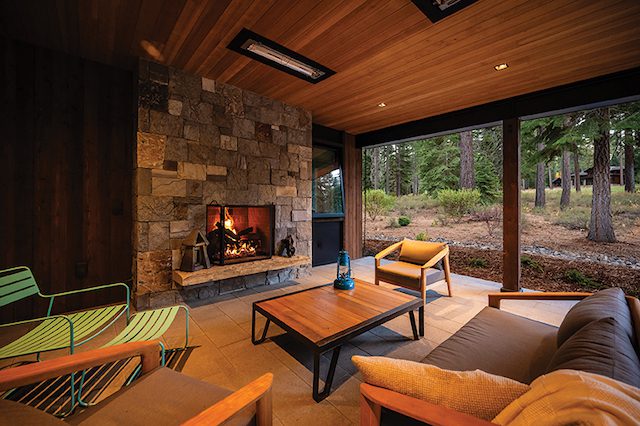
A covered outdoor lounge with a rugged stone fireplace is the perfect place for après dinner conversations. Overhead radiant heaters extend the use of the space into the cooler seasons
“That ceiling definitely took some doing,” says Steve Casey, owner and principal of Casey Custom Builders. “We had three carpenters that lived on scaffolding up in there for a couple of months.”
Wood is a material that evokes Tahoe’s historic design elements, Riley says, but he edited out the expected structure that was often the result of structural necessity. Now, visibly heavy trusses aren’t needed to support a ridge. Today’s tools and structure-concealing design abilities keep load-bearing steel and heavy wood discreetly above the hemlock so “the gestalt of that experience, the shape of that uninterrupted space—edited, cleaned up—contributes to a sort of lightness and kind of a gracefulness that sometimes gets lost in the heaviness of beams and timber trusses,” Riley says.
Some of the uppermost windows in the cross-vault space are mere inches below the hemlock, a proximity not seen—or structurally feasible—in more traditional designs. Those windows—and others next to the fireplace, with glass abutting the stone without a ribbon of wall between them—allow light to come in from different directions throughout the day, morning to twilight. Riley says the sun rises from over the entry door and swings around to set over the fairway. Triangular windows even create an illuminated arrow at times, pointing directly toward the hearth.
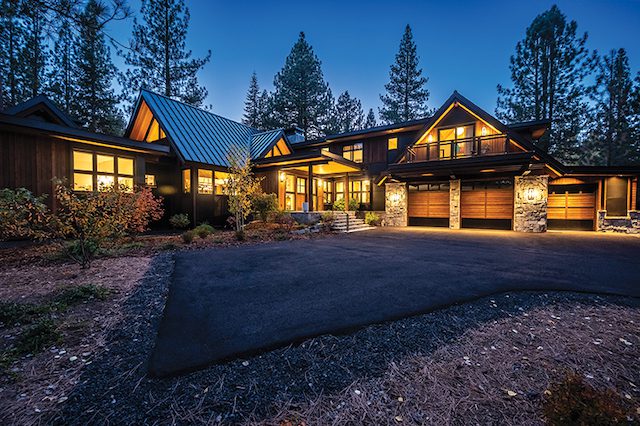
Steeply pitched gabled roofs define the great room, primary suite and garage, echoing elements of traditional alpine architecture
“Allowing pools of sunlight to drift through and among the furnishings is really critical to beautiful spaces,” he says.
Interior designer Colette Fonseca, owner and principal of Altitude Design Co., worked closely with Riley and the owners to ensure the fixtures and finishes fit perfectly into the home. She says Riley sat in on their first design meeting, which involved discussions of extravagant choices: an emerald green kitchen backsplash and brass fittings. What followed was a natural part of her design process.
“Because the architecture is so beautiful and it didn’t also feel right to the clients to be maximalists, we started working through, brainstorming, talking, collaborating,” Fonseca says. “The final design package is incredibly focused and detailed.”
Rather than hitting the senses hard, they decided to lean into serenity. Despite the grandeur of the cross-vaulting, there is still a human scale to the space. To further build relatability into the open area, Fonseca considered the reality of so many windows and talked with the owners about motorized roller shades to minimize glare at certain times. Ideas like this are best discussed early, since creative solutions to daily challenges go far in preserving the longevity of the home’s design intention.
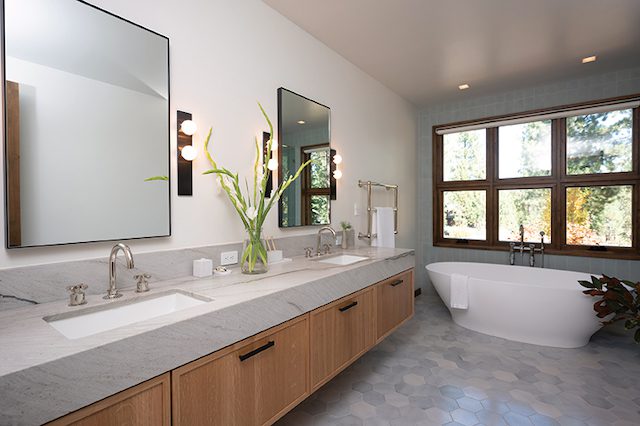
An expansive vanity in the main bathroom floats over a Waterworks hex tile and is composed of micro-shaker drawers and a thick quartzite apron-front counter
“It’s not an afterthought,” she says, “because that will ruin the design integrity immediately.”
Fonseca also worked to create focal points revealed through the lighting, the kitchen monolith and the fireplace. That warmth-giving structure within a structure, for example, is a simple concrete hearth with a firebox ensconced against 3/4-inch-thick natural raw steel. Elsewhere, an asymmetrical light illuminates a vanity, fine wool draperies allow for privacy and brushed marble “looks like a blanket, it’s so soft,” Fonseca says.
Despite the ethereal sensibilities, there are also some unexpected moments. Fonseca says her personal favorite element is an upstairs bathroom where she took a risk and went dark: “It comes as a little bit of a surprise.” A vanity with a quadricolor Waterworks hex tiled floor leads into a black marble shower with—yes—brass fixtures.
“We all loved this combination of materials,” Fonseca says, noting that they “didn’t go crazy with the accents, but downplayed the drama and kept it a little more levelheaded.”
The marble has white veining, so it’s not like a black hole, and a window in the shower brings it light to keep the space both approachable and interesting in a way that Fonseca admits is not everyone’s cup of tea, but that landed—resoundingly—with the owners.
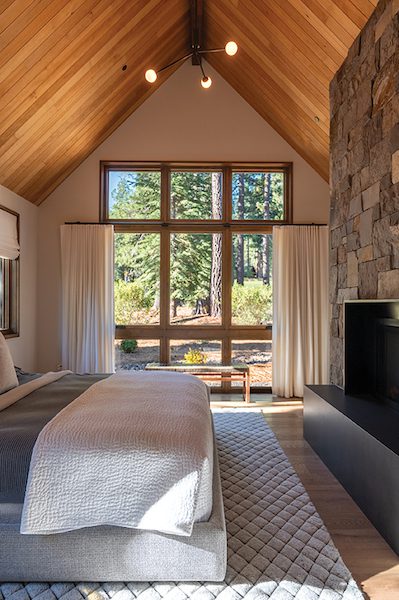
The main bedroom features a vaulted ceiling and large windows framed by fine wool drapery by Pillows and Create. The fireplace is a smaller version of the grand living room fireplace
Off the great room, a single-story space—another example of compression—leads past a pantry and butler’s bar to a vaulted primary bedroom and bathroom wing with a soaking tub. The 12-and-12 gable appears again, but feels more like a cabin retreat from the balance of the house, Riley says. The second floor—home to a small office, three bedrooms and two bathrooms—is accessible via a staircase with oak treads supported by a single piece of steel, set away from the adjacent wall, with a simple oak-and-steel railing.
On the opposite side of the home’s main level is a media room that could transform into another bedroom, a nearby bathroom and access to a semi-in-ground hot tub. A covered outdoor lounge area features overhead radiant heaters, and while Riley originally envisioned outdoor dining, the owners liked their interior dining table so much they decided to keep the outdoor space uncluttered and serving perhaps the ultimate vaulted space, one lit by the flames in a crackling firepit and the stars above.
Award: Mountain Now
Building Design: designSense
Builder: Casey Custom Builders
Interior Design: Altitude Design Co.
Landscape Design: Rock & Rose
Square Feet: 4,212
No Comments