




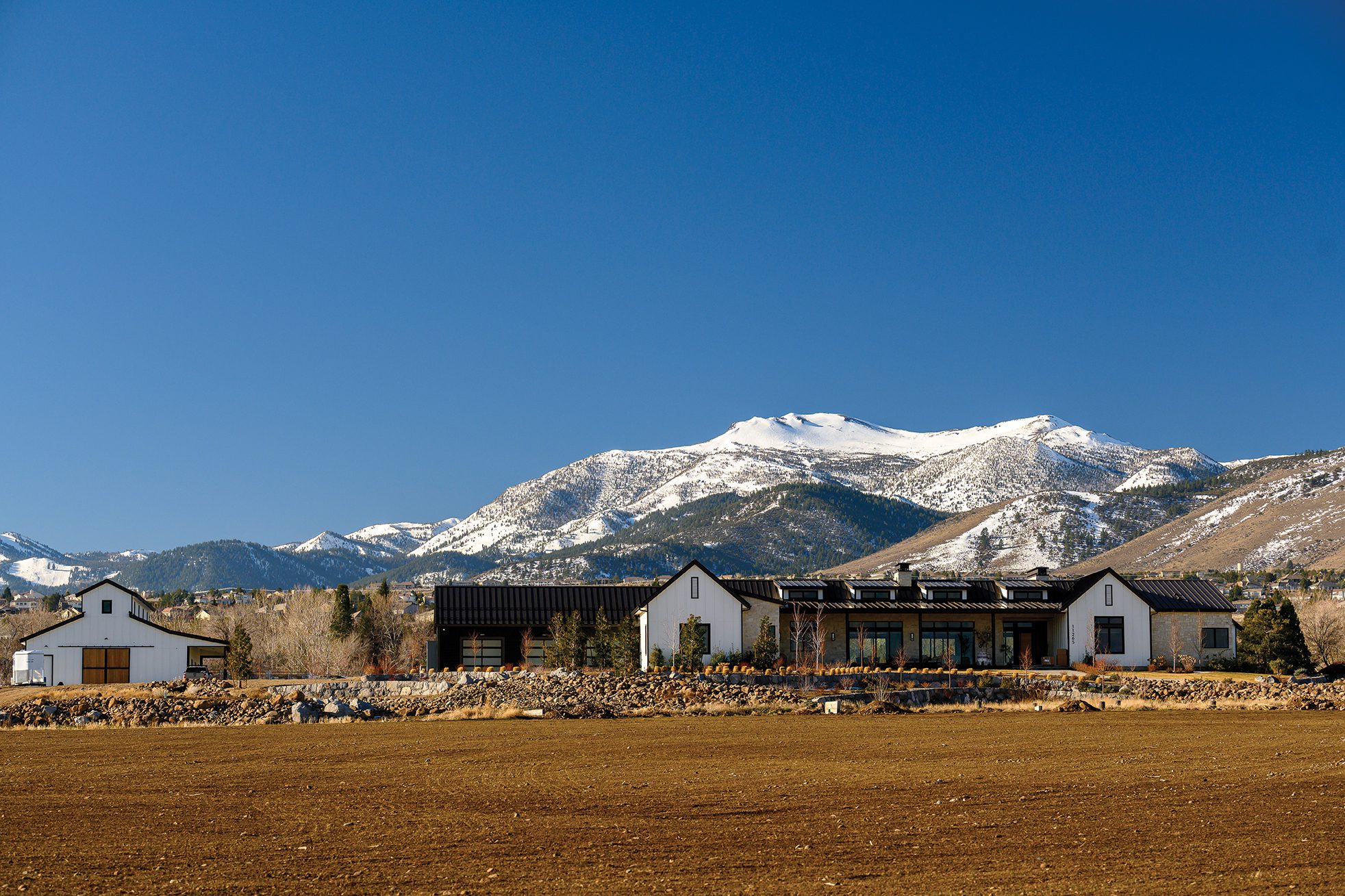
01 Mar Houses on the Hill
Within the confines of a fast-growing city, a rare nook rooted in Reno’s ranching history retains its rural charm and open spaces
Most neighborhoods have a certain look. They are part of a master plan, built with a cohesive design, and easy to name and navigate. But not this one. This southwest Reno enclave is well hidden, strangely hard to define, packed with a who’s-who of longtime locals and deeply rooted in the city’s ranching past.
We’re talking about a hidden pastoral land west of Virginia Street, between Windy Hill and Fricke Lane. Oh, you don’t know the Frickes (frick-ee)? Well, you’ll meet them soon.
But first, visualize this eclectic place.
The sprawling neighborhood could best be described as faux rural … perhaps urban farmland? Turning off Virginia Street immediately gives way to two-lane roads that melt into single-lane bridges, dirt tracks and streets named after the people who settled there 40-plus years ago (like Kevin Circle; who was Kevin, anyway?).
“You name the street whatever you want,” says Cary Lurie. “We named it Lurie Lane. We were the only ones there.”
People jog down the main streets, and cars give a wide berth. Coyotes pass through fields, looking for their next meal. Houses dot the horizon, while Thomas Creek, Steamboat and Last Chance ditches cut through the land, supplying water for irrigation, water features and wells.
The houses range dramatically from simple mid-century designs to palatial custom manors to architectural marvels. Several gated communities and HOAs hide among the barns, fields and refurbished divorce ranches of yore.
One zoning rule keeps the land open: No parcels under 2.5 acres are allowed.
People call the area Holcomb Ranch, Huffaker Hill or Thomas Creek for the three main roads that run through it. Others called it Pill Hill because of all the doctors who live there. Some still call it by the old ranch names, which suddenly makes every South Reno neighborhood make sense: Caughlin Ranch, Damonte Ranch, Double Diamond, ArrowCreek, Pecetti Ranch, Bartley Ranch, Rancharrah and on and on.

Elmer the English Longhorn rests on a property near Huffaker Lane and Lakeside Drive in southwest Reno
Before Reno, those ranches supplied beef to the region’s miners. Today, there are gabled roofs, porticos, parapets, cantilevered living quarters, dovetailed finger-locking wood and archways.
To be clear, there are still cows, like Elmer the English Longhorn. There are also sheep, alpaca and, for some reason, peacocks. Just ask Kellen Flanigan about her childhood pets.
“It’s really changed,” Flanigan says of the neighborhood, where her family moved in the early 1970s. “My parents had a fetish for exotic animals. People would pull up along the road, gawk and feed them. We had emus with Texas Longhorn and potbelly pigs. People always thought you had to keep them separate, but we threw them all together.”
Of the dozen people interviewed for this story, they all say the same thing: Despite its quirks, the neighborhood feels pleasantly quiet and rural, with beautiful views and friendly people, and yet it’s only a few minutes away from Reno-Tahoe International Airport, MidTown and Whole Foods. Many of its residents were not even looking for a house there, but once they toured one, they fell in love.
“It’s almost like going back in time,” says Reno-based architect Jack Hawkins, winner of Tahoe Quarterly’s 2026 Outstanding Award—a mid-century-inspired masterpiece located in this very neighborhood. “You don’t see the urban problems. It’s like you’re in a bubble—a nice bubble.”
Doug McGoff says he enjoys standing on his back porch watching airplanes land. He uses an app to track flights. When a friend’s airplane touches the tarmac, he knows it’s time to jump in the car and head to the airport.
“When you’re out there, you have a completely different environment,” Hawkins says. “If you’re lucky, you get great views of the highlands, or if you’re really lucky, you get great views of Mount Rose.”
And though the neighborhood has changed—it’s become denser over the years, been threatened by commercial development and even dealt with rampant chimpanzees at one point—it remains a special gem in an otherwise fast-growing city.
But living in this distinctive corner of Reno isn’t just about the views, the crisp, clean air and the smell of hay; it’s about what people choose to build, restore and protect.
Cosplaying Rural
“People always say old houses are better, but it’s not true,” Hawkins says. “There’s nothing worse than a 1950s mid-century house in a high seismic zone, and you get an earthquake and it comes down on you.”
Over the last 30 years, the ranch lands have been subdivided repeatedly, often taking hundreds of acres and converting them into 2.5- to 5-acre parcels. Many of the older, petite ranch houses are in poor condition. Hawkins says new owners buy the plots and raze the old homes to make room for contemporary houses that fill the smaller parcels edge to edge.
“Sometimes it’s really cool to repurpose stuff from a sustainability standpoint,” he says. “It takes a special type of human to get through those projects.”

Tamsen Fricke and Doug McGoff pose in their multi-acre backyard wearing cocktail attire. In the distance, they can see downtown Reno, the Atlantis Casino, Grand Sierra Resort, The Nugget and Reno-Tahoe International Airport
Tamsen Fricke, of Fricke Lane fame, and husband Doug McGoff are those special humans.
“The first day I moved in, I FaceTimed with Doug and burst into tears,” Fricke says. “I said, ‘This place is such a shit hole!’ And Doug said, ‘Take a step back and look at the potential.’”
They live in an unassuming single-story white house on 7.5 acres of land at the end of Thomas Creek Lane. It’s cozy with warm woods on the inside, a modest central room, a well-stocked 1950s-style bar and two bedrooms.
The house belonged to Fricke’s grandmother briefly. She grew up visiting because her father, Dr. Fred Fricke, a retired gastroenterologist, lived next door in another mid-century house. Since Fricke split her time between her mother’s and father’s area of town as a child, she never grew into the neighborhood.
“I was never comfortable there as a kid because there were mice and rural things that I didn’t really understand because my mom’s house was in Lakeridge on the golf course,” Fricke says. “They were extreme opposites.”
After college, she traveled the world for 22 years before resettling in Reno. McGoff, who grew up in rural New York, joined the Navy and rose through the ranks to command a destroyer before retiring. Fricke returned to their new home in 2016, and McGoff followed a year later, beginning his new chapter as a math teacher at Reno High School.
They started restoring their new home by first replacing a Sears oil boiler. Then every problem snowballed. The property needed a new transformer, which required a trench that could only be dug with a tractor, then it needed a new kitchen, and so on.
“Our first year here, we tried to do everything by hand, and we tried to battle juniper with loppers, but what you need is a vehicle,” Fricke says. “I think we’ve removed hundreds of yards of brush from the property. It didn’t look anything like it does now. Everything was encroaching on the driveway, creating a fire hazard. Our project has been to make the house safe, functional and comfortable, in that order.”
McGoff feels more comfortable in the fields, while Fricke has had to learn to adapt to this new, rugged lifestyle.
“I love being able to live next door to my dad,” Fricke says. “It’s good for my family, but I wouldn’t be able to manage it if I hadn’t partnered with someone like Doug.”
Colleen Barrett of Dickson Realty and her husband Marvin Davis experienced a similar renovation journey when they moved into the neighborhood.
As Barrett recalls: “Our home inspector came from under the house and said: ‘Do you want the bad news or really bad news? Three sides of the joists are rotted out. And it’s so bad it might be into the framing, and you won’t know until you tear the house down.’”
Luckily, Davis is a structural engineer. Undeterred, they spent the last 26 years slowly restoring their house instead of tearing it down.
“I wanted to live in the neighborhood so bad,” Barrett says. “I paid the woman full price for the house and couldn’t get her out fast enough.”
The neighborhood’s unique character draws people in. The pastures provide space for livestock, pickleball courts and other spacious amenities. And while some homeowners focus on restoring modest ranch houses, others have left an entirely different architectural mark on the hills.
Ten Miles of Mahogany
“So many events we had there,” Cary Lurie says about her former house on Lurie Lane. “Everything was done at the house; we never had to rent any facilities.”
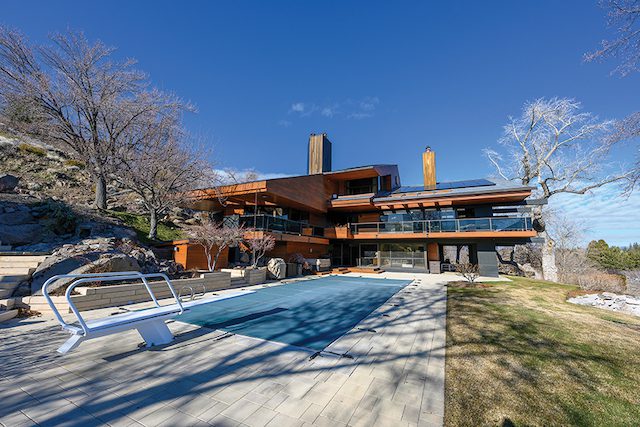
This unique house in southwest Reno, designed by Swiss architect Eduard Dreier in the late 1970s, was built over several years. The view from the rear pool showcases the various rooflines and architectural elements
In 1977, Cary and Dr. Arthur Lurie moved to Reno so Arthur could start work at Washoe Medical, now Renown Regional Medical Center.
“I came here kicking, screaming and pregnant,” Cary says. “But it was a great opportunity for him to start a brand-new open-heart surgery program in Reno.”
Cary wanted a contemporary house and Arthur wanted something with big open spaces after growing up in Chicago. They found an open plot of land in the hills above Lakeside Drive off Faretto Lane.
“I don’t think it was really for sale,” Cary says. “It had no road.”
The vice president of JCPenney owned it, thinking he’d retire in Reno, but ultimately decided not to and sold the parcel to them. But it needed a house, so they drove up to Lake Tahoe to look for inspiration in Incline Village. Cary found something she loved and walked right in while it was under construction.
“The owner walks into the kitchen and says, ‘What are you doing here?’” Cary recalls. “So, I have no filter and said, ‘Oh, the house was such a mess, I didn’t realize anyone lives here. I just want to know the architect. I really admire this house.’”
Eduard Dreier, a distinguished Swiss architect who combined art, craft and technology, had designed it. After some searching, she found him in Salt Lake City, and the couple set out to build their new home.
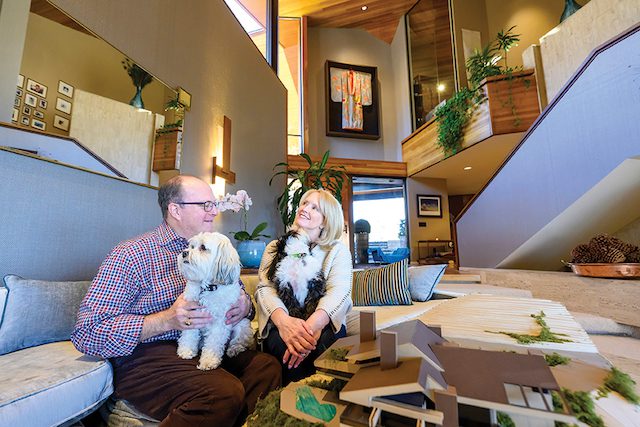
Michael and Pamela Hillman sit in the spacious living room with their dogs. In front of them is an original architect’s model of their home, which was completed in 1983 and purchased from the original homeowners in 2017
Partway through the design process, Arthur bought 58,000 board-feet of Philippine mahogany. Dreier loved it and incorporated it into the house’s exterior and interior. Despite a fire burning part of the house during construction, the Luries were moved in by 1983.
In 2017, Michael and Pamela Hillman bought the property from the Luries, even though they originally planned to move to Tahoe, not Reno.
“There’s just a thousand details, and we sucked up every one of them,” Pamela says of the home. “I’m a finance person, and every detail is important, and Michael is an engineer. We have to take in everything.”
The approximately 10,000-square-foot house immediately opens to a more than two-story living room with a central staircase clad in travertine. It follows a 1970s-style nested floor plan, unlike current open-concept designs. Cary specifically wanted to avoid people congregating in her kitchen.
While touring the house, Michael, a former engineer at Apple and product designer of several generations of iMacs, points out a mind-boggling number of fine details: giant windows that let in morning light, drywall meeting perfectly cut door frames without sloppy trim, mahogany beams supporting a cantilevered dining room, and an almost complete lack of 90-degree angles in the ceiling and wall joints in the living room.
Dreier loved playing with materials and gave rooms a sense of motion. He instructed builders to use commercial-grade materials, making it resistant to the Nevada zephyrs, too.
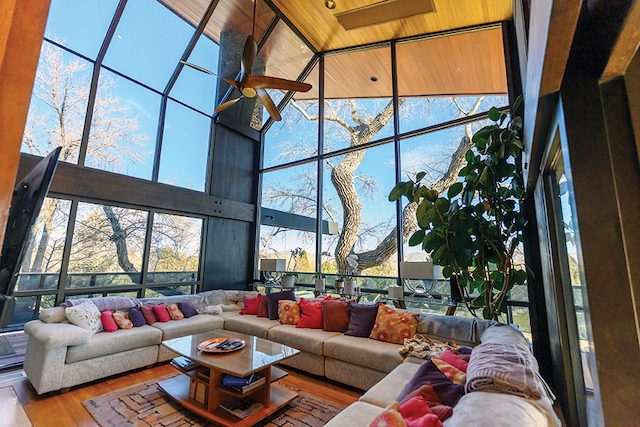
A glass-lined sitting room in the Hillman residence cantilevers over the ground below. The giant cottonwood seen through the windows provides additional privacy during the summer
“There’s nothing quite like it,” Michael says. “They don’t build homes like this anymore, at least in the last 30 years, where the architect put so much effort into detailing and engineering for absolutely everything. There are plans for the landscaping, the furniture, the plants, everything.”
The Hillmans display the original plans prominently in the hallway. They say they feel like stewards of this grand architectural artifact, keeping it in pristine condition for the next owners.
“Living here has just been amazing; our neighbors are amazing; just good people,” Pamela says. “It reminds me of the ’70s neighborhood where I grew up.”
But as more people discover this rare urban enclave, its future is becoming a topic of conversation among longtime residents.
A Slow-Growing Neighborhood
“The majority of people here are migrants to Nevada,” Michael says. “It’s not people who grew up and spent their careers here. They’ve realized, like we have, that it’s a wonderful place to live, and it’s a distinct separation from places we came from. I love the Bay Area; we raised two kids there, but I don’t imagine myself going back to live anywhere in the Bay Area.”
As the neighborhood grows, longtime owners worry about density and water rights.
“The ditch master is like the mayor in this little area of town,” says Kellen Flanigan, a real estate agent with Dickson Realty who grew up in the neighborhood in the 1970s.
Water rights tightly control how much ditch water each property can use, and the ditch master helps settle disputes.
“Norm Dianda used to come out to everyone’s property to make sure the ditch heads were letting out the proper amount of water,” Flanigan says.
Dianda wasn’t the ditch master, but he was the co-founder of Q&D Construction, a company that you might say built Reno.
Parcel sizes, custom home construction costs and water rights put most properties—old or new—in the $1 to $4 million range.
“As somebody who lives here, I don’t like seeing the development and growth, but that’s just me being a NIMBY,” Barrett says. “But as a Realtor, did I move here with any misconceptions that those parcels wouldn’t be developed? No. I knew that would happen.”
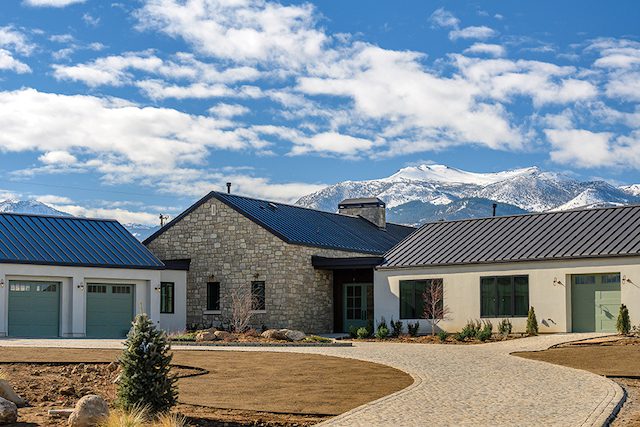
A model house in the new Glenhaven neighborhood
The newest housing development in 20 years, called Glenhaven, is taking those concerns into account. The original parcel, like everything else, was ranch land that the new developers later subdivided into 24 lots.
“The developer’s goal wasn’t to change the face of the neighborhood but to add a layer and stay in character with what this area already is,” says Leslie Davidson of Compass Real Estate. “We’re offering something a little different.”
The Glenhaven subdivision will allow people to build custom homes within an HOA, either using recommended designs or designing from scratch with their own architect.
“All the lots are different sizes and shapes,” Davidson says. “It’s the opposite of cookie-cutter.”
Fricke balks at the idea of new houses drawing from the Steamboat Ditch water table. But she changes her tune after being told Glenhaven would use city water, sewer and gas utilities. Most of the neighborhood still relies on septic tanks, propane fuel and wells, but some houses closer to Virginia Street have access to city utilities.
The Glenhaven model homes prioritize large, open great rooms, multi-car garages and homes designed for entertaining. They fit the lifestyle of many of the other houses around them.
“The double-edged sword is people want it to be quiet and aren’t looking to change things fundamentally, but at the same time, in my opinion, growth is good, and nothing stays the same forever,” Davidson says. “But you want to grow responsibly and thoughtfully.”
For now, the winding roads and open fields remain, preserving a rare balance of rural quiet and modern life.
While exploring this unique neighborhood, Reno-based writer and photographer Mike Higdon took several moments to sit and enjoy the incredible vistas and silence of the sweeping hills. He watched a coyote cross a field, while sheep grazed safely nearby. But at heart, he loves the bustling activity of MidTown.
No Comments