




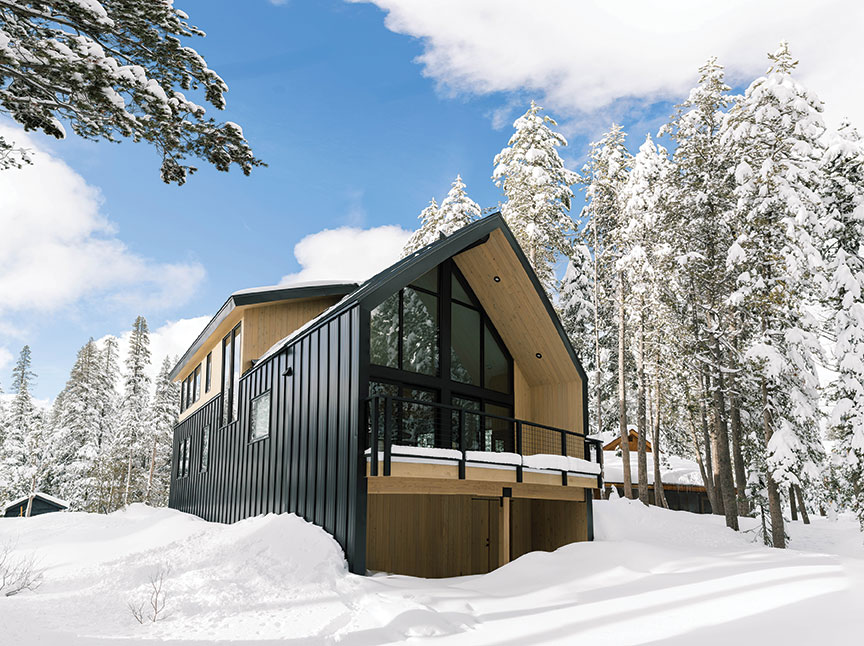
27 Jun Trial by Wildfire
Tahoe-area homes are increasingly designed, built and maintained around the threat of fire
Around Lake Tahoe, high-end homes have long been inspired by the landscape. But as the West grows hotter and drier and the risks of wildfire rise, homeowners, architects and builders are rethinking mountain design, resulting in homes that no longer simply complement their surroundings, but are also able to survive them.
Ever-Present Danger
In 2025 alone, California lost more than 16,500 structures to wildfires, while Nevada saw more than 395,000 acres burn. South Lake Tahoe residents are still haunted by the memory of the 2021 Caldor Fire, which destroyed some 1,000 buildings and burned into the Tahoe Basin before it was finally extinguished (thanks in part to defensible space efforts by homeowners in the Basin).
Alison Edelstein and her husband Geoff bought their property in Martis Camp in 2007, the same year the Angora Fire tore through South Lake Tahoe and destroyed about 280 structures.
“The house was designed with fire in mind,” she says.
Designed by Truckee architect Greg Faulkner, the Edelstein home is a contemporary five-bedroom made primarily of glass, concrete and corten steel. It’s built to withstand Tahoe’s extremes. And while individual homeowners can do their part to improve fire resilience, communities are safest when everyone does their part.
“Fire is a natural occurrence, and it will happen, it’s just where and when,” Edelstein says. “When it comes to fire, we are all in it together.”
Designed to Endure
For new builds, architect Tara Sypriano of Truckee’s Hedda Inc. says streamlining the architecture can have a big impact.
“Simpler forms generally perform better in wildfire conditions,” she says. “Fewer corners, fewer roof intersections and fewer transitions reduce the places where embers can accumulate.”
During a wildfire, wind-driven embers, which can travel more than a mile, are the leading cause of home ignition. Roofs are especially vulnerable.
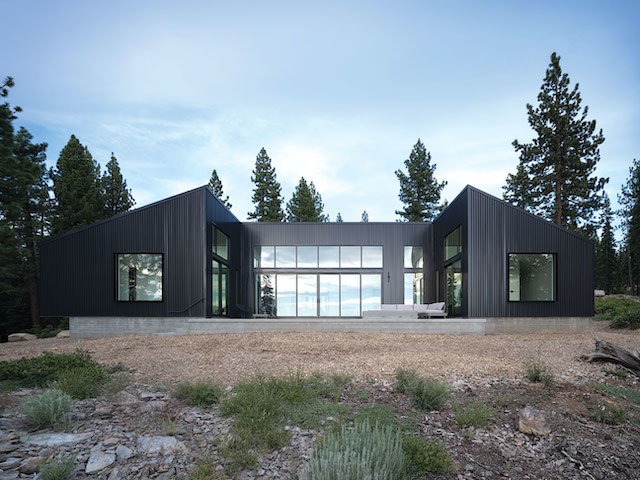
A Truckee home designed by architect Gordon Magnin was built with fire-resistant materials at the request of its owner, who is a retired fire chief, photo by Patrick Brennan
Sypriano says homeowners often request complex rooflines, layered massing, deep shadow gaps and heavily articulated exterior detailing. “While visually compelling, these conditions can also create pockets where embers and debris collect,” she says. “The more transitions, gaps, corners and collection points a home has, the more opportunities there are for ember intrusion.”
Architect Gordon Magnin of Reno’s Magnin Architecture minimizes openings such as attic and crawlspace vents, where embers can blow into the home.
“Rain gutters can accumulate debris, which acts as kindling,” he says. “These openings/gutters have provisions for screens, but it is even better if they can be minimized or reduced.”
Enclosing soffits and eaves can also help reduce a home’s vulnerability to wildfire, in addition to simplified forms.
“That does not mean architecture needs to feel overly minimal or utilitarian, but simplicity and restraint often lead to both stronger design and better long-term performance,” Sypriano says.
Materials That Make a Difference
Cory Hannaford of South Lake Tahoe’s Sierra Sustainable Builders says fire resilience is a growing priority. “This is more frequently something our clients bring up early on,” he says.
Exterior materials must meet strict fire safety standards, with concrete, stone and steel among the most durable noncombustible options.
For decks, which can gather embers easily, Hannaford recommends steel framing paired with concrete decking products.
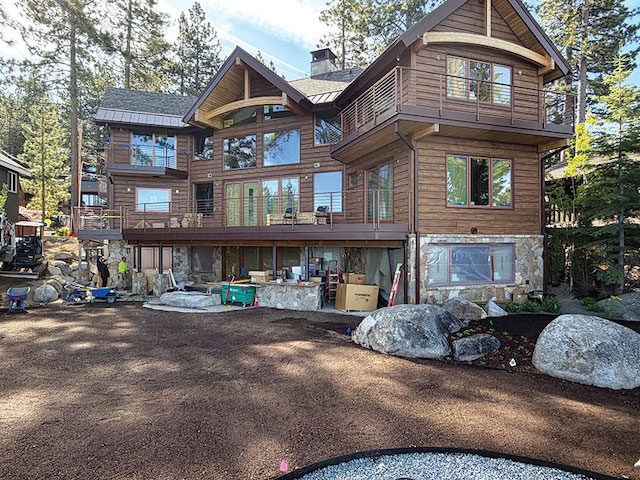
A Tahoe home built by Sierra Sustainable Builders is constructed with fire-safe concrete log siding by EverLog Systems. In addition to siding, the Montana-based company sells concrete logs and timbers that offer the look and texture of natural wood, photo courtesy Cory Hannaford
While wood is inherently more flammable than stone or steel, some species and treatments perform significantly better than others. Heavy timber, for example, tends to char rather than burn. Western red cedar has a class B fire retardant rating. Meanwhile, Douglas fir, a softwood staple of Lake Tahoe building in the 1970s and ’80s, is highly flammable.
“There are also some amazing coatings/additives for paints and stains that show a great deal of promise, making materials they are applied to nearly fireproof,” Hannaford says. “But they do require reapplication every few years.”
For sheathing, Hannaford uses products like drywall, DensShield (a fiberglass mat gypsum panel) or FlameBlock (a wood panel coated with Pyrotite). Products like fiber cement boards mimic the look and feel of Tahoe-style wooden siding but add a superior level of fire protection.
“We are currently completing two homes that are great examples of this,” Hannaford says. “One is a lakefront home in Skyland [in Zephyr Cove], where the entire exterior is a cementitious log siding product that looks like a traditional Tahoe home but is a fireproof material requiring little to no maintenance.”
The other home, in Kirkwood, incorporates metal siding, metal roofing, steel-framed decks and cement decking boards. “This home is considered to be in a high fire danger area and is certified as a fire-hardened home,” Hannaford says.
Magnin is also a proponent of noncombustible finishes. “We have a project in construction right now on the West Shore that is all concrete, steel and tempered glass,” he says. While fire resistance was not one of the home’s original top priorities, he adds, “It has come up in subsequent conversations, and we are very well protected.”
Defensible Space
Protecting a property from wildfire means more than building a fire-safe home; it also requires careful management of the surrounding landscape.
“It starts with the vegetation around your home,” says Amy Berry, CEO of the nonprofit Tahoe Fund. “Really try your best to clear any bushes and low vegetation 5 feet from the structure.”
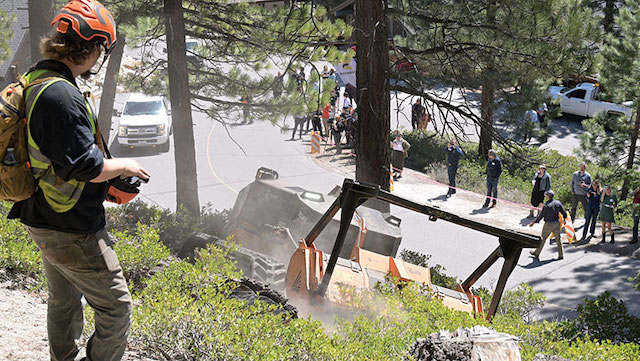
A BurnBot remotely operated masticator machine removes vegetation in a Tahoe neighborhood as part of the Tahoe Fund’s Fire Smart Community Pilot program, photo by Jeff Freeman, courtesy Tahoe Fund
Last summer, the Tahoe Fund, which supports area environmental projects, launched the Fire Smart Community Pilot program. The pilot began with Incline Village’s Tyrolian Village (identified as high-risk) and quickly expanded to five more neighborhoods, implementing fuels mitigation, defensible space and home-hardening measures
“You can change the outcome of wildfire in your community by doing your part, and encouraging your neighbors to do the same,” Berry says. “Get a defensible space inspection from your fire department and get to work.”
Edelstein agrees. “We can keep our house safe, but if a neighboring community doesn’t clear, we will burn anyway.”
Within the 5-foot zone, nonflammable hardscaping, such as gravel or pavers, are recommended. Beyond that, native and adapted plants are good choices; ensuring they are irrigated makes them less susceptible to ignition.
“Landscape design should be considered part of the resilience strategy, not something separate from the architecture,” Sypriano says. “Fire resilience is rarely one singular feature. It comes from many small decisions working together as
a system.”
Magnin often includes sprinkler systems both inside and out. “Landscape and roof sprinkler systems are becoming more common,” he says. “There are even water cannon options for exterior protection.”
Remodels and Maintenance
For existing homes, simple upgrades can make a big difference, such as installing fine mesh over vents and eaves, and clearing firewood away from the home. Larger improvements include replacing wooden roofs and decks, installing fire-resistant siding and upgrading to double-pane tempered windows.
Designing and building a fire-resilient home is only part of wildfire protection.
“One of the biggest misconceptions is that fire resilience is achieved once construction is complete,” Sypriano says. “In reality, resilience is heavily tied to long-term maintenance. Even a well-designed home becomes vulnerable if roof valleys collect debris, vents are not regularly cleaned, or surrounding vegetation becomes dry and stressed over time.”
Defensible space also needs to be constantly maintained. Edelstein’s home in Martis Camp gets yearly assessments and clearings. “We view it as an annual process to keep the house safe, have fire breaks behind the house and plenty of defensible space,” she says. “And, I’m perfectly happy to live with a more organic landscape and not bring plants that are flammable too close to the house.”
Edelstein knows the dangers well. Although she and her husband live part-time in Truckee, their primary residence is in L.A.’s Pacific Palisades, where an estimated 6,800 structures were lost to wildfire last year. Edelstein says roughly 70 percent of her neighborhood was destroyed. While her home survived, it was filled with toxic black ash; the contamination forced them to discard every soft item in the house.
She advises homeowners to plan ahead: Know evacuation routes, identify safe zones and decide in advance what to grab during an emergency. “Don’t think it won’t happen to you,” she says.
Wildfire in the Sierra Nevada is both expected and unpredictable. For those lucky enough to live in or around the Tahoe Basin, preparing homes and properties for fire is part of the responsibility of living in the mountains.
Berry believes the lesson is clear.
“It really does take a village to ensure everyone is safe from fire,” she says.
Reno writer Alison Bender is a strong proponent of home hardening and defensible space, particularly after she was evacuated for almost a week during the 2024 Davis Fire.
No Comments