




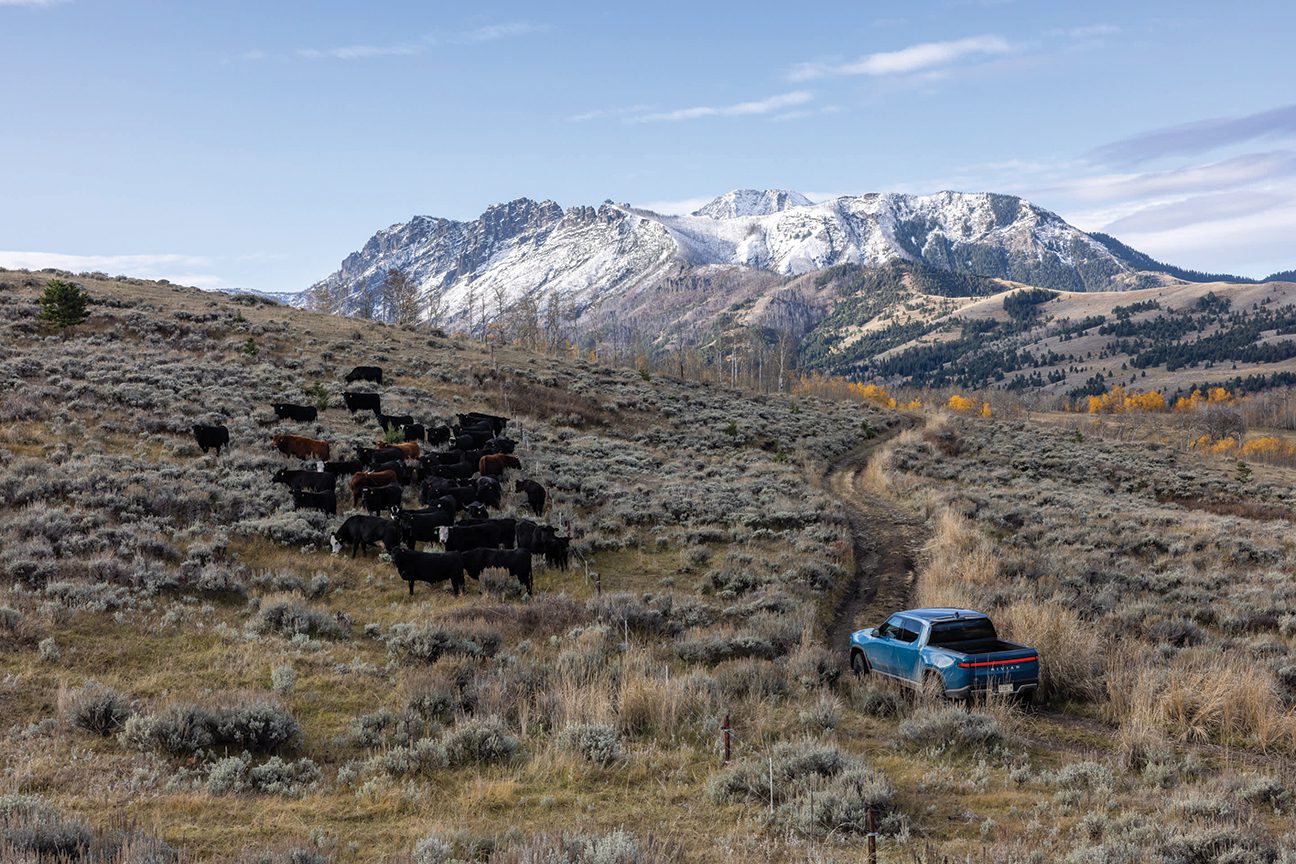
29 Nov Tahoe’s Electric Evolution
As electric vehicles become more prevalent, questions abound about their performance and practicality, particularly in a challenging environment like the Sierra
From the farthest stretches of the globe to the streets of Tahoe, the rise of the electric vehicle has been explosive over the last decade.
The statistics bear this out.
In 2014, approximately 100,000 electric vehicles (EVs) were sold in the United States, which represented about half of the global share, according to the International Energy Agency. In 2024, more than 1.2 million electric vehicles were sold across the country, representing a mere fraction of the worldwide total of approximately 17.5 million EVs, with China alone accounting for more than 10 million.
This boom is plainly visible in the Tahoe area, where electric vehicles have become a common sight in recent years.
“When I first bought my Rivian (in 2023), I would see one or two on the roads,” says Truckee resident Casey Eberhardt. “Just the other day I was dropping my kids off at school in Glenshire, and I saw about 10 as I was waiting in line.”
While electric vehicle sales continue to climb, the numbers have cooled recently as buyers weigh a complex and ever-evolving mix of pros and cons, from environmental factors and economics to performance and fueling. The viability of electric vehicles is also specific to geography and climate, and few regions test their practicality like the Sierra Nevada.
EVs of Old
Electric vehicles are not new, and in fact predate their gas-powered counterparts, with the invention of the rechargeable lead-acid battery in 1859 accelerating their use. The development of gas-powered cars didn’t occur until the 1880s, with Karl Benz patenting the first model in 1886.
For the next 20 years, electric vehicles led the nascent automobile market, as they were considered quieter and easier to use than early gas-powered cars, which required a heavy crank to start.
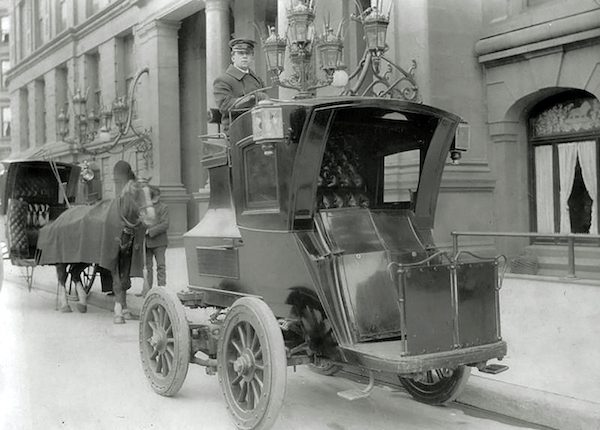
The E.V.C. Hansom Cab was an electric taxi built from 1899–1906 by the Electric Vehicle Company and its successor, the Columbia Automobile Company, courtesy photo
Henry Ford’s mass-produced Model T, introduced in 1908, followed by the invention of the electric starter, made gas-powered cars more affordable and led to the near obsolescence of electric vehicles for the next century. The subsequent discovery of vast petroleum reserves and the creation of an elaborate gas station infrastructure propelled gas-powered vehicles to the forefront.
Research into electric battery technology continued sporadically throughout the twentieth century, but it was not until public concern over air pollution became pervasive in the 1960s that interest was renewed. When California initiated action to reduce emissions in the 1960s, eventually culminating in the Zero Emission Vehicle Mandate of 1990, car manufacturers, despite resisting the regulations, began investing more research into the technology. A crucial breakthrough came in 1980 when John Goodenough developed the lithium cobalt oxide cathode, paving the way for modern batteries.
Yet, most car manufacturers kept their electric vehicles off the market.
The debut of the Tesla Roadster in 2008 demonstrated that electric vehicles could not only provide a low-emission alternative but could also excel in performance and desirability.
By 2024 (the latest year available for stats), electric vehicles had grown to represent more than 10 percent of vehicle sales in the United States, signaling a significant, if still emerging, shift in automotive technology.
Electric Upsides
There are multiple compelling reasons for owning an electric vehicle.
Leading the way is simple economics, as EV owners can skip the gas pump and opt out of costly oil changes and other maintenance costs. Additionally, for those who bought at the right time, federal and state tax credits reduced prices for both new and used EVs.
Truckee resident Anne Smith, who asked to use an alias to protect her identity, says she bought a new Tesla Model Y in 2023 in part because of the financial incentives.
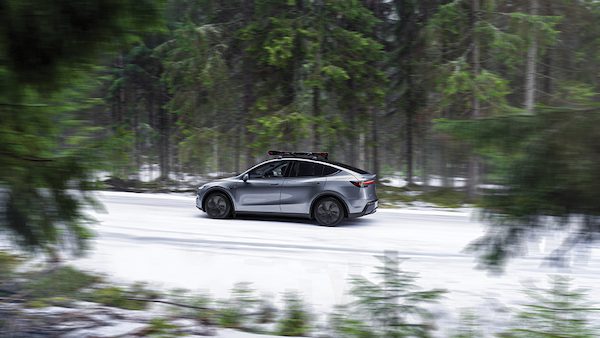
A Tesla Model Y on the road, photo courtesy Tesla
“The state of California was offering a $7,500 tax credit, plus a $7,500 federal tax credit, and because I buy my electricity with the Truckee Donner Public Utility District, it offered me a $600 credit on top of it,” Smith says.
The federal tax credit program ended on September 30, 2025, while the California credit lapsed on November 8, 2023, citing a lack of funds. Some utility districts still offer various credits and incentives.
Environmental considerations are also high on the list. Electric vehicles produce no tailpipe emissions, and as a result, EV owners reduce their carbon footprint by contributing less pollution.
Performance is yet another allure. Electric cars excel in instant torque, have a smoother and quicker acceleration path, and are quieter than gas-powered vehicles.
“It’s the best car I’ve ever owned, by far,” says Tyler Ross of Truckee, who owns a Tesla Model 3. He notes the drivability, but also luxury features such as heated seats, remote start and computer assist, although he remains lukewarm on the self-driving feature.
Eberhardt says he appreciates how his Rivian functions as a roving Wi-Fi station, which is particularly important to his work as a project manager with Mark Tanner Construction, which often requires him to travel in and out of dead zones where he needs to maintain communication.
“The way to think of it is that it’s basically just a big computer on wheels,” Eberhardt says.
Specific to Tahoe, Smith’s Tesla makes for an ideal ski vehicle.
“We use it as a mini ski lodge because you can crank the heat, use the heated seats and you are not idling your vehicle,” she says, adding that her family also uses the Model Y on family camping trips because they can sleep in the car and use the heater without worrying about emissions.
She says the car needs to be properly powered up for the camping scenario, however, as it loses about 5 to 7 percent of its battery life overnight.
The Downsides
Electric vehicles have their drawbacks too: Most EVs depreciate quicker than traditional vehicles; refueling can be time-consuming and inconvenient (and impossible in rural areas with no charging stations); manufacturing requires the mining of rare-earth minerals; and battery disposal remains problematic.
In addition, Ross says the repeated need to update new software creates a lag in the vehicle’s response time as the software outpaces the hardware, a phenomenon anyone with a computer or smartphone is familiar with when the latest operating system seems to inhibit function rather than enhance it.
“As you put more demands and software updates on top of the existing hardware, technically, it slows down a little bit,” Ross says.
Bryce Harper, operations manager at the Truckee Auto Mall, notes another negative regarding performance in cold temperatures, with a reduction in range and longer charge times.
“You’re losing a ton of electricity from just the cold and moving up and down mountain geography,” he says. “It really does take a toll on those batteries.”
The range for electric batteries declines by 38 percent when temperatures reach 20 degrees or below, according to a recent study by the American Automobile Association. Tesla disputed the finding but did not provide data of its own.
Ross, Eberhardt and Smith all notice a slight to moderate reduction in battery range in cold temperatures, but Eberhardt points out that Truckee, unlike some other mountain climates, does not typically experience prolonged periods of intense cold.
“Truckee weather is not cold compared to Montana,” he says. “I don’t notice a big difference, but I’m doing most of my charging overnight at my home, in my garage, so I don’t necessarily have to pull up and charge in town.”
EVs in Snow Country
When it comes to the driving landscape of Tahoe-Truckee, specifically snowstorms during the winter, Eberhardt, Ross and Smith say their EVs are up to the task.
“I have been in full whiteout conditions on I-80 before, the road is an ice sheet, and the Tesla handles exceedingly well,” Ross says. “It’s because the Tesla has all-wheel drive, just like a Subaru does.”
Eberhardt credits his Rivian’s snow-driving performance to the weight of the truck, as EVs are heavier than their gas-powered counterparts. His Rivian is also aided by a low center of gravity, an all-wheel-drive system that distributes power to the wheels that require traction and an adjustable suspension system, which increases clearance from 8 inches to
14 inches to handle deep snow.
Harper remains skeptical. He says traditional vehicles with traction control perform as well or better than EVs, whose weight can be a detriment in icy conditions.
“When you’re talking about really, really heavy weight in certain conditions, it’s nowhere near as good as, say, a Toyota Tacoma with a few sandbags in the back,” he says.
Fuel for the Road
In terms of practicality, two other major concerns stand out among EV owners: “range anxiety,” as it is known, and battery charging.
Eberhardt and Smith have home charging stations, so range anxiety is rarely reflected in their daily lives. Furthermore, they’ve both taken their electric vehicles on extended road trips that require one or more charges and say the experience was not overly cumbersome.
“It’s not that big of a deal,” Eberhardt says. “We take the Rivian down to Pismo every summer, and we plan to stop in Paso Robles or San Luis Obispo. It takes about 25 to 30 minutes, but we treat it as an opportunity to get the kids out of the car and get something to eat.”
Smith says she had a similar experience when her family took a road trip to Colorado, which required advanced planning for charging, but the opportunity to stop and walk around with their children. But when they took a trip to a remote part of Idaho that lacks the same charging infrastructure, they opted to take their gas-powered car.
As for refueling around Tahoe, the experience is markedly different for EV owners who do not have a home charging station.
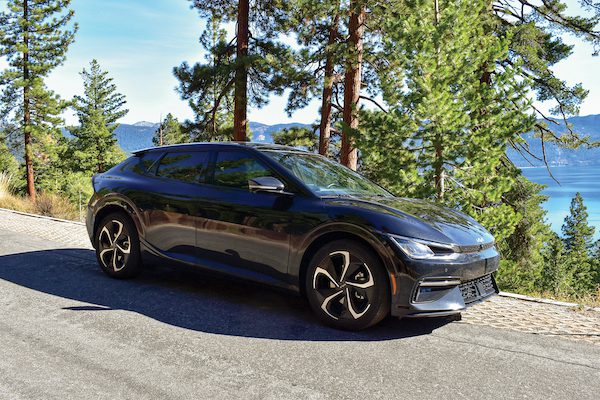
Tahoe resident Kelly Heapy, who leases a 2024 Kia EV6, has mixed feelings about the vehicle. While she says the car is fun to drive, she does not own a home charger and must rely on a limited charging network in the North Lake Tahoe area, photo by Kelly Heapy
“Because we don’t have a charger at home, we have to use the limited charging network in the surrounding area,” says North Lake Tahoe resident Kelly Heapy, who began leasing a 2024 Kia EV6 in April 2024.
At the time, the Crystal Bay Club had four charging stations within walking distance of her home, allowing her to conveniently leave her car charging overnight. But the company that owned the chargers has since gone out of business.
Other charging stations exist on Tahoe’s North Shore, though not in abundance. Some are slow chargers (referred to as levels 1 and 2) and others are fast chargers (called Level 3 DC). Some of the fast-charging Tesla ports, which are the most prevalent both locally and across the United States, are designed for Teslas only. Heapy says the Incline Village Raley’s has 10 Tesla-only fast chargers and only one EVgo charger that works for other car brands, such as her Kia.
“The Tesla chargers at the Truckee Raley’s are supposedly open to all models, but my attempt with our Kia a few months ago was unsuccessful,” says Heapy, who often uses the slow charger overnight at Incline’s Forest Pine Condominiums, which is cheaper than fast chargers and available 24 hours. (Slow chargers, including home models, are typically better for long-term battery life, while fast chargers produce more heat and stress and are thus worse for a battery’s health.)
Heapy also notes a significant learning curve, particularly when it comes to range anxiety, which both she and her husband experience somewhat frequently.
“We came up over 431 (Mount Rose Highway) and got to the top of that pass and realized that we had only 10 percent of the battery left. We had a tense moment thinking, ‘We’re not gonna make it home,’” she says.
As such, knowing the topography of a planned route is imperative to overcoming range anxiety, because EVs lose power quickly when climbing hills but regain their charge on the descent.
“If I have 100 ‘miles’ on my gauge and I want to go to Reno, that’s on the border of being able to make it there and back comfortably, especially if I’m driving fast on the highway, all over Reno and back uphill,” Heapy says. “Driving an EV requires more thinking and attention than it does to just hop in a gas-powered car and be able to fill up anywhere.”
A Complex Picture
Harper says such realizations are common among new electric vehicle owners, which is why, after an initial frenzy for EVs that peaked sometime in 2022, he has seen demand decline considerably.
“In 2022, they were going for $10,000 or $15,000 over sticker,” he says. “Now, when they’re taking $12,000 off a truck because they can’t sell them, that kind of shows you a little bit where the demand has gone.”
The International Energy Agency’s most recent report backs Harper’s observations, as the market growth for electric vehicles slowed in 2024, increasing by just 10 percent compared to 40 percent in 2023.
After the initial excitement around electric vehicles, consumers appear to be reckoning with the downsides.
“Essentially, if you don’t have a system in place at your house, then it doesn’t make a ton of sense, because you’re still paying a fortune when you go to try to charge the thing with a quick charge,” Harper says.
The experience also varies according to the manufacturer. Tesla, Rivian and other companies fully dedicated to producing electric vehicles are still ahead of traditional carmakers.
“Most Teslas will go 300,000 or 400,000 miles on that battery, so for them it’s not an issue,” Harper says. “But for other manufacturers, like Audi and BMW and those kinds of cars, their life expectancy on those [batteries] is only like 150,000 miles.”
The economic picture also remains complex. For instance, a study conducted by George Washington University that looked at more than 60,000 car dealerships found that, with the notable exception of Teslas, EVs depreciated much faster than gas-powered cars.
“It’s almost like buying the iPhone 17 compared to an iPhone 8,” Harper says. “No one wants the 8, right? And that’s kind of what you look at.”
Environmentally, the fact that electric vehicles have zero tailpipe emissions is clearly a boon to air quality, public health and environmental health.
But the large-scale production of EV batteries requires the mining of lithium, cobalt and nickel, which can be environmentally destructive. Environmental groups have rallied against proposed lithium mines in Nevada, and concerns have grown about labor practices around cobalt mining in less developed areas of the world. Furthermore, the disposal and recycling of electric batteries has yet to be done efficiently on a mass scale.
Nevertheless, the Environmental Protection Agency stresses that electric vehicles do reduce emissions over the long term, particularly if the energy infrastructure relies on renewable sources.
Banking on Advancements
Even skeptics like Harper concede that some of the problems with electric vehicles could be solved through innovation, which could double the current range of EVs.
While questions remain whether such advances are possible, carmakers are competing with one another to develop various technology improvements, such as solid-state batteries that increase energy density.
Toyota, for example, is targeting 2026 as the year it will unveil a lithium-ion battery capable of delivering a 600-mile range.
Also, improvements in battery disposal could assuage fears about environmental issues when EVs reach the end of their lives.
Most of the electric vehicle owners interviewed for this story are content, even exuberant, about their purchases, as Eberhardt, Ross and Smith all say they would buy another one. Yet, Heapy says she will most likely opt for a hybrid model when her lease is up next year.
In the Tahoe area, EV owners seem to accept that they are part of an evolving story about balancing everyday necessity with progress.
Matthew Renda is a former Tahoe-based journalist who now lives in Santa Cruz. Given the price of new cars, he plans to drive his 2012 Toyota Tacoma with 168,000 miles until the day it dies.
No Comments